
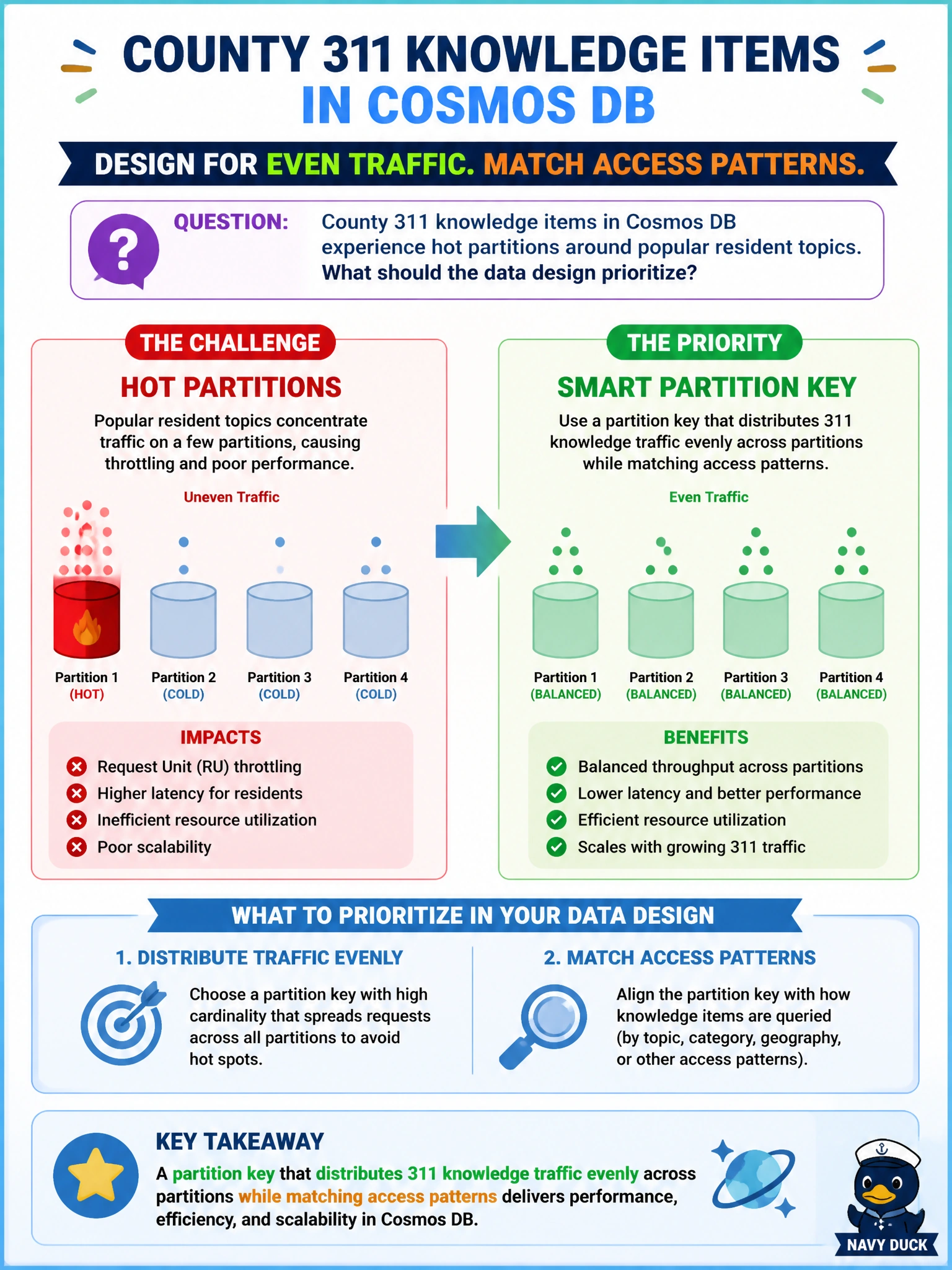
County 311 knowledge items in Cosmos DB experience hot partitions around popular resident topics. What should the data design prioritize?
Select an answer to reveal the explanation.
Short Explanation
A hot Cosmos partition is like every 311 call landing on one clerk’s desk—pick a partition key that spreads resident-topic traffic instead of funneling the city into one bottleneck.
Full Explanation
Cosmos DB partition keys for a county 311 knowledge store should distribute traffic evenly across logical partitions while still matching how the app queries resident topics. A well-chosen key spreads RU consumption so popular topics do not pin the entire workload to one hot partition. Balancing distribution and access patterns is the data-design priority when hot partitions appear around popular civic topics.
Using a single partition key value for all items fails by concept because every request funnels into one logical partition—the textbook hot partition. Randomly deleting popular topics fails because it destroys needed municipal knowledge instead of fixing distribution. Storing all knowledge items as one giant document fails because it avoids horizontal partition scale, creates huge document problems, and concentrates load rather than balancing it.
Exam caveat: Perfect uniformity is rare; choose keys with high cardinality that align with common filters (for example a composed key) without making cross-partition queries unnecessarily dominant. Changing partition keys later is expensive—design carefully. Hot partitions can also come from uneven traffic even with a decent key; monitor partition-level metrics.
Operational check: Review Cosmos partition metrics for the 311 container, identify skewed RU, propose a higher-cardinality key aligned to access patterns, test query patterns against a redesigned sample, and plan migration. Confirm popular topics no longer map to a single overloaded logical partition.