
Transit ETA agent microservices need internal cluster traffic on Azure Kubernetes Service. What should the team deploy?
Select an answer to reveal the explanation.
Short Explanation
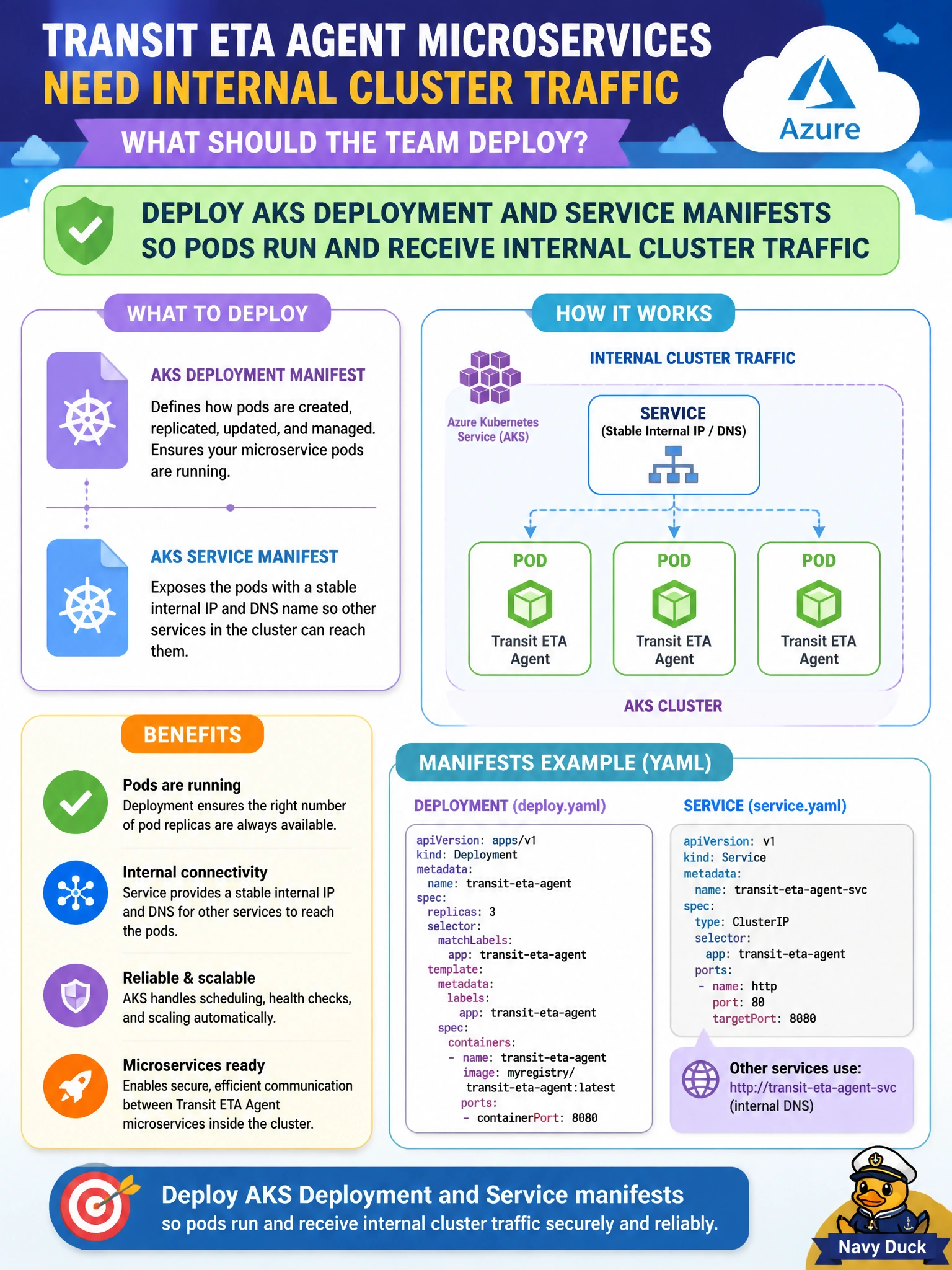
On AKS, a Deployment keeps your ETA agent pods running, and a Service gives them a stable internal address—even when individual pods are replaced. With both in place, other cluster components can reliably reach your agents through internal service discovery.
Full Explanation
On Azure Kubernetes Service, a Deployment maintains the desired pod replicas for a microservice, while a Service provides a stable virtual IP and DNS name for internal cluster traffic. Transit ETA agent microservices need both: Deployments run and restart the pods, and Services let other in-cluster components reach them without tracking changing pod IPs. This Deployment-and-Service pattern supports east-west traffic between microservices on AKS. Only CronJobs, with no Service objects or Deployments, fail to provide continuously available agents with stable endpoints: CronJobs run finite tasks rather than keeping an ETA service available. Public Blob Storage static websites for each microservice endpoint do not provide the in-cluster service discovery used for pod-to-pod API traffic. Dispatcher-PC shortcuts that launch local Python ETA scripts do not host the services inside AKS, so cluster components cannot rely on them as in-cluster endpoints. Exam caveat: ClusterIP Services are typical for internal-only traffic; LoadBalancer or Ingress are used when exposing services externally. Because the question specifies internal cluster traffic, the conceptual answer is an AKS Deployment and Service, typically a ClusterIP Service. Practical check: Apply the manifests for each ETA agent, verify that the Service endpoints include ready pod IPs, then curl the Service DNS name from another pod in the cluster. Confirm that internal calls do not depend on Blob static sites or dispatcher-PC scripts.