
Public works wants event-driven scale for a permitting chatbot API during Monday morning peaks on Azure Container Apps. Which KEDA-oriented approach fits?
Select an answer to reveal the explanation.
Short Explanation
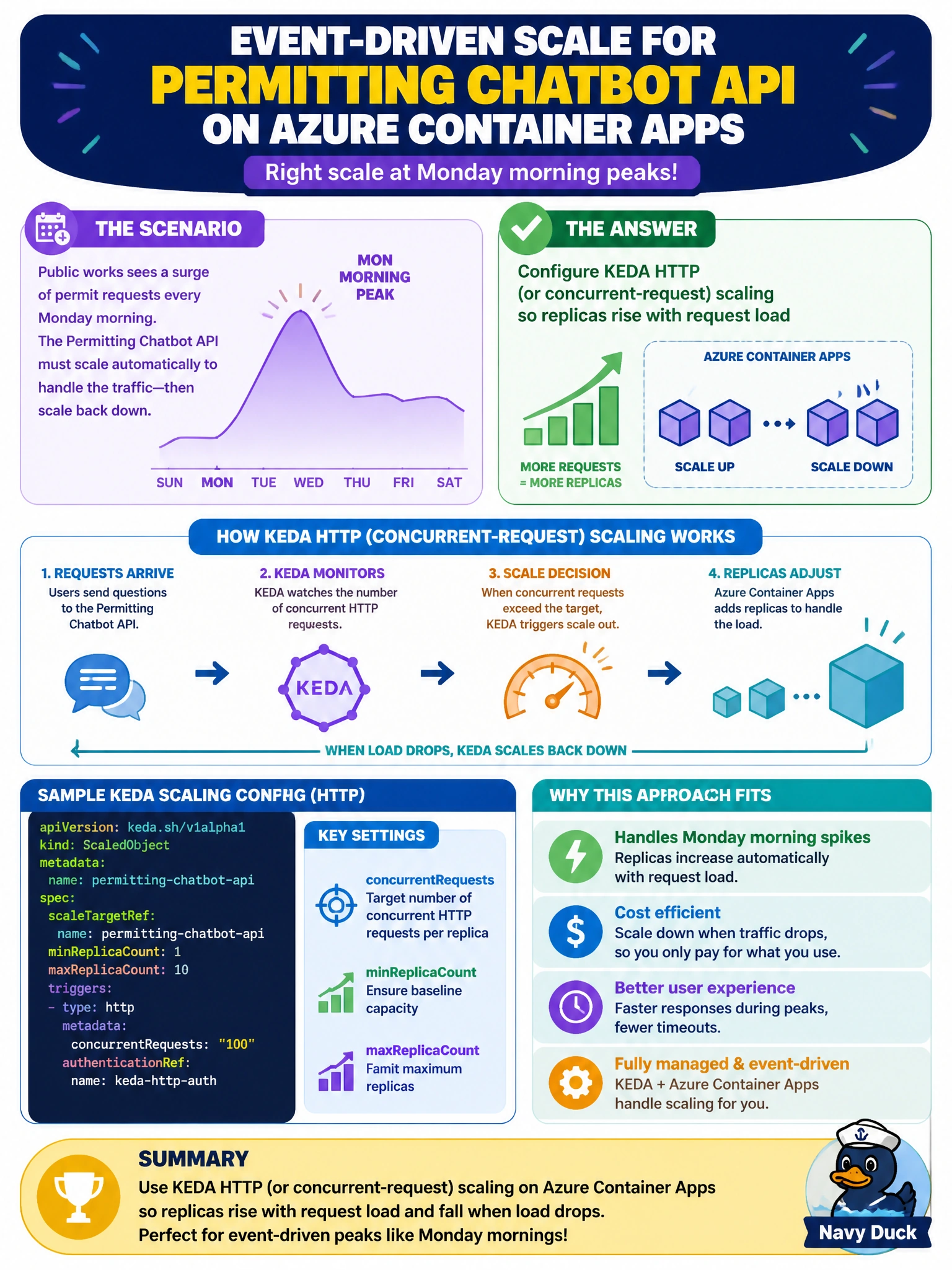
Monday’s permit rush is a burst, like every contractor calling the front desk at once. You can configure KEDA HTTP or concurrent-request scaling so Container Apps adds chatbot API replicas as requests surge, then scales back when the peak ends.
Full Explanation
For an HTTP-facing Azure Container Apps workload, configuring KEDA HTTP or concurrent-request scaling lets replicas rise with request load and scale back when the peak ends. That event-driven pattern fits a permitting chatbot API with Monday morning bursts: Container Apps can add capacity as concurrent requests increase rather than waiting for a person to react. Turning off scaling and accepting timeouts leaves the API unable to handle known peaks, undermining availability. Scaling only when a developer manually edits YAML during the morning rush is not automated and cannot reliably keep pace with a burst. Replacing Container Apps with one always-busy jump box for all chat sessions removes elasticity and leaves the Monday peak without the event-driven scaling the API needs. Exam caveat: HTTP/concurrency scaling fits request-driven API peaks; queue-based scaling addresses a different workload shape. Cold starts can still occur when the minimum replica count is zero. Practical check: simulate concurrent Monday-morning chatbot sessions, verify that replica count rises under the HTTP/concurrency rule, and confirm p95 latency stays within target. Set maximum replicas and CPU and memory limits so a traffic spike cannot exhaust the environment unnoticed.