
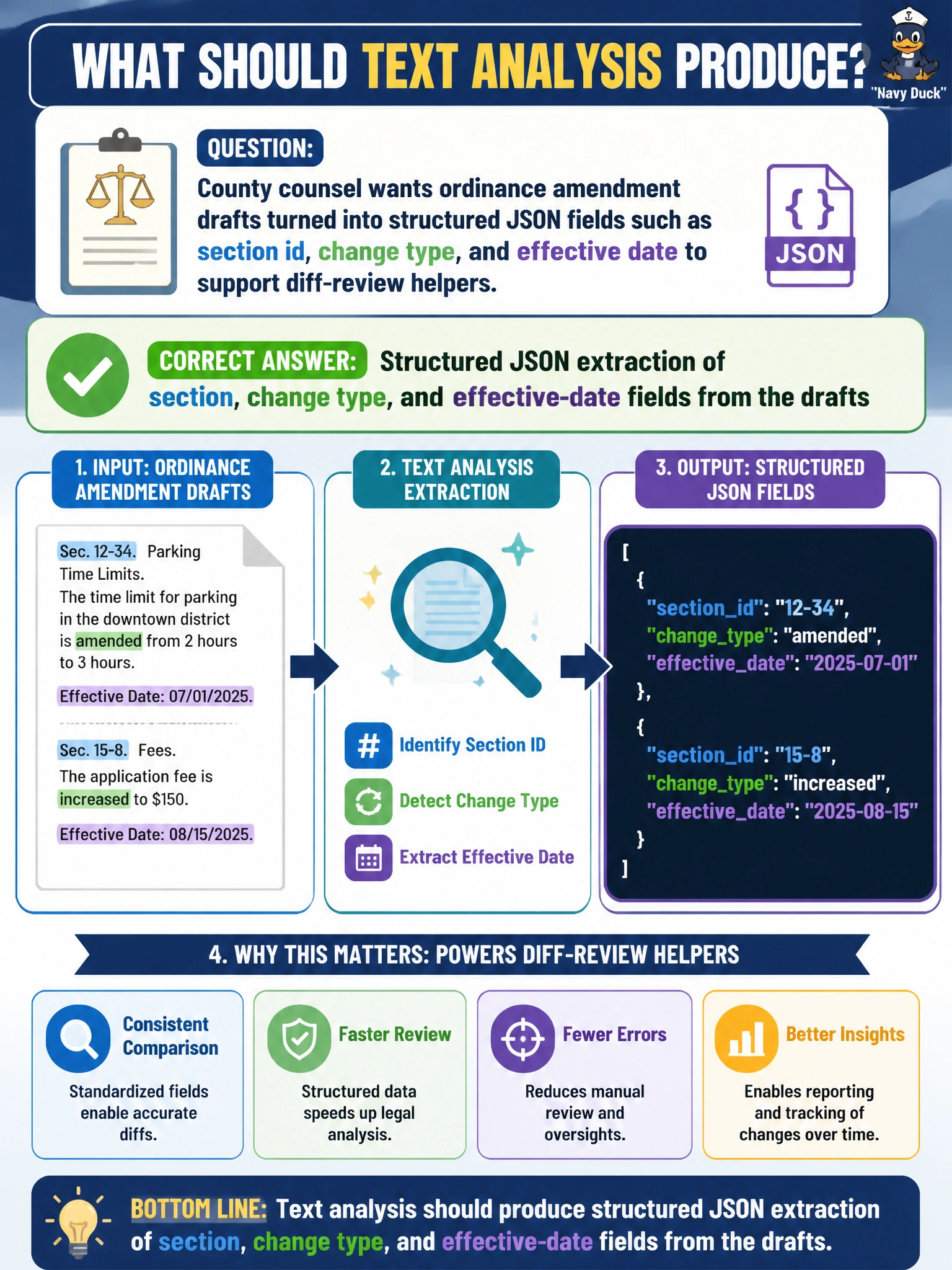
County counsel wants ordinance amendment drafts turned into structured JSON fields such as section id, change type, and effective date to support diff-review helpers. What should text analysis produce?
Select an answer to reveal the explanation.
Short Explanation
Diff helpers need labeled drawers, not just extracted sentences about section, change type, and effective date. Structured JSON extraction pulls section, change type, and effective date from amendment drafts so review tools can compare cleanly. Pulling key phrases or running predefined tagging for those ideas still won't give you the labeled fields you'll need for comparison.
Full Explanation
County counsel wants ordinance amendment drafts turned into structured JSON fields such as section id, change type, and effective date to support diff-review helpers. Text analysis should therefore produce structured JSON extraction of those fields from the drafts so downstream tools can compare versions machine-readably. Civic legislative review depends on labeled drawers—section, change type, effective date—not on extractive summarization of section, change type, and effective-date fields alone, which returns source sentences rather than typed JSON. Extractive summarization of section, change type, and effective-date fields from the drafts cannot feed diff helpers because it selects verbatim sentences about those topics rather than producing labeled JSON fields with normalized values. Key phrase extraction of section, change type, and effective-date fields from the drafts still returns salient phrases rather than schema-bound values, so a diff tool has no reliable typed field to compare across drafts. Predefined named entity recognition of section, change type, and effective-date fields from the drafts fails because a predefined model is limited to built-in entity types and cannot be defined for custom fields like section id and change type, so it cannot yield the schema counsel needs. Those options fail because they do not yield the typed fields counsel needs for amendment comparison. Exam caveat: structured extraction (JSON/schema) differs from extractive summarization of section, change type, and effective-date fields and from predefined named entity recognition and key phrase extraction of those fields. When the stem lists field names and a machine consumer (diff-review helpers), choose structured extraction. Validate against schema rather than trusting extracted sentences about section, change type, and effective date. Operational check: define a JSON schema for section id, change type, and effective date; extract from a sample of ordinance amendment drafts; compare extracted fields to counsel’s gold labels; and reject documents that fail schema validation. Version the schema with the ordinance template so helpers stay aligned as drafting conventions evolve.
Prefer to study offline? Printable PDF study book + test engine ($7.50, unofficial). These questions stay free here.