
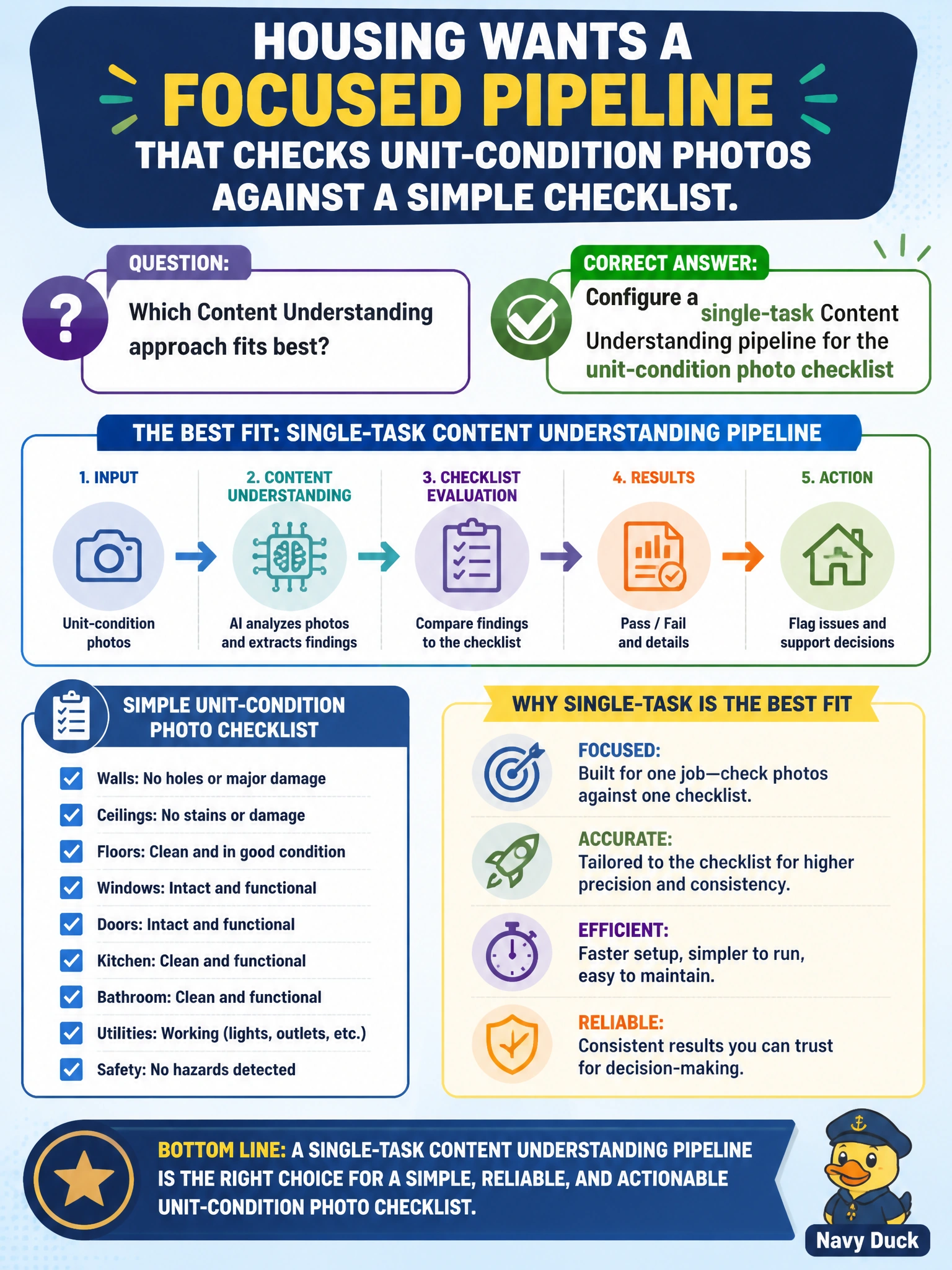
Housing wants a focused pipeline that checks unit-condition photos against a simple checklist. Which Content Understanding approach fits best?
Select an answer to reveal the explanation.
Short Explanation
A single-task pipeline is one checklist, one job—you look at the unit photo and answer the condition questions. You should configure Content Understanding that way for unit checks. A single-field, single-label, or single-analyzer setup for that same checklist won't cut it—you'd miss items because you're capturing only one piece when you've got a full list to answer.
Full Explanation
Content Understanding can be configured as a single-task pipeline when the civic workflow is narrow and checklist-driven. Housing that wants to evaluate unit-condition photos against a simple condition checklist should choose that focused single-task approach: one visual job, clear outputs mapped to checklist items (damage present, fixture status, readiness signals), and minimal orchestration overhead. The fit is intentional narrowness—unit photos in, checklist-aligned understanding out.
Configuring a single-field Content Understanding pipeline for the unit-condition photo checklist fails because a single field captures only one output value, not the full checklist; scoring unit photos requires multiple mapped outputs for damage, fixture status, and readiness. Configuring a single-label Content Understanding pipeline for the unit-condition photo checklist fails because a single label returns only one classification, not answers for each checklist item; the unit-condition job needs distinct judgments per photo, not one overall tag. Configuring a single-analyzer Content Understanding pipeline for the unit-condition photo checklist fails because a bare analyzer without the single-task framing does not deliver checklist-mapped task outputs; the housing workflow needs one focused task that turns each unit photo into structured condition answers.
Exam caveat: single-task pipelines excel when the schema is stable; if housing later needs multi-document packets mixing floor plans, forms, and photos, a broader configuration may be required, since single-field, single-label, or single-analyzer approaches would remain too narrow for that expanded job. Checklist automation still needs inspector override. Operational check: define the unit-condition checklist fields, configure the single-task Content Understanding pipeline against sample unit photos, compare outputs to inspector judgments, and gate work orders on reviewed results.
Prefer to study offline? Printable PDF study book + test engine ($7.50, unofficial). These questions stay free here.