
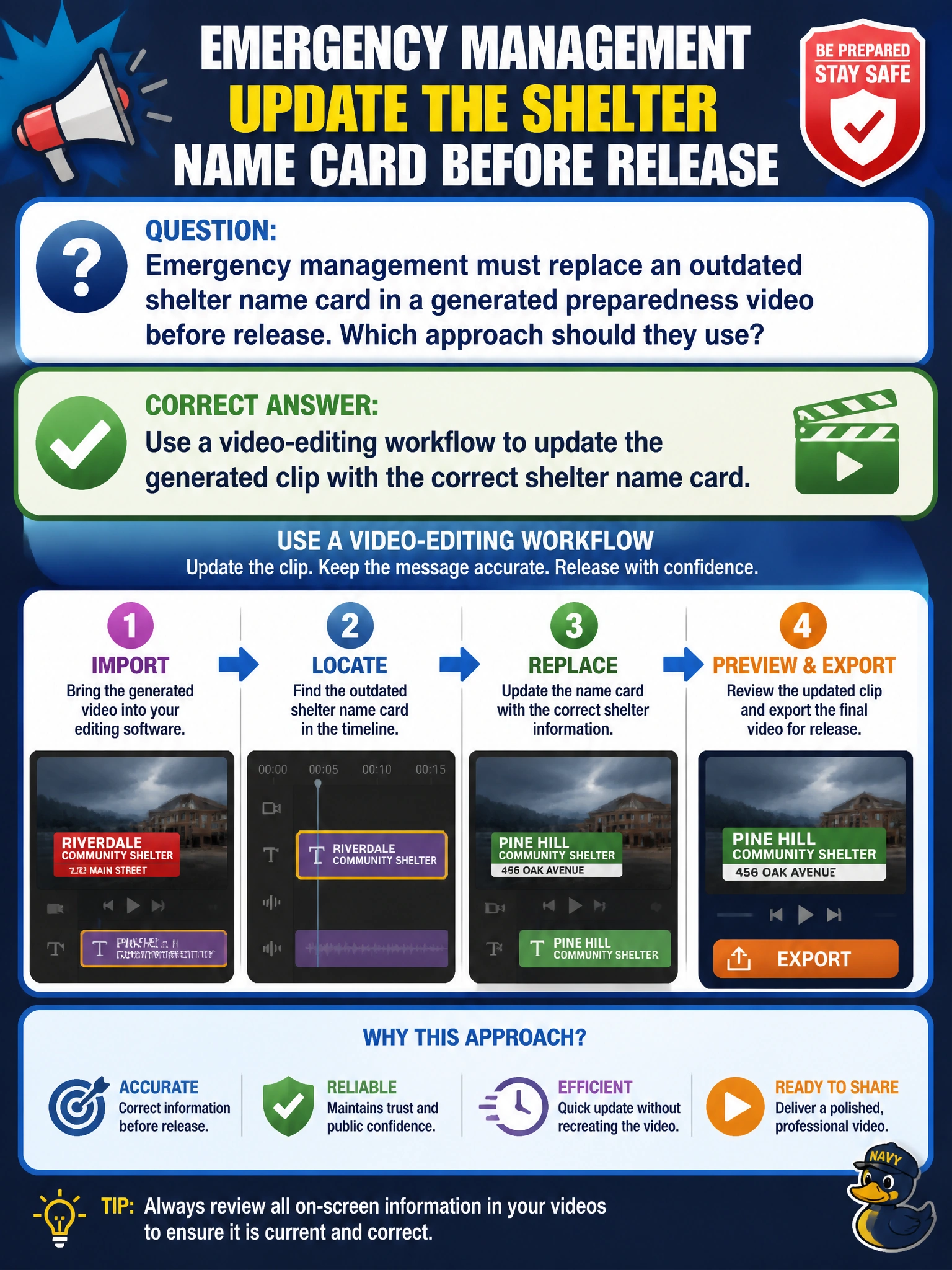
Emergency management must replace an outdated shelter name card in a generated preparedness video before release. Which approach should they use?
Select an answer to reveal the explanation.
Short Explanation
Think of the shelter name card like a wrong street sign on a training film — you edit the clip, you don’t ship the mistake. Emergency management should run a video-edit pass on the generated preparedness video and swap in the correct name. A super-resolution pass, a text-prompt rewrite, or a frame-interpolation pass all skip the simple, targeted fix you'll need for the name card.
Full Explanation
Generated preparedness videos remain editable assets after the model finishes rendering. When emergency management discovers an outdated shelter name card in a clip that is otherwise ready for release, the correct operational path is a video-editing workflow: open the generated file in an approved editor, replace or overlay the incorrect name card with the current shelter designation, then re-export and re-review before publication. That approach preserves usable motion content—evacuation sequencing, accessibility cues, and narration timing—while correcting the single stale visual fact that would mislead residents during an incident. Using a super-resolution workflow to update the generated clip with the correct shelter name card only increases sharpness and resolution but does nothing to replace the text printed on the name card, so the outdated shelter name stays exactly as wrong as before, just with higher clarity. Using a text-prompt rewrite to recreate the generated clip with the correct shelter name card fails because a full regeneration can change other approved details—timing, accessibility cues, narration—while still offering no guarantee the new render gets the shelter name right, when a targeted edit of the one wrong card was all that was needed. Using a frame-interpolation workflow to update the generated clip with the correct shelter name card only synthesizes intermediate frames to smooth motion but does nothing to replace the text printed on the name card, so the outdated shelter name stays exactly as wrong as before. Exam caveat: generative video is a starting point, not a finished public record. Name cards, facility lists, and other time-sensitive civic labels must be verified against current emergency-management source systems before release. Operational check: confirm the edited clip shows the correct shelter name in every appearance, validate closed captions still match, obtain the same review sign-off used for non-AI videos, and archive both the original generation and the corrected master for audit.
Prefer to study offline? Printable PDF study book + test engine ($7.50, unofficial). These questions stay free here.