
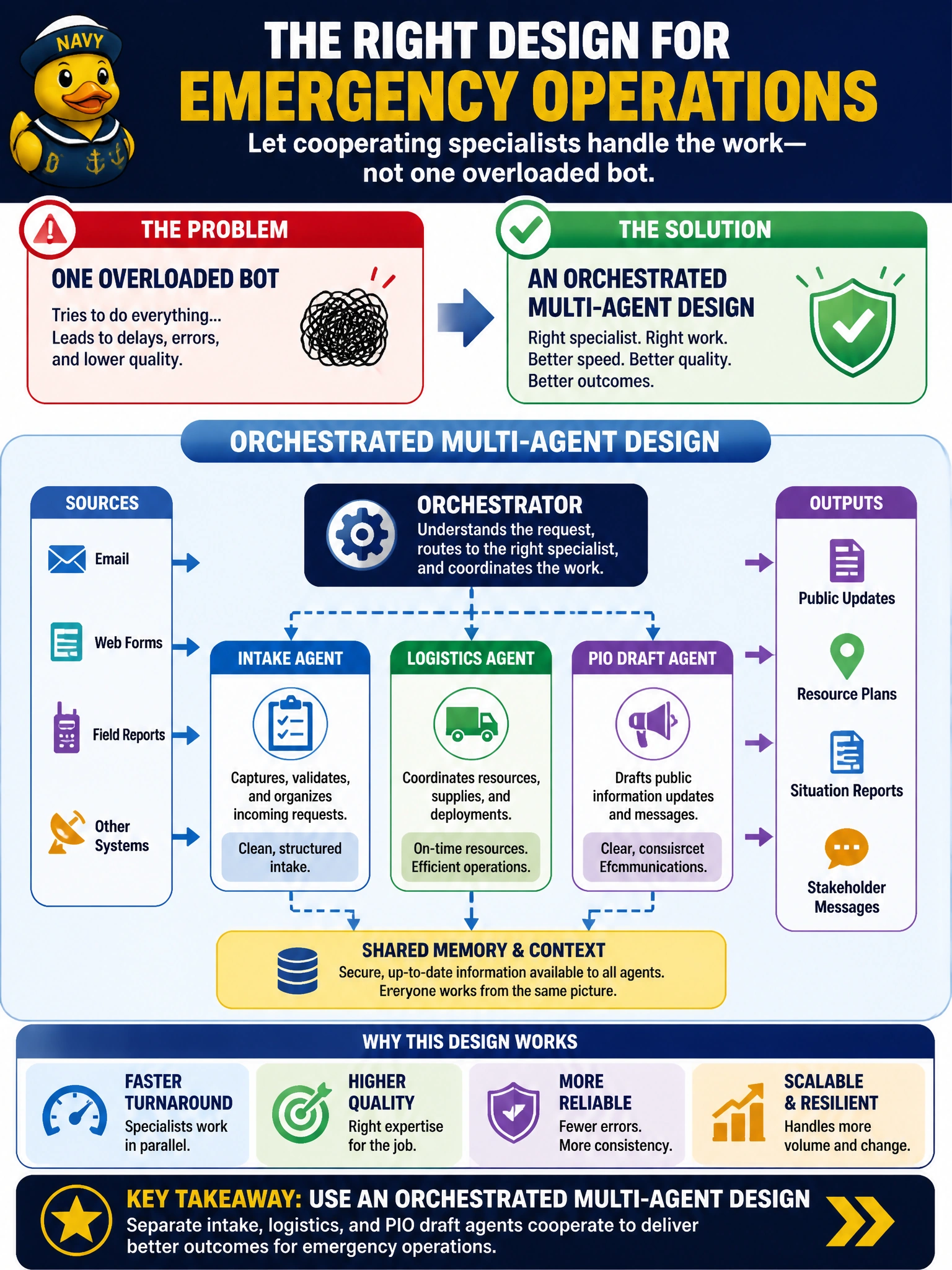
Emergency operations wants intake, logistics, and public-information draft work handled by cooperating specialists rather than one overloaded bot. Which design should they implement?
Select an answer to reveal the explanation.
Short Explanation
Emergency ops is a team sport—intake, logistics, and the PIO desk each have a job. Orchestrated multi-agent design mirrors that and you'll see specialists cooperate with shared context, while a decentralized design with coordinated intake, logistics, and PIO agents leaves you with peer coordination but no central orchestration, so you'll still get dropped handoffs. Shared orchestration keeps you moving in a surge, while a staged sequential handoff of intake, logistics, and PIO locks you into a rigid order and a cooperative swarm of intake, logistics, and PIO agents lacks orchestrated handoffs, so you'll get conflicting drafts.
Full Explanation
Emergency operations that need intake, logistics, and public-information draft work handled by cooperating specialists should implement an orchestrated multi-agent design with separate intake, logistics, and PIO draft agents. Orchestration assigns clear roles, shares necessary context, and sequences handoffs the way a real EOC desk structure works, rather than leaving a decentralized multi-agent design with coordinated intake, logistics, and PIO draft agents to coordinate peer-to-peer without central orchestration. That separation reduces mixed responsibilities during surge and keeps PIO drafts distinct from logistics actions. A decentralized multi-agent design with coordinated intake, logistics, and PIO draft agents keeps the three roles separate with peer coordination but without orchestrated cooperation or centrally managed shared context, so intake updates can still be missed or mis-sequenced between logistics and PIO when coordinated surge work is needed. A sequential handoff multi-agent design with staged intake, logistics, and PIO draft agents forces a fixed staged order without true specialist cooperation or dynamic context sharing, recreating bottlenecks and duplicate work under pressure. An autonomous swarm multi-agent design with cooperative intake, logistics, and PIO draft agents relies on autonomous emergent cooperation rather than separate agents with orchestrated handoffs, risking conflicting drafts and uncoordinated actions when structured cooperating specialist work is required. On the exam, orchestrated multi-agent specialization fits complex civic surge workflows; distractors are a decentralized coordinated-agent design, a fixed sequential handoff staged design, or an autonomous cooperative swarm design handling intake, logistics, and PIO work. Caveat: orchestration adds coordination complexity—define handoff contracts and shared memory carefully so intake context is not dropped between logistics and PIO. Operational check: simulate a surge scenario, verify intake hands off to logistics and PIO draft agents with shared context, and confirm no agent has unsupervised public posting rights.
Prefer to study offline? Printable PDF study book + test engine ($7.50, unofficial). These questions stay free here.