
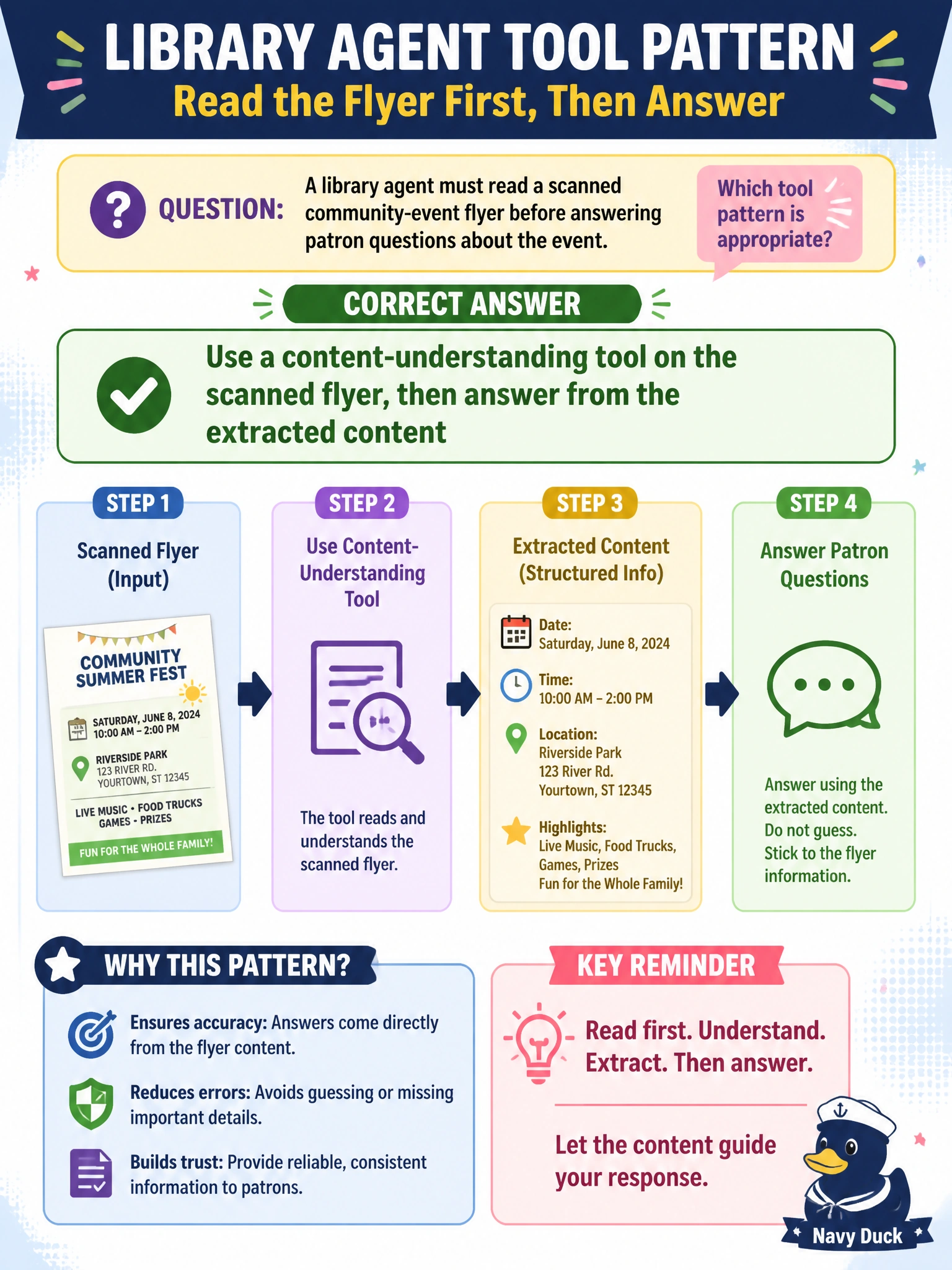
A library agent must read a scanned community-event flyer before answering patron questions about the event. Which tool pattern is appropriate?
Select an answer to reveal the explanation.
Short Explanation
A scanned flyer is just a picture until something reads it—content understanding is the library’s digital magnifying glass. Run that tool first, then answer patrons from what was extracted. Generating a new image won't extract readable text, so you'll have nothing reliable to answer from.
Full Explanation
A library agent asked about a community event on a scanned flyer should use a content-understanding tool on the image first, then answer from the extracted content. Scanned flyers are visual artifacts; without OCR/document understanding, the language model has no reliable access to dates, venues, or contact lines printed on the page. Extract-then-answer keeps patron guidance tied to what the flyer actually says rather than using an image-generation tool on the scan, which generates pixels rather than extracting readable dates, venues, or contact lines to answer from. Using an image-generation tool on the scanned flyer and answering from the extracted content fails because generation produces another image without extracting machine-readable text, so there is no reliable extracted content and patrons could be sent to the wrong time or place if the recreation distorts details. Running an audio-transcription tool on the scanned flyer fails because transcription expects spoken audio, not a visual page, so it cannot extract the printed dates, venues, and contact lines, leaving no extracted content to answer from. Running a text-translation tool on the scanned flyer fails because translation converts already-extracted text between languages rather than reading text from a scanned image, so it cannot extract this flyer's actual dates, venues, or contact lines for the answer. On the exam, content-understanding tools bridge scanned civic materials into agent answers; distractors use image generation without extracting content, use audio transcription on an image with no audio, or use text translation without reading this scanned notice. Caveat: extraction quality varies with scan quality—low-contrast flyers need confidence checks or staff review before publishing event answers to patrons. Operational check: submit a scanned event flyer, run content understanding, confirm key fields (date, time, location) are extracted, and verify the patron answer cites those fields rather than model invention.
Prefer to study offline? Printable PDF study book + test engine ($7.50, unofficial). These questions stay free here.