
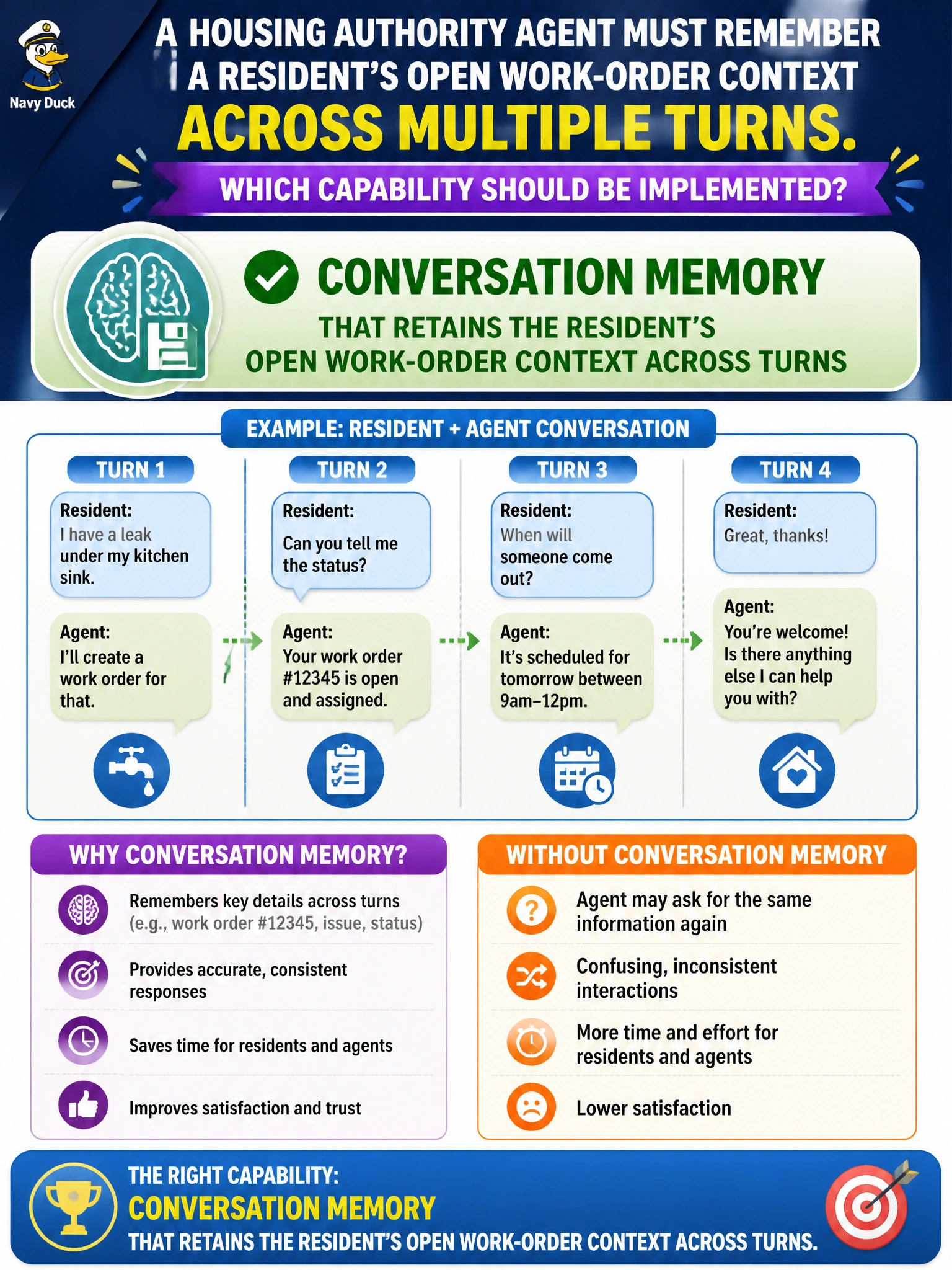
A housing authority agent must remember a resident’s open work-order context across multiple turns. Which capability should be implemented?
Select an answer to reveal the explanation.
Short Explanation
You'll get frustrated if you count on intent classification to preserve your open work order because it can't—that's what conversation memory is for. Keep the open-case context handy across turns so the housing agent can continue where the resident left off. Just labeling your intent as preserving context won't save you from repeating yourself when repairs drag on.
Full Explanation
A housing authority agent helping with open work orders must retain the resident’s case context across turns, which means implementing conversation memory for identifiers, issue details, and prior clarifications. Multi-turn municipal casework fails when relying on intent classification that preserves the resident’s open work-order context across turns, because it only labels intent: residents still repeat work-order numbers, staff lose continuity, and the agent cannot follow up on the same ticket coherently. Memory that carries the open work-order context across the session is the capability that matches that requirement. Intent classification that preserves the resident’s open work-order context across turns only identifies what the latest message means and does not actually preserve the open work-order context across turns. Entity extraction that stores the resident’s open work-order context across turns only spots the ID in that one turn and does not actually store the open work-order context across turns. Prompt templating that maintains the resident’s open work-order context across turns only structures the immediate reply and does not actually maintain the open work-order context across turns. On the exam, multi-turn case agents need conversation memory; distractors are intent classification that preserves the resident’s open work-order context across turns but only labels the current intent, entity extraction that stores the resident’s open work-order context across turns but only spots IDs in one message, or prompt templating that maintains the resident’s open work-order context across turns but only formats the latest reply. Caveat: memory should be scoped and time-bounded—persist only what the work-order workflow needs, and honor municipal retention/privacy rules for resident chat data. Operational check: start a work-order dialogue, supply an ID once, continue for several turns without re-stating it, and confirm the agent still references the same open work order in tools and replies.
Prefer to study offline? Printable PDF study book + test engine ($7.50, unofficial). These questions stay free here.