
Public health wants a generative reply that first pulls live clinic hours from an API, then drafts the resident message. Which pattern should developers build?
Select an answer to reveal the explanation.
Short Explanation
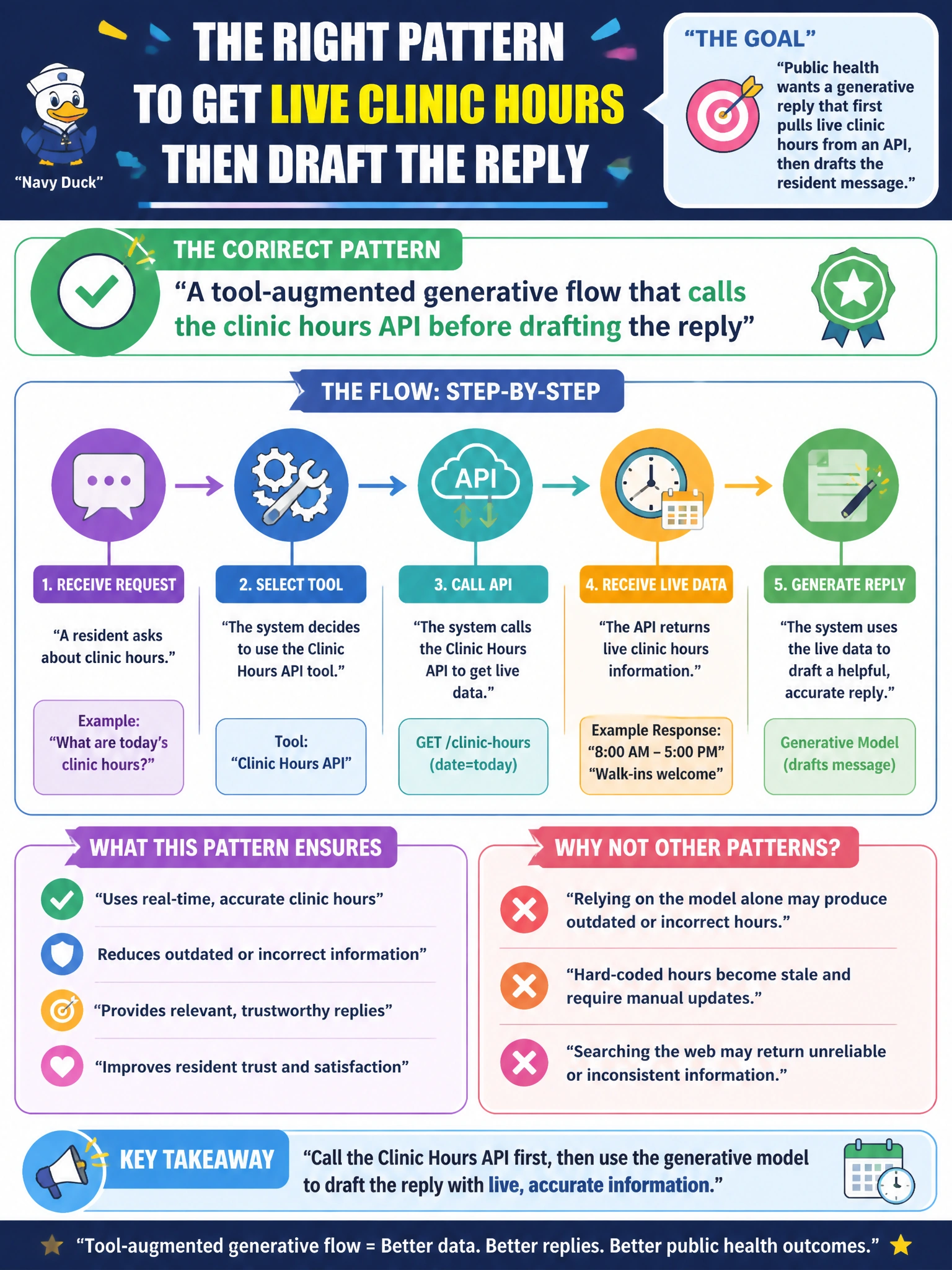
Clinic hours change — you'll need a true tool call to get today’s hours, so don't trust retrieval, fine-tuned, or base labels just because they mention the API. Call the hours API first, then draft the reply from what it returns. That order is what keeps the answer tied to today’s actual schedule.
Full Explanation
A tool-augmented generative flow that calls the clinic hours API before drafting the reply is the correct pattern for the public-health resident message. Clinic hours, holiday closures, and walk-in cutoffs change in operational systems of record; parametric model memory does not reliably track today’s schedule. Tool augmentation lets the generative step fetch authoritative hours first, then draft the resident-facing message from that tool result so wording stays helpful while facts stay current.
A retrieval-augmented generative flow that calls the clinic hours API before drafting the reply mislabels the pattern: retrieval augmentation means grounding the draft in passages retrieved from a document index, not fetching live state via an API tool call, so calling the hours API is tool use and the flow should be named tool-augmented, not retrieval-augmented. A fine-tuned generative model that calls the clinic hours API before drafting the reply misattributes how live facts arrive: fine-tuning bakes prior schedules into model weights and cannot supply today’s live hours on its own, so any live fetch from the hours API is tool augmentation, and the pattern should be named tool-augmented rather than fine-tuned. A base generative flow that calls the clinic hours API before drafting the reply contradicts its own label: a base flow drafts from parametric knowledge without live tool help, so once the flow depends on calling the hours API first it is by definition tool-augmented, not base.
Exam caveat: tool-augmented generation is the exam term for calling a live API as a tool before drafting; even if another choice mentions calling the clinic hours API, do not select retrieval-augmented, fine-tuned, or base, because retrieval means grounding in a document index, fine-tuned means relying on trained weights, and base means drafting without tools. Operational check: change a clinic’s hours in an API stub and confirm the generative reply updates without redeploying the model; block or fail the tool and confirm the flow refuses, escalates to staff, or states uncertainty rather than inventing hours.
Prefer to study offline? Printable PDF study book + test engine ($7.50, unofficial). These questions stay free here.