
A clerk's office needs a generative flow that classifies a filing type, drafts a checklist, then cites applicable fees. Which application design fits?
Select an answer to reveal the explanation.
Short Explanation
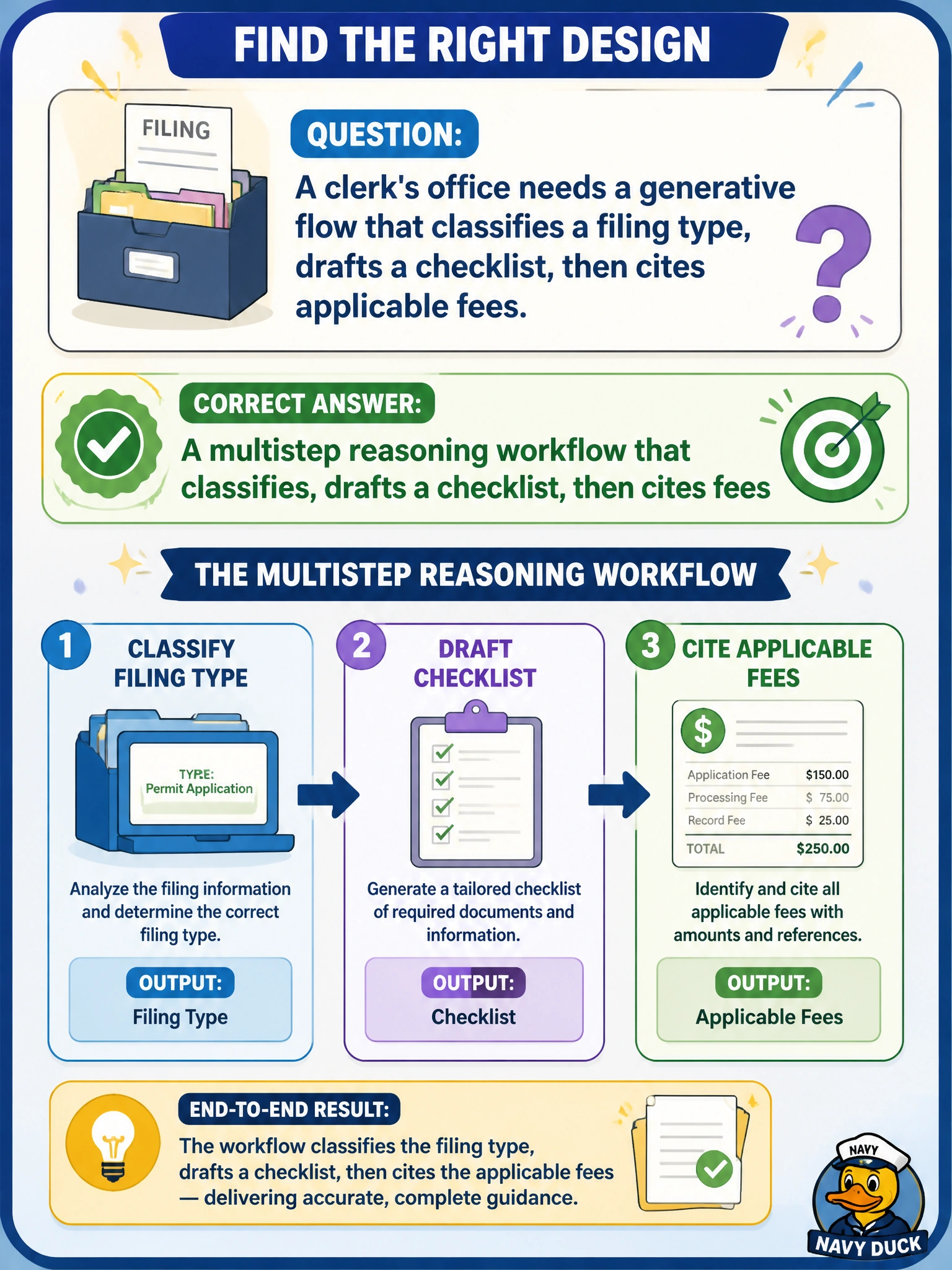
Filings are a little assembly line: you figure out the type, build the checklist, then attach the fees. A multistep generative workflow mirrors that clerk process instead of a multistep parallel fan-out workflow that classifies, drafts, and cites fees at once so you can't feed each result into the next step. Stage the reasoning and you'll get a clearer path.
Full Explanation
A multistep reasoning workflow that classifies filing type, drafts a checklist, then cites applicable fees matches the clerk's office generative flow. The task is staged: classification determines which checklist and fee schedule apply; checklist drafting depends on that class; fee citation depends on both. Multistep (or orchestrated) generative application design sequences those stages with intermediate state rather than handing the whole filing to a multistep parallel fan-out workflow that classifies, drafts a checklist, then cites fees in parallel branches and skips the staged dependencies. A multistep parallel fan-out workflow that classifies, drafts a checklist, then cites fees runs the steps concurrently instead of sequentially, so the checklist can't use the filing class and the fee citation can't use both prior outputs. A multistep embedding lookup workflow that classifies, drafts a checklist, then cites fees performs similarity-based vector retrieval rather than generative reasoning, so it can surface similar filings but cannot carry out the staged classify-then-draft-then-cite generation the task requires. A multistep model retraining workflow that classifies, drafts a checklist, then cites fees would update model weights rather than execute a per-filing generative flow, so it does not perform the classify-then-draft-then-cite inference sequence the clerk's office needs. Exam caveat: agentic/multistep designs are indicated when later steps must consume structured outcomes of earlier steps. Operational check: run sample filings through the workflow and assert each stage emits inspectable outputs (filing class, checklist items, fee citations) that downstream steps consume—not a multistep parallel fan-out workflow that classifies, drafts a checklist, then cites fees in parallel without letting downstream steps consume upstream outputs.
Prefer to study offline? Printable PDF study book + test engine ($7.50, unofficial). These questions stay free here.