
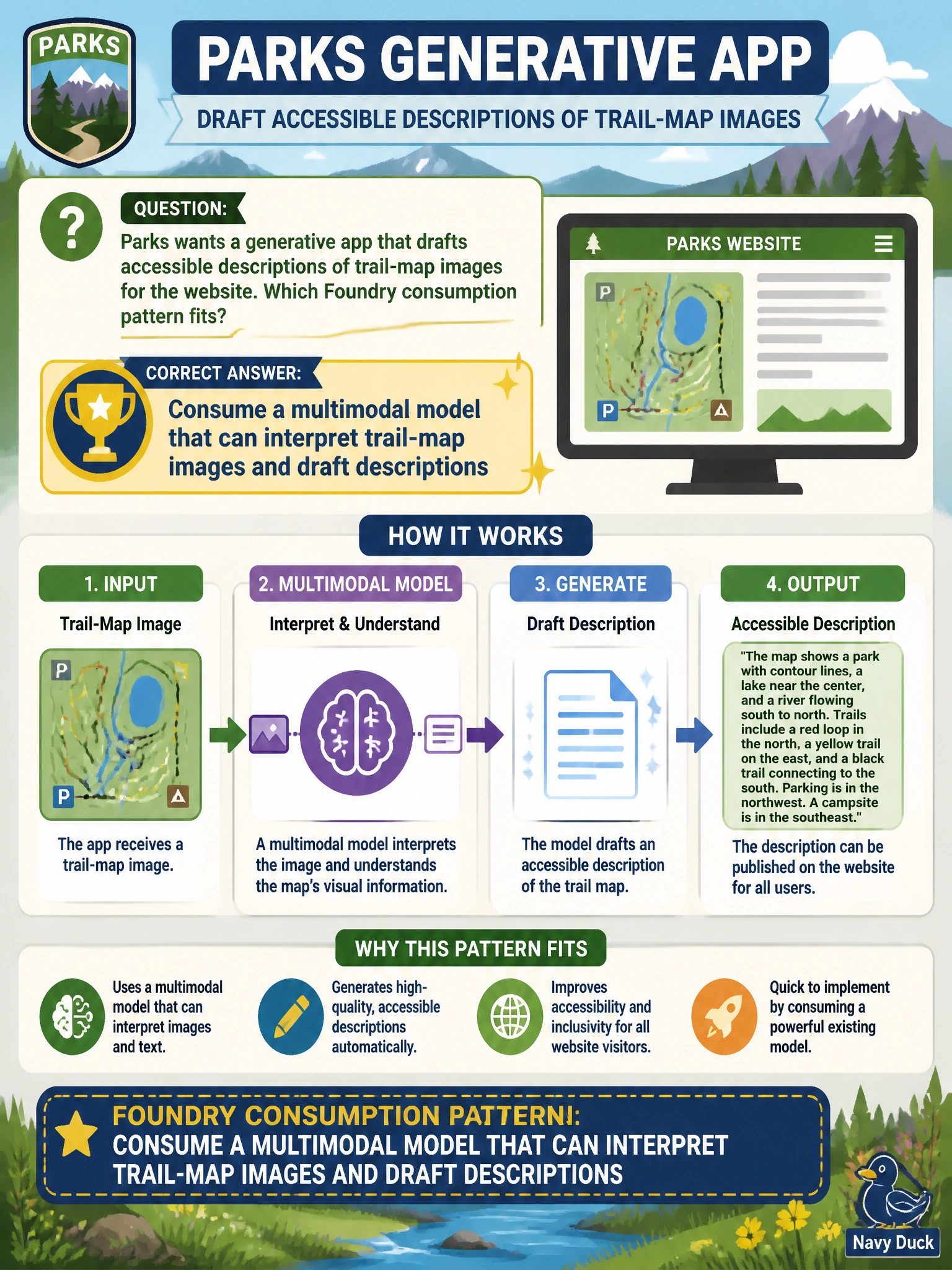
Parks wants a generative app that drafts accessible descriptions of trail-map images for the website. Which Foundry consumption pattern fits?
Select an answer to reveal the explanation.
Short Explanation
Trail maps are pictures—if you want words for accessibility, the model has to see the image. Plug in a multimodal Foundry model that reads the map and drafts the description. You won't get that draft from an image generation model claiming it can describe the map since you'll just get new pictures, and you won't get it from a vision retrieval model or an object detection model claiming the same since you'll just get retrieved images or box labels, not drafted descriptions.
Full Explanation
Consuming a multimodal model that can interpret trail-map images and draft descriptions fits Parks' generative accessibility goal on the municipal website. Trail maps encode paths, difficulty markers, water sources, and landmarks visually; accessible copy and long descriptions require a model that accepts the map image as input and generates natural-language text residents and assistive technologies can use. Multimodal Foundry consumption is the pattern that connects map pixels to drafted alt text or narrative descriptions rather than forcing staff to re-describe every seasonal map by hand.
An image generation model that claims to interpret trail-map images and draft descriptions still only outputs new images from prompts, so it cannot draft accessible natural-language descriptions of the map content. A vision retrieval model that claims to interpret trail-map images and draft descriptions still only retrieves relevant images or content for a query, so it can surface similar maps but cannot generate accessible natural-language descriptions of the map itself. An object detection model that claims to interpret trail-map images and draft descriptions still only outputs bounding boxes and class labels for detected symbols, so it cannot draft the flowing accessible text descriptions themselves for the website content pipeline.
Exam caveat: choose multimodal generative consumption whenever the primary civic input is an image and the required output is descriptive natural language. Operational check: upload a representative trail-map image through the parks generative app to the multimodal Foundry endpoint and confirm the draft mentions visible trail features and legend cues; verify an image generation model claiming to interpret trail-map images and draft descriptions cannot complete the same image-to-description workflow because it only produces new images, not drafted descriptions.
Prefer to study offline? Printable PDF study book + test engine ($7.50, unofficial). These questions stay free here.