
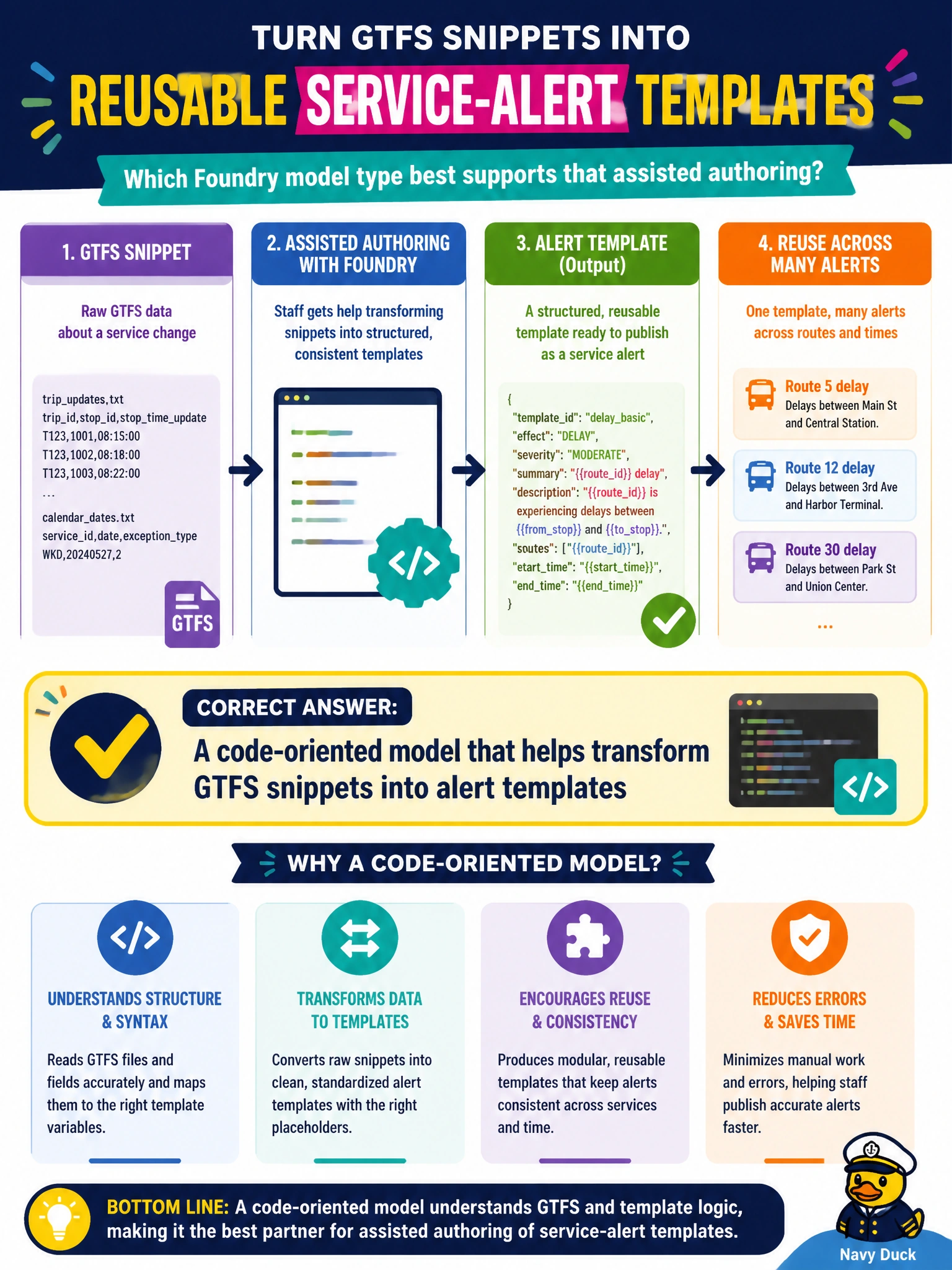
Transit staff need help turning GTFS snippets into reusable service-alert templates. Which Foundry model type best supports that assisted authoring?
Select an answer to reveal the explanation.
Short Explanation
GTFS looks like code-ish transit data, and turning it into alert templates is a transformation job. A code-oriented model is the right co-pilot for that staff authoring path. A conversational chat, embeddings, or summarization model won't reshape GTFS snippets into editable templates for you even when it's described as helping transform them.
Full Explanation
A code-oriented model that helps transform GTFS snippets into alert templates best supports transit staff's assisted authoring in Foundry. GTFS feeds are structured, machine-oriented text; turning selected fields into reusable service-alert templates is a transformation and templating task similar to code or config authoring. Code-oriented generative models excel at structured edits, pattern application, and producing consistent template skeletons staff can review. A conversational chat model that helps transform GTFS snippets into alert templates is optimized for dialogue and general drafting, but it does not perform the structured, code-like field-to-template transformation needed to produce reusable, editable alert-template skeletons. An embeddings model that helps transform GTFS snippets into alert templates only produces vector representations for similarity search, but it does not perform the GTFS-to-template structural authoring needed to build reusable alert templates. A summarization model that helps transform GTFS snippets into alert templates is designed to condense longer text into shorter summaries, but it does not turn GTFS snippets into editable alert-template text. Exam caveat: Foundry model-type selection should match modality and task shape—code/structured text versus conversational chat, embeddings, or summarization even when each is described as helping transform GTFS snippets into alert templates. Operational check: feed representative GTFS stop/trip snippets into the code-oriented deployment and verify staff receive editable alert-template drafts that preserve identifiers and times, which a conversational chat, embeddings, or summarization deployment described as helping transform GTFS snippets cannot reliably produce.
Prefer to study offline? Printable PDF study book + test engine ($7.50, unofficial). These questions stay free here.