
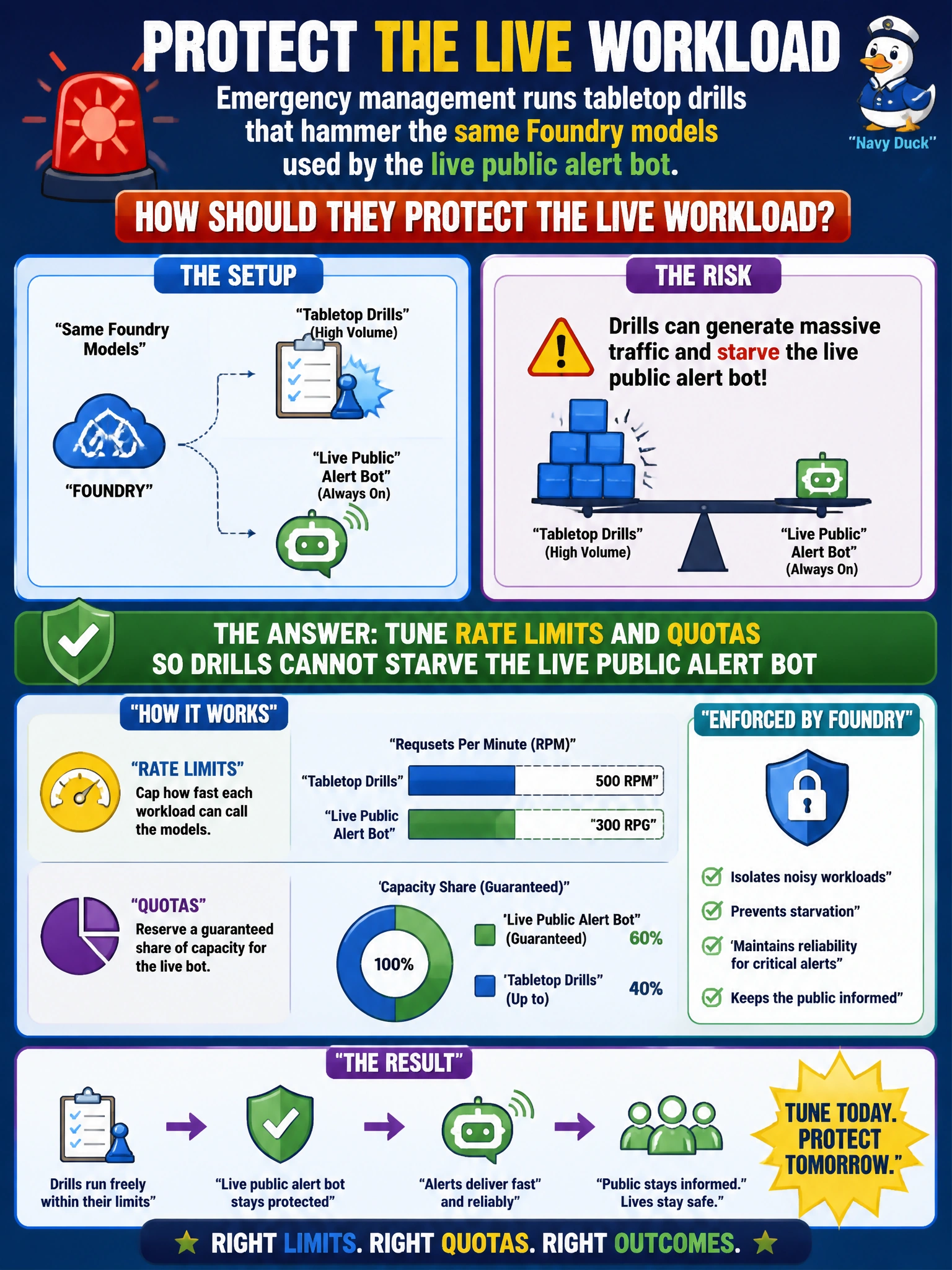
Emergency management runs tabletop drills that hammer the same Foundry models used by the live public alert bot. How should they protect the live workload?
Select an answer to reveal the explanation.
Short Explanation
Drills should stress the system, not knock the real alert bot offline—like not letting a parade block the ambulance lane. Carve rate limits and quotas so exercise traffic cannot starve live public alerts. Practice hard, keep the real channel healthy.
Full Explanation
Emergency management should tune rate limits and quotas so tabletop drills cannot starve the live public alert bot that shares the same Foundry models. The approach works because drills intentionally generate heavy traffic; without separate caps, priority queues, or partitioned capacity, drill load consumes TPM/RPM and causes throttling or latency on the live alerting channel residents rely on during real events. Protecting the live workload is a reliability and public-safety requirement, not an optional FinOps nicety. Routing drills to separate deployment sharing TPM quota to protect alert capacity fails because separation of deployments without separation of quota still leaves a shared TPM/RPM pool, so drill bursts can consume capacity and starve the public alert bot. Issuing isolated drill keys on the live deployment with metering to preserve alerts fails because separate keys do not isolate capacity when both map to the live deployment, so metering alone still lets exercise spikes consume TPM/RPM reserved for emergency alerts. Raising TPM quota on drill deployment to handle drills while shielding live alert bot fails because increasing the drill quota only permits more drill throughput and does not cap or partition drill consumption, so heavy exercise traffic can still consume shared model capacity and throttle the live public alert bot. Exam caveat: hard splits (separate deployments/subscriptions) may be required when soft rate limits are too coarse for true isolation during large multi-agency exercises. Operational check: assign distinct application identities and quotas for drill vs live, load-test that live alert SLOs hold during a drill profile, alert when live throttling rises, and document an emergency abort that pauses drill traffic first.
Prefer to study offline? Printable PDF study book + test engine ($7.50, unofficial). These questions stay free here.