
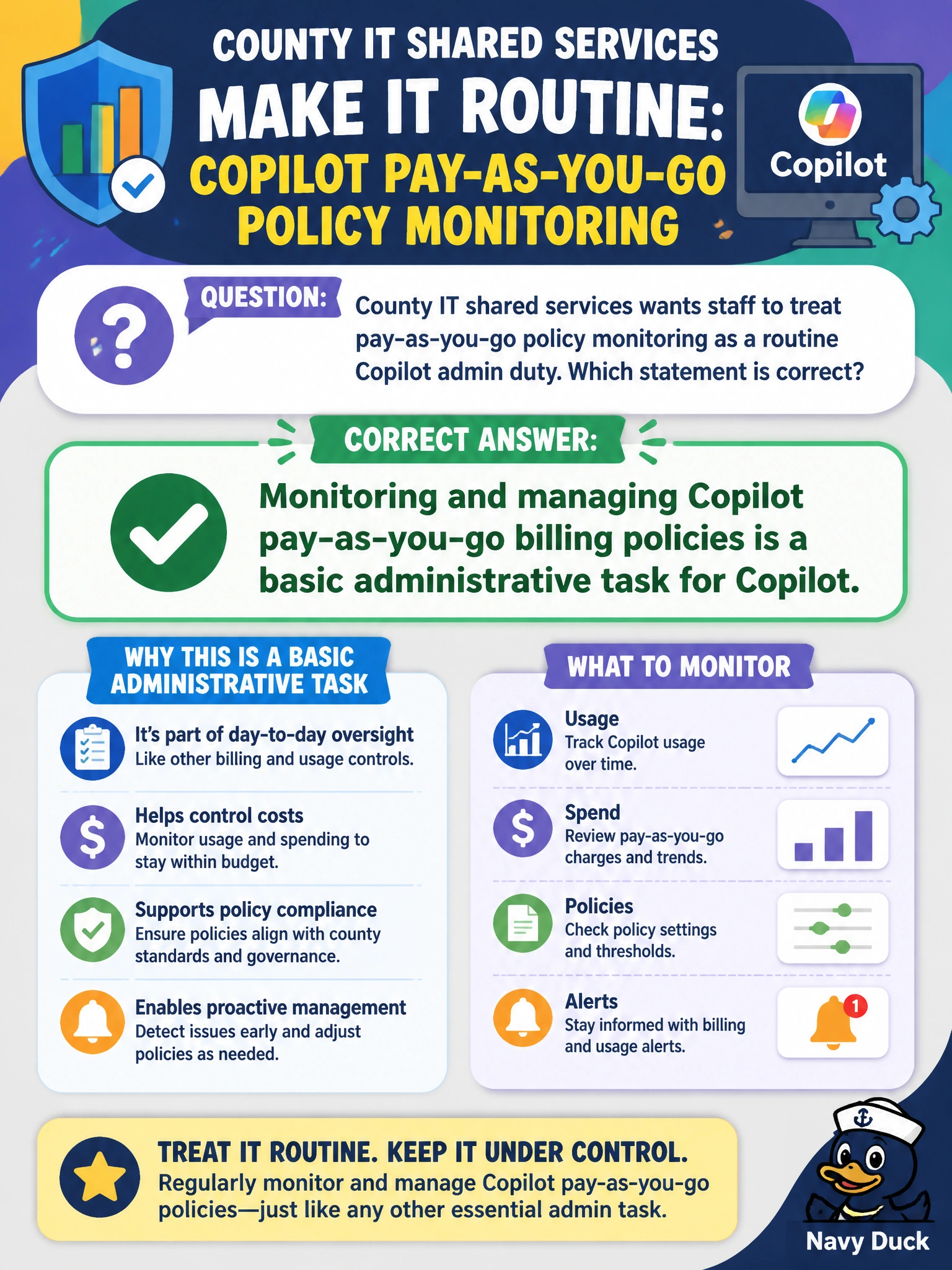
County IT shared services wants staff to treat pay-as-you-go policy monitoring as a routine Copilot admin duty. Which statement is correct?
Select an answer to reveal the explanation.
Short Explanation
Think of PAYG like a city fuel card—someone has to watch the meters, not just hand them out. Monitoring and managing those billing policies is basic Copilot admin work. County shared services should keep it on the ops checklist.
Full Explanation
Monitoring and managing Copilot pay-as-you-go billing policies is a basic Copilot administration task, and that is the correct framing for county IT shared services. PAYG metering is not a set-and-forget fiscal artifact: consumption policies, budgets, alerts, and assignment scope change as municipal workloads expand, so routine review belongs on the Copilot admin checklist alongside license and feature controls. Treating policy monitoring as core admin work keeps finance, procurement, and IT aligned on what metered Copilot activity the county is actually authorizing and paying for.
Assigning Copilot pay-as-you-go billing policies as a basic administrative task for Entra ID licensing fails by concept. Entra ID licensing governs identity and seat license assignment, not Copilot pay-as-you-go billing policies; those policies are administered through Microsoft 365–aligned Copilot admin surfaces as basic Copilot administrative work.
Reviewing Copilot pay-as-you-go billing policies as a basic administrative task for Azure cost analysis fails because Azure cost analysis tracks Azure resource consumption, not Copilot pay-as-you-go metered consumption; PAYG billing policies are reviewed in Microsoft 365 Copilot admin billing surfaces, and neglecting regular review is the opposite of operational billing hygiene.
Monitoring Copilot pay-as-you-go billing policies as a basic administrative task for Power Platform governance fails because Power Platform governance is built for Power Platform environments and controls, not Copilot pay-as-you-go billing; PAYG billing activity is monitored in Microsoft 365 Copilot admin surfaces, and ignoring policy removes the city’s control plane over that spend.
Exam caveat: AB-900 Domain 3 expects you to recognize PAYG billing policy management as ordinary Copilot admin work, not as an Entra ID licensing task, not as an Azure cost analysis task, and not as a Power Platform governance task. Do not confuse Copilot metering governance with unrelated Microsoft 365 admin surfaces or assume municipal tenants somehow escape billable metered usage.
Operational check: In the county shared-services runbook, confirm who owns Copilot PAYG policy review, where policies are viewed in Microsoft 365 Copilot admin surfaces, which departments are in scope, what budget or alert thresholds finance expects, and that the last review date is recent enough to catch new metered workloads before the next invoice cycle.
Prefer to study offline? Printable PDF study book + test engine ($7.50, unofficial). These questions stay free here.