
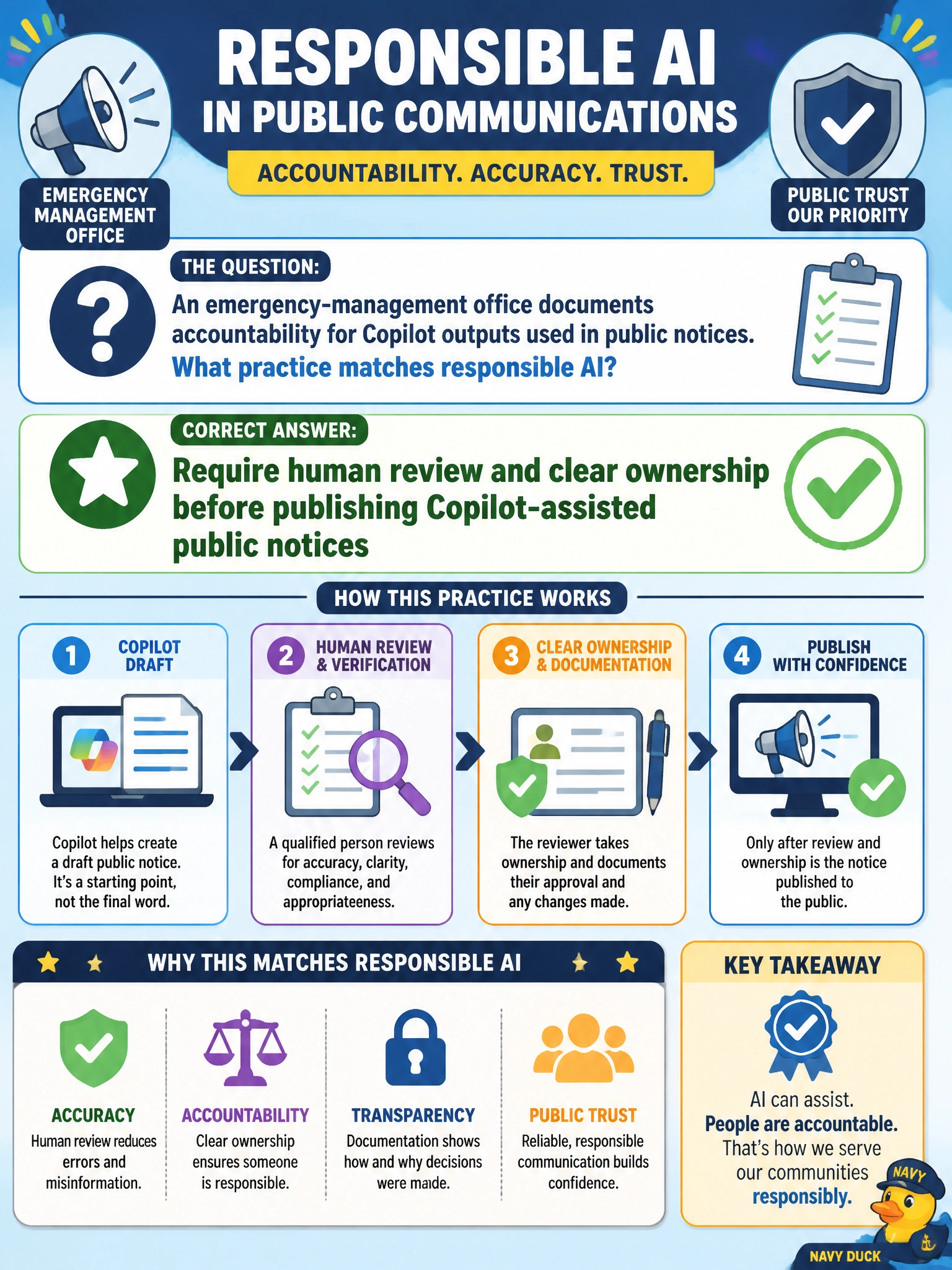
An emergency-management office documents accountability for Copilot outputs used in public notices. What practice matches responsible AI?
Select an answer to reveal the explanation.
Short Explanation
If Copilot drafts a public notice, a human still owns the publish button—accountability with a name on it. You can't treat Copilot's safety evaluations as documented ownership, transparency notes as an accountability record, or retained prompts and outputs as human oversight. Responsible AI means review and ownership before it hits the public.
Full Explanation
Emergency-management practice that matches responsible AI for Copilot-assisted public notices is requiring human review and clear ownership before publishing. Public notices affect resident safety, legal obligations, and trust. Copilot can draft language quickly, but accountability means a named person or role verifies accuracy, tone, and authority to publish, then accepts responsibility for the posted notice. That human-in-the-loop ownership is the civic application of accountability for AI-assisted outputs.
Use Copilot content safety evaluations as documented ownership for emergency public notices fails accountability: safety evaluations may screen for harmful content, but they do not verify shelter locations, timelines, or publishing authority, and they do not name a human owner responsible for the notice. Adding Copilot-generated transparency notes as accountability record for emergency public notices is insufficient by itself: transparency notes tell readers AI was used, but they do not name the accountable staff reviewer or provide the required pre-publication human sign-off. Retaining Copilot prompts and outputs as human oversight record for emergency public notices is a useful record, but it does not establish oversight: logs of prompts and outputs do not show which named person reviewed and authorized the notice before it was published.
Exam caveat: AB-900 expects you to identify accountability practices for AI-assisted content, not to draft emergency-operations law. Related ideas such as retention of published notices or sensitivity labeling of drafts may appear in nearby items, but this stem is specifically about human review and ownership before publish.
Operational check: Define a publish checklist for Copilot-assisted notices—fact check, legal/ops review if required, named approver recorded, then publish—and verify staging drafts are not auto-pushed to the public site. Confirm staff can name the owner for the last published notice and that Copilot is documented as a drafting aid, not a signing authority.
Prefer to study offline? Printable PDF study book + test engine ($7.50, unofficial). These questions stay free here.