
A municipal permitting office explains layered protections against Copilot misuse of sensitive permit packets. What should the explanation emphasize?
Select an answer to reveal the explanation.
Short Explanation
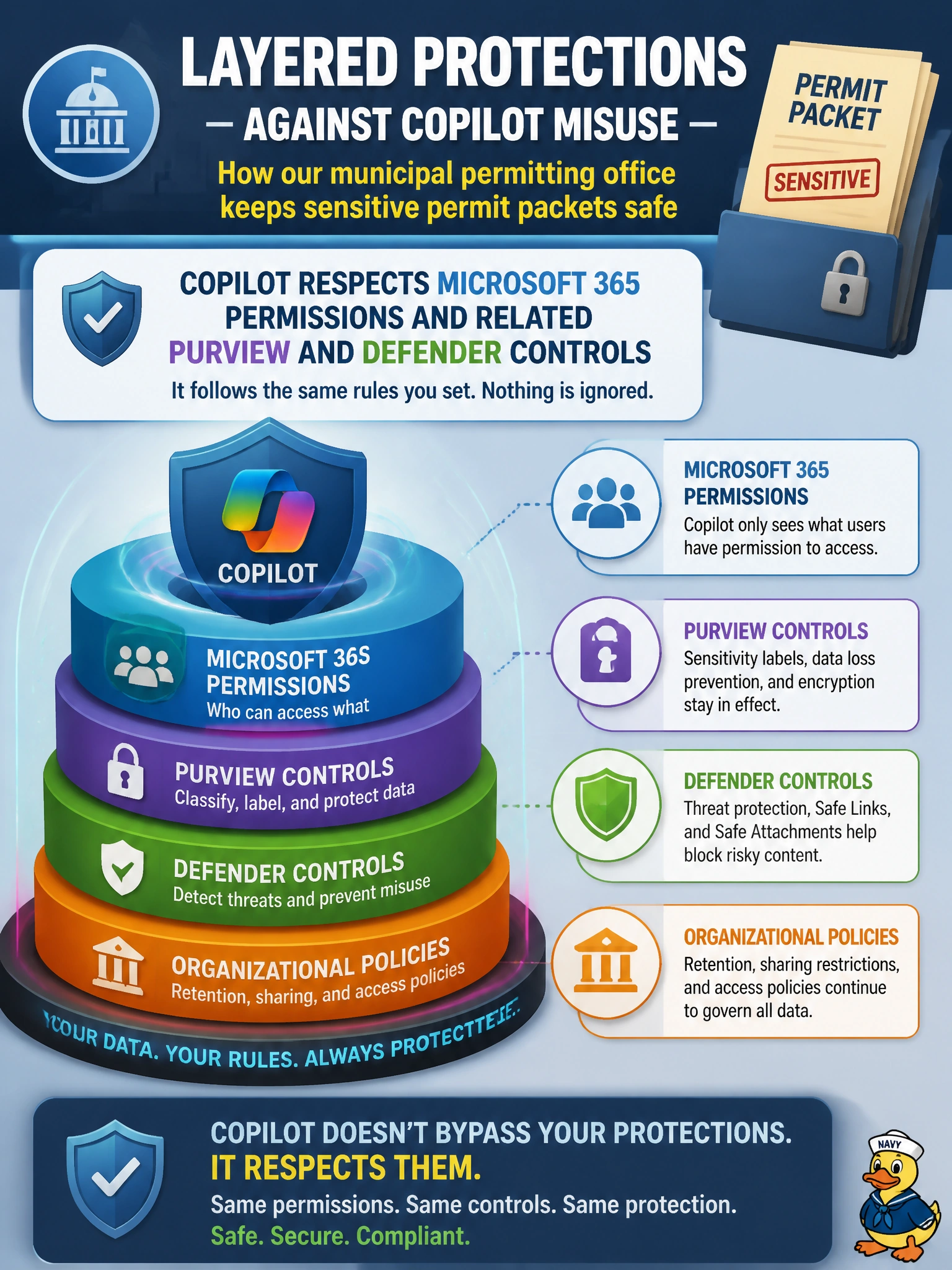
You'll stay protected because Copilot still respects Microsoft 365 permissions plus related Purview and Defender protections. Labels won't block you from getting summaries you're authorized to see, and DLP doesn't encrypt responses with your own keys, it just blocks risky sharing. Enabling an agent doesn't give you a separate permissions model, it still uses your existing SharePoint access.
Full Explanation
Layered protections against Copilot misuse of sensitive permit packets work because Copilot respects Microsoft 365 permissions and related Purview and Defender controls rather than ignoring them. A municipal permitting office explaining those layered protections should emphasize that respect for existing controls. Purview sensitivity labels on permit packets do not block Copilot from including that content in summaries for authorized users; an authorized user with access can still get a Copilot summary, because labels apply protection and handling controls rather than denying authorized summarization. Purview data loss prevention for permit packets does not encrypt Copilot model responses with customer-managed keys; DLP applies policies to detect and restrict oversharing in prompts and generated outputs, while encryption with customer-managed keys is a separate encryption control. Enabling Analyst agent for permit packets does not create a separate Copilot permissions model for SharePoint libraries; the agent still operates within the same Microsoft 365 permissions and whatever access the user already has to the libraries it analyzes. Exam caveat: layered controls matter because Copilot still operates under Microsoft 365 permissions plus related Purview and Defender protections. Operational check: keep permit packets labeled and least-privilege shared, verify Copilot prompts with "urgent" language cannot bypass labels, and confirm Analyst or other agents do not create a separate permissions model and still respect each user's existing rights. Permitting staff should therefore describe Copilot as operating inside the same control stack used for ordinary document security, not as a license that voids labels, Defender, or ACLs. Misuse reduction comes from keeping permit packets correctly permissioned and protected, then verifying agents and prompts cannot bypass that boundary by creating a separate permissions model or through urgency wording.
Prefer to study offline? Printable PDF study book + test engine ($7.50, unofficial). These questions stay free here.