
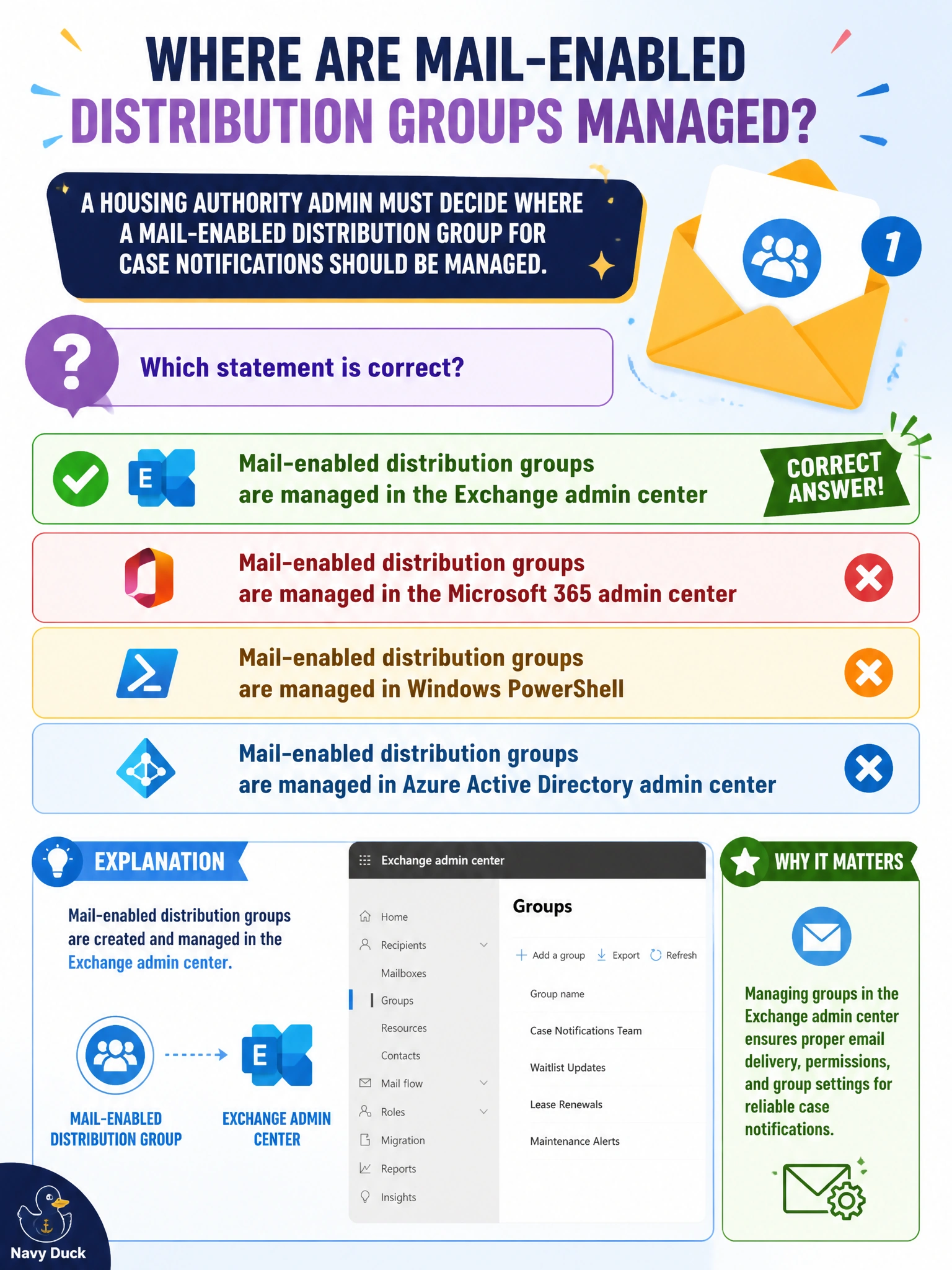
A housing authority admin must decide where a mail-enabled distribution group for case notifications should be managed. Which statement is correct?
Select an answer to reveal the explanation.
Short Explanation
If it exists mainly to blast email to a list of people, you're in Exchange territory. Mail-enabled security groups, Microsoft 365 shared mailboxes, and the Entra admin center each solve different problems — none of them are the home for a classic mail-enabled distribution group.
Full Explanation
For a housing authority that needs a mail-enabled distribution group for case notifications, the correct statement is that mail-enabled distribution groups are managed in the Exchange admin center. These objects exist to deliver email to a defined membership set—caseworkers, supervisors, or partner contacts—so Exchange is the authoritative admin surface for create, membership, moderation, and delivery-related properties of that distribution group.
‘Managed as mail-enabled security groups’ fails by type: mail-enabled security groups are a separate recipient type that combines mail distribution with permission grants, while a classic distribution group is mail-distribution only and cannot assign access. Managing them as Microsoft 365 shared mailboxes fails because a shared mailbox is a single shared inbox for joint send-and-receive, not a distribution list that fans a case notification out to each member’s own mailbox. Managing them in the Entra admin center fails because the Entra admin center governs identity and access objects, not classic Exchange mail-enabled distribution groups for mail delivery.
Exam caveat: AB-900 distractors often attach other recipient types or portals (mail-enabled security groups, shared mailboxes, Entra admin center) to ordinary Exchange objects. If the object’s purpose is mail distribution, stay with Exchange unless the stem explicitly describes a Microsoft 365 group collaboration package.
Operational check: locate or create the case-notification distribution group in Exchange admin center, verify it is mail-enabled and has the intended SMTP address on a verified domain, update membership for active case teams, send a controlled test notification, and confirm delivery and moderation settings match housing-authority communication policy before using the list for resident-sensitive case traffic.
Prefer to study offline? Printable PDF study book + test engine ($7.50, unofficial). These questions stay free here.