
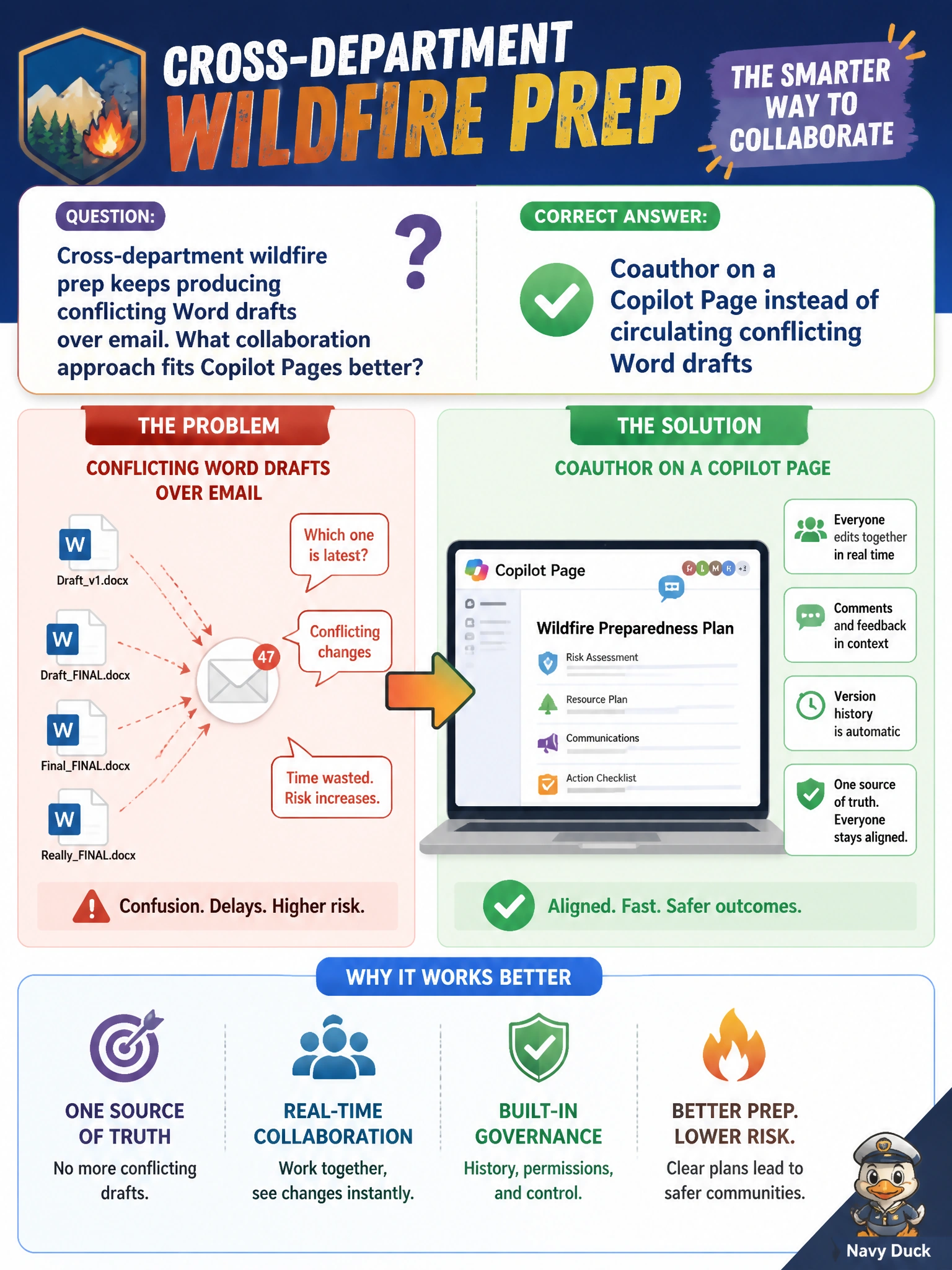
Cross-department wildfire prep keeps producing conflicting Word drafts over email. What collaboration approach fits Copilot Pages better?
Select an answer to reveal the explanation.
Short Explanation
Wildfire prep drafts colliding in email? Move the work onto a Copilot Page so departments coauthor one living canvas. One shared page beats a pile of conflicting Word files.
Full Explanation
Cross-department wildfire preparedness work fails when each agency emails a divergent Word draft and nobody shares a living source of truth. Coauthoring on a Copilot Page instead of circulating conflicting Word drafts is correct because Pages provide a multi-party collaboration canvas where emergency management, fire, police, public works, and communications can edit together with Copilot assistance, reducing version collision and stale attachments. For municipal wildfire prep, a shared page keeps staging concepts, contact trees, and public messaging aligned as conditions change.
Keeping emailing separate Word drafts with no shared living workspace fails collaboration hygiene; conflicting attachments multiply rework and silent divergence. Deleting all prep content overnight so each shift starts from a blank file destroys continuity across watches and wastes prior coordination. Publishing confidential evacuation staging details to an unsecured public site fails operational security. Staging locations and related tactics can create safety and security exposure if posted without authorization.
Exam caveat: a Copilot Page improves coauthoring but does not automatically become the official EOC plan of record; sensitive annexes still need appropriate access controls and formal approval pathways. Operational check: move the working draft to a permissioned Page, invite the responsible departments, keep confidential staging details restricted, and promote only reviewed content into the official preparedness packet.