
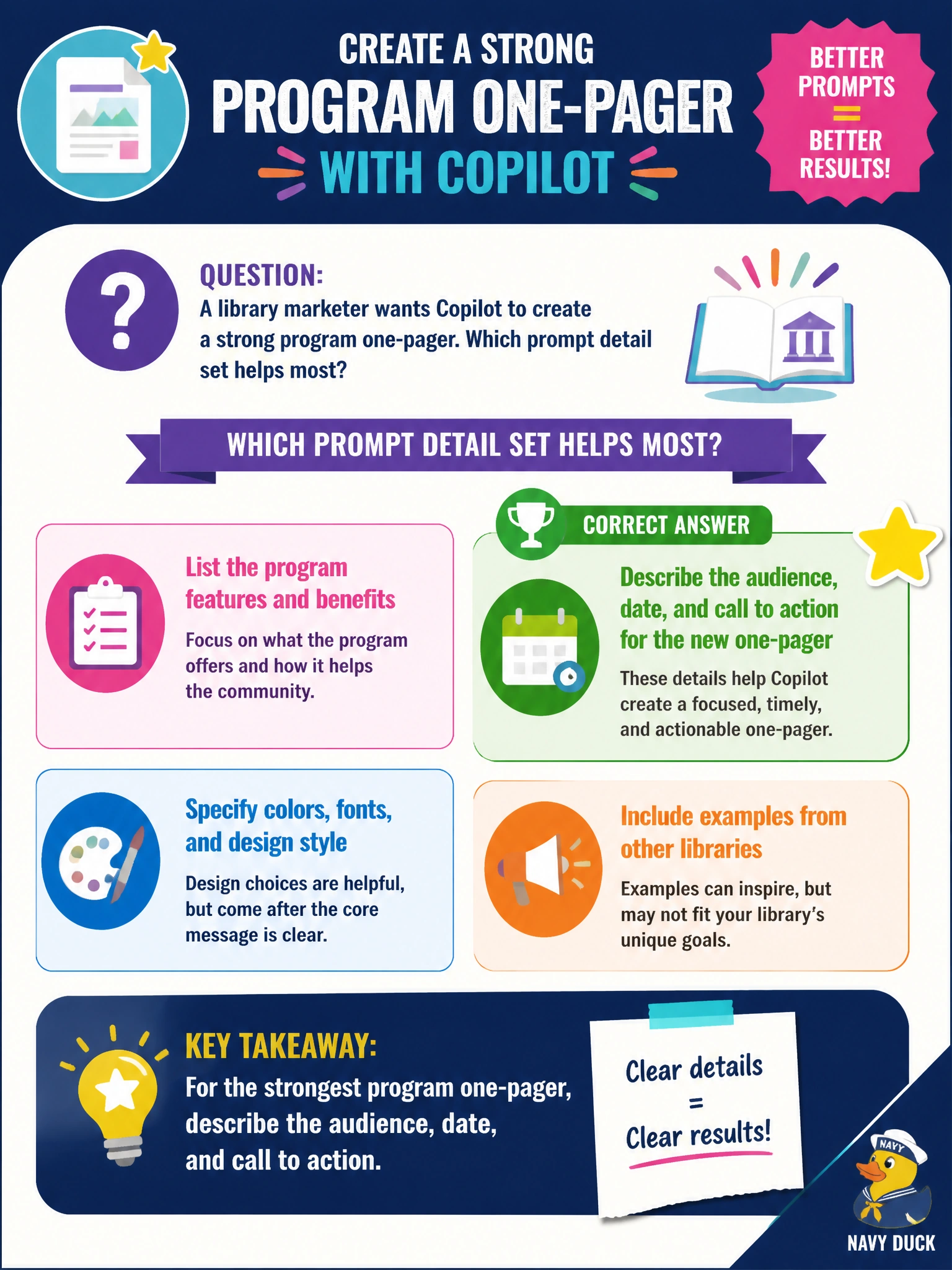
A library marketer wants Copilot to create a strong program one-pager. Which prompt detail set helps most?
Select an answer to reveal the explanation.
Short Explanation
One-pagers love specifics—audience, date, and call to action in the prompt. “Make a flyer” alone is like asking for directions with no destination.
Full Explanation
Describing the audience, date, and call to action for the new one-pager is the prompt detail set that most helps a library marketer get a strong program flyer from Copilot. Prompt specificity drives document quality: audience shapes reading level and hooks, date anchors the event, and a call to action tells residents what to do next (register, show up, bring a card). Those details turn a vague ask into a usable municipal marketing draft.
Providing only the single word “flyer” with no audience, date, or call to action fails because Copilot lacks the constraints that make a one-pager actionable. Outputs become generic and require heavy rewrite.
Asking Copilot to omit the event date and invent attendance numbers for marketing fails on accuracy and ethics. Invented attendance is misleading promotion; omitting the date removes a core logistics fact residents need.
Prompting Copilot to include private borrower addresses on the public one-pager fails as a privacy violation. Public program materials must not expose personal borrower addresses.
Exam caveat: For create-new-document prompts, AB-730 rewards concrete municipal details and punishes fabrication or inclusion of personal data in public collateral.
Operational check: Include audience, date, and CTA in the prompt, generate the one-pager, verify the date against the program calendar, and confirm no private borrower data appears before printing or posting.