
A city clerk must produce a brand-new public-hearing notice with no prior template file open. What should the clerk do?
Select an answer to reveal the explanation.
Short Explanation
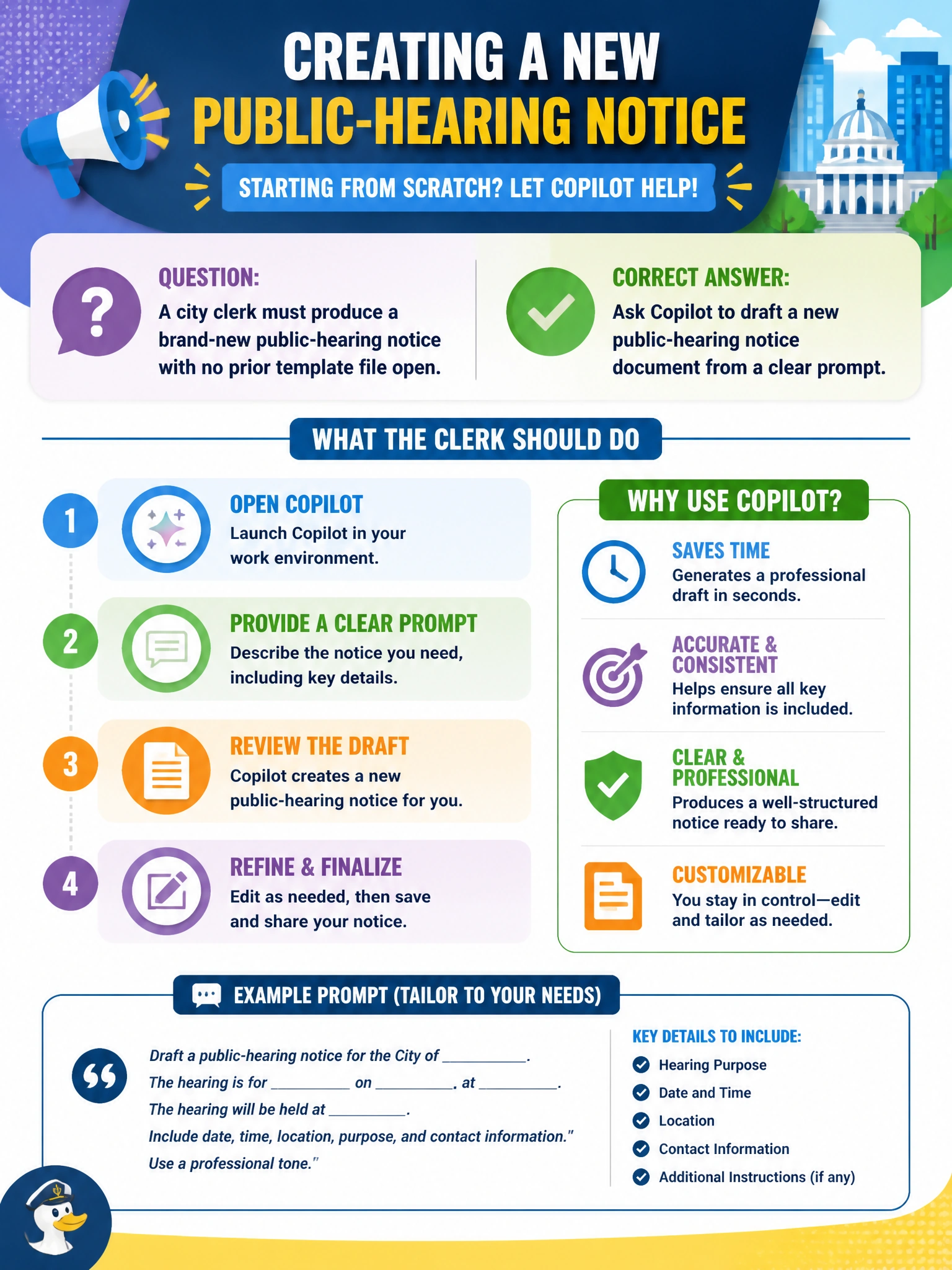
No template open? That’s fine—give Copilot a clear prompt and draft a brand-new public-hearing notice. Prompt-to-new-document is the clerk’s friend here.
Full Explanation
Asking Copilot to draft a new public-hearing notice document from a clear prompt is what the city clerk should do when no prior template file is open. New-document creation from a prompt supports municipal communications: the clerk supplies hearing subject, date/time if known, location, how to comment, and accessibility notes; Copilot produces a draft notice for human verification. Clarity in the prompt substitutes for an open template file.
Waiting for Copilot to invent hearing dates without any prompt details from the clerk fails because undirected invention fabricates civic facts. Hearing dates must come from the clerk’s calendar inputs, not model guesswork.
Exporting the notice only by screenshotting an unrelated Teams chat with no document fails as a records and quality practice. Screenshots of unrelated chats are not reusable notice documents and omit proper structure for posting and archival.
Telling Copilot to overwrite the adopted municipal code instead of creating a notice fails by targeting the wrong artifact. Notices are communications; the adopted code is controlling law and must not be overwritten by a drafting exercise.
Exam caveat: Prompt-to-new-document still requires accurate municipal facts from the user; Copilot drafts—it does not authorize inventing hearing logistics.
Operational check: Provide a complete prompt with confirmed hearing details, generate the notice document, verify every date and location against the official calendar, and only then route for posting.