
A city IT champion teaches staff how to approach Copilot agents for municipal tasks. Which guidance matches store-first judgment?
Select an answer to reveal the explanation.
Short Explanation
Champion tip: check Agent Store first, customize second. Same habit as looking in the supply closet before ordering a whole new stapler.
Full Explanation
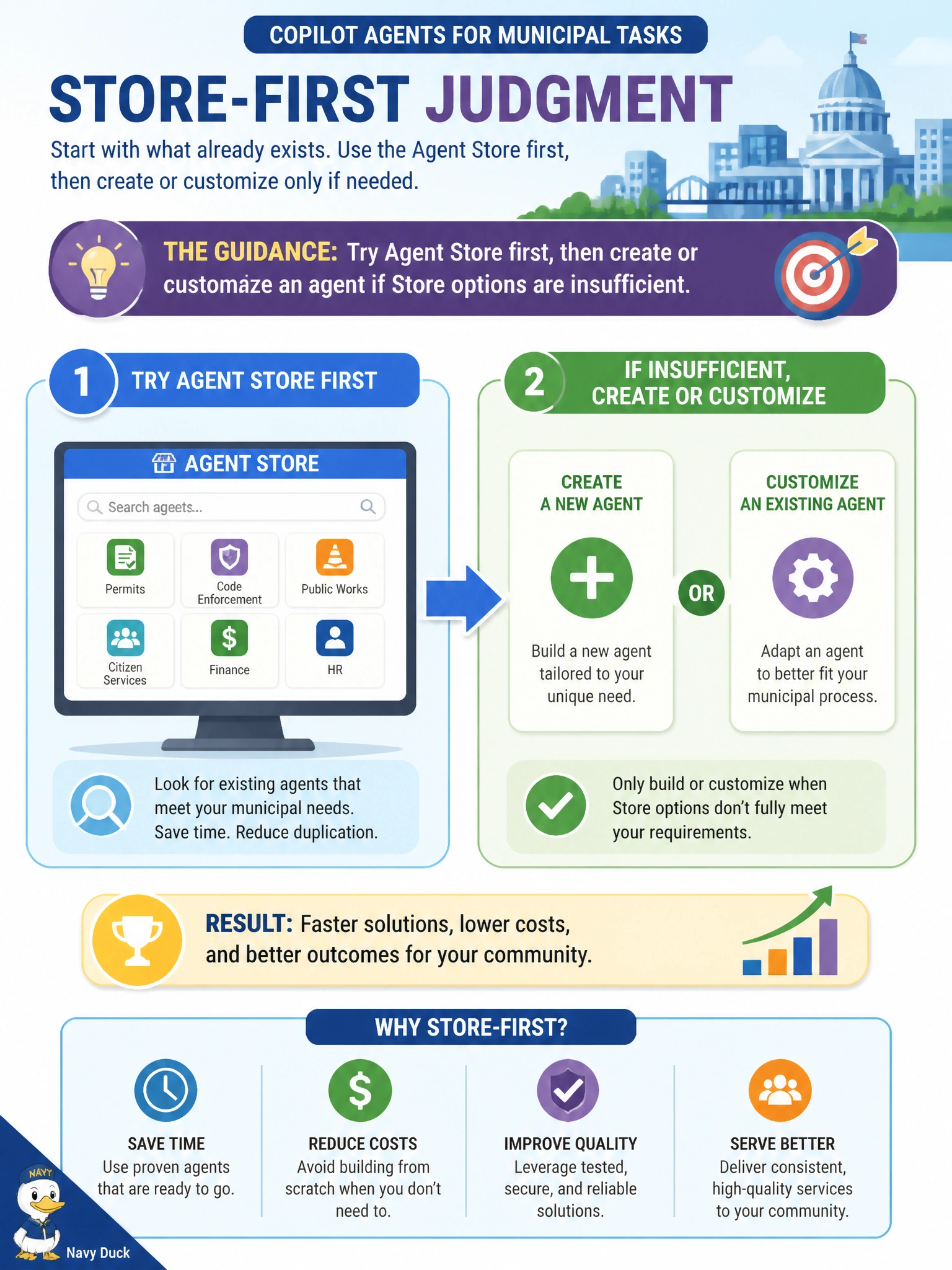
Store-first judgment is the teaching IT champions should give municipal staff: try Agent Store first, then create or customize an agent if Store options are insufficient. That sequence reduces duplicate agents, speeds adoption of suitable existing helpers, and reserves custom work for real gaps in Copilot agent coverage for city tasks.
Always inventing a blank custom agent before checking Store fails the store-first rule and multiplies maintenance. Forbidding Agent Store so every department rebuilds from empty settings fails reuse and contradicts champion guidance. Skipping agents entirely and pasting every municipal question into an unmanaged personal chatbot fails governance, consistency, and the Copilot agent pathway AB-730 emphasizes for organizational work.
Exam caveat: store-first is a default sequence, not a ban on custom agents. After a good-faith Store check, customization or creation remains appropriate when fitness criteria (purpose, knowledge, capabilities) are unmet.
Operational check: publish a short staff playbook—search Agent Store, evaluate fit, adopt or else create/customize—and audit a sample of new departmental agents for evidence that Store was checked before custom builds.