
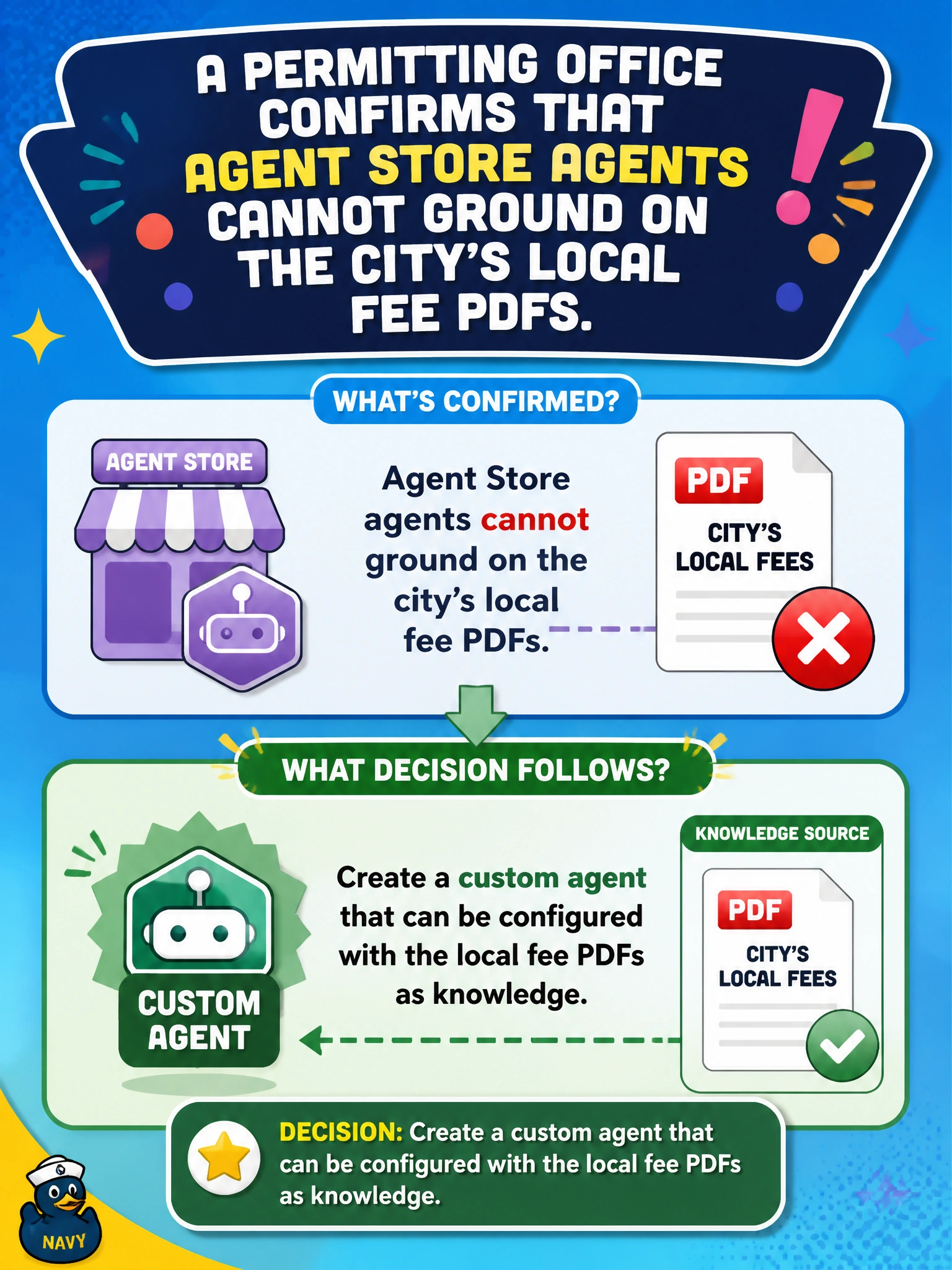
A permitting office confirms that Agent Store agents cannot ground on the city’s local fee PDFs. What decision follows?
Select an answer to reveal the explanation.
Short Explanation
Store helpers can’t see the city’s fee PDFs? Build a custom agent and point it at those files. Local grounding needs local knowledge—not a generic helper that never saw the schedule.
Full Explanation
A core Store-versus-custom decision criterion is whether the agent can ground on required municipal knowledge. When a permitting office confirms Agent Store agents cannot ground on the city’s local fee PDFs, the correct decision is to create a custom agent configured with those fee documents as knowledge. Local fee schedules and related PDFs are authoritative for counter answers; if Store agents cannot use them, custom configuration is the path that restores grounding.
Keeping a Store agent that cannot ground on local fee documents fails accuracy—staff would rely on an agent blind to the city’s schedule. Removing fee PDFs from municipal records so no agent needs local grounding fails records and service obligations; destroying source documents is not an agent strategy. Relying only on generic web chat with no agent knowledge configuration fails municipal grounding and increases fabrication risk on fee amounts.
Exam caveat: creating a custom agent for local PDFs still requires using the current approved fee schedule versions and controlling who can change knowledge sources. Grounding on documents does not remove the need for staff verification on unusual fee scenarios.
Operational check: create the custom permitting agent, add the official fee PDFs as knowledge, ask sample fee questions, confirm answers cite or match the schedule, and retire use of unfit Store agents for fee guidance.