
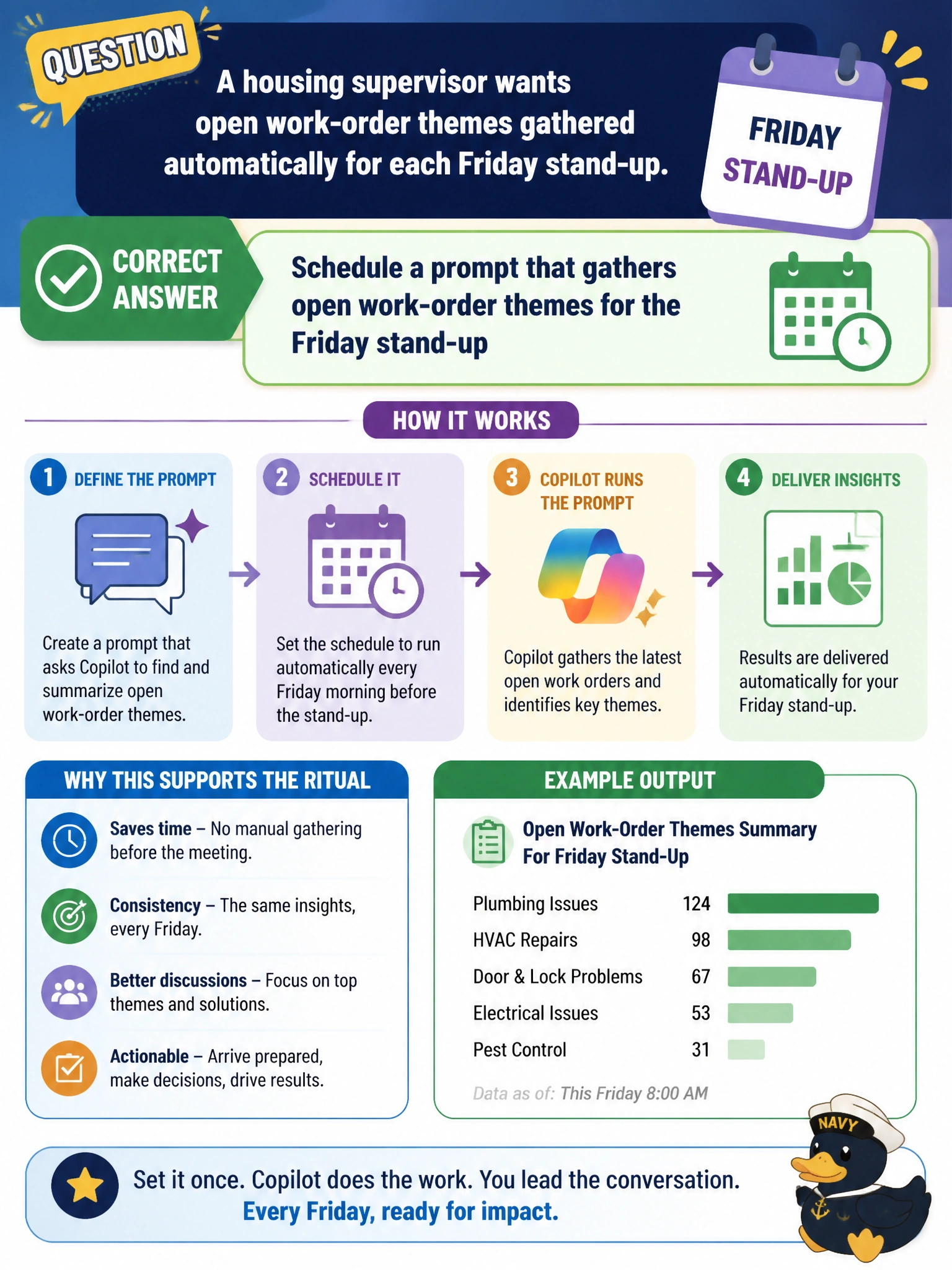
A housing supervisor wants open work-order themes gathered automatically for each Friday stand-up. What Copilot action supports that ritual?
Select an answer to reveal the explanation.
Short Explanation
Friday stand-up needs the same prep every week—schedule the prompt that pulls open work-order themes. Treat it like setting the agenda alarm the night before.
Full Explanation
A housing supervisor who wants open work-order themes gathered automatically for each Friday stand-up should schedule a prompt that gathers open work-order themes for the Friday stand-up. Scheduling binds Copilot prep to the weekly ritual: theme clustering across open work orders (leaks, unit turnover delays, accessibility fixes, vendor waits) arrives as a draft agenda input without manual re-prompting each Thursday night. The prompt should use authorized work-order exports or lists and avoid injecting unnecessary resident sensitive data.
Relying on sticky notes only and never using Copilot for recurring stand-up prep fails the automation goal and scales poorly as portfolios grow. Deleting the work-order list every Thursday so Friday themes cannot be summarized sabotages the data needed for the stand-up. Pasting resident Social Security numbers into the prompt to enrich theme detection fails privacy and is unnecessary for theme aggregation—SSNs do not improve maintenance theme detection and introduce serious compliance risk.
Exam caveat: theme digests are decision-support drafts; supervisors still validate against the live work-order system before assigning crews, and scheduling should not run against stale exports. Minimize PII in prompts—addresses or unit identifiers only as policy allows, never government identifiers for “enrichment.”
Operational check: after enabling the Friday schedule, compare one week’s theme draft to a manual skim of open work orders, confirm no prohibited PII appears in the prompt or output, and verify the draft is available before the stand-up start time.