
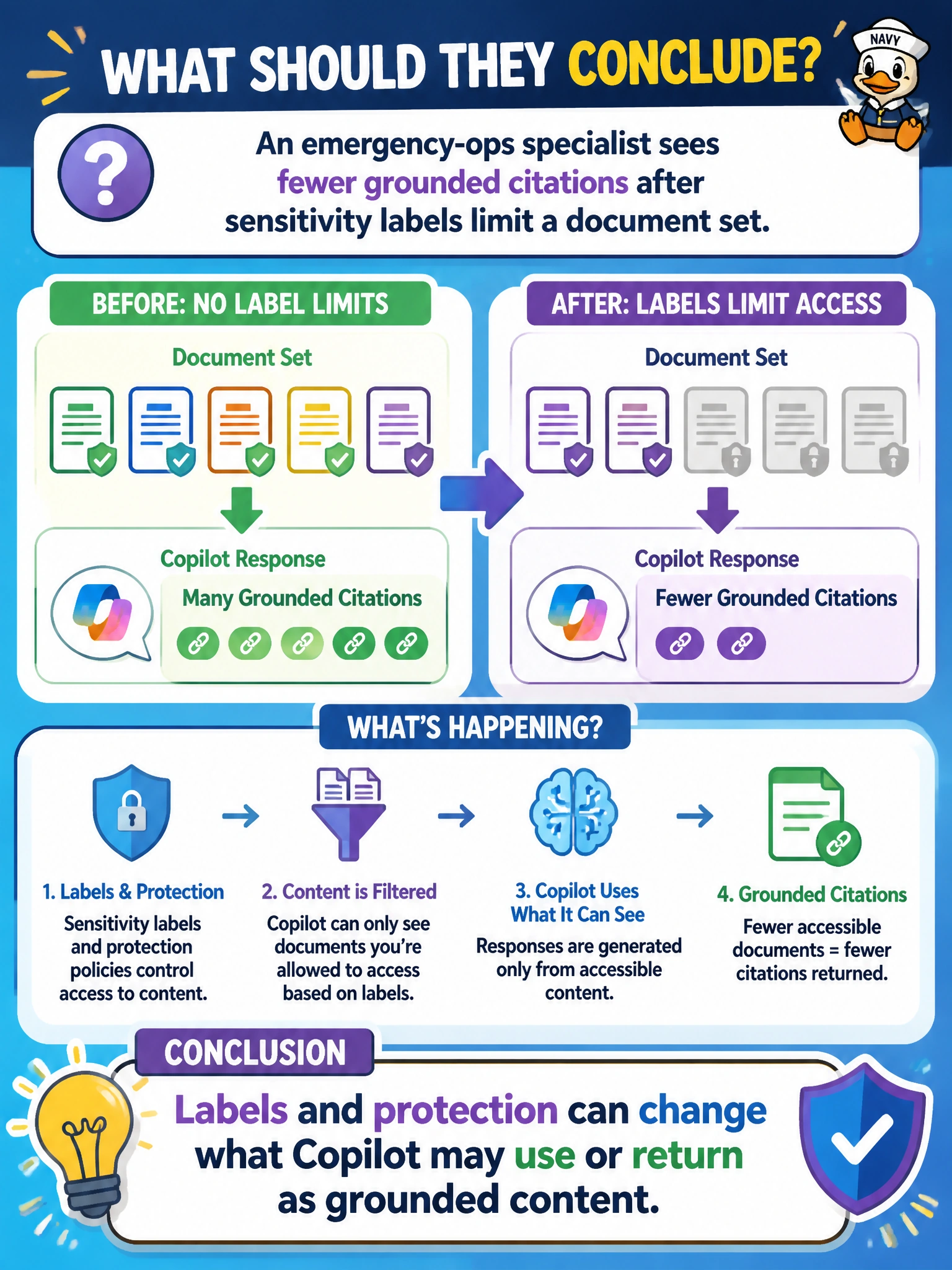
An emergency-ops specialist sees fewer grounded citations after sensitivity labels limit a document set. What should they conclude?
Select an answer to reveal the explanation.
Short Explanation
You can see fewer grounded citations when labels narrow the documents Copilot may use; it isn’t ghosting you for fun. Protection can shrink the citeable pool, so fewer citations may be expected.
Full Explanation
When an emergency-ops specialist sees fewer grounded citations after sensitivity labels limit a document set, the right conclusion is that labels and protection can change what Copilot may use or return as grounded content. Sensitivity labels classify and protect municipal incident files; when they are applied or tightened, the grounding pool available to that user can shrink. Citation volume depends partly on which sources are accessible and allowed by labels, not solely on whether Copilot is helpful. The claim that sensitivity labels never affect Copilot and only change PowerPoint themes fails because labels are data-protection controls, not cosmetic theme switches, and can affect retrieval and use. The claim that fewer citations always mean Copilot fabricated emergency plans overnight confuses fabrication risk with access restriction: sources may be unavailable, which is not proof that plans were invented. Removing sensitivity labels from incident files to make the full document set citeable also fails conceptually because stripping protection to maximize citations sacrifices the confidentiality emergency operations require. Exam caveat: fewer citations can be correct behavior under tighter labels; distinguish protection effects from assumed deletion or universal fabrication. Practical check: inventory labels on incident documents, compare grounding before and after a controlled label change on a test file the specialist may use, and adjust expectations and alternate briefing sources when labels intentionally narrow the citeable set.