
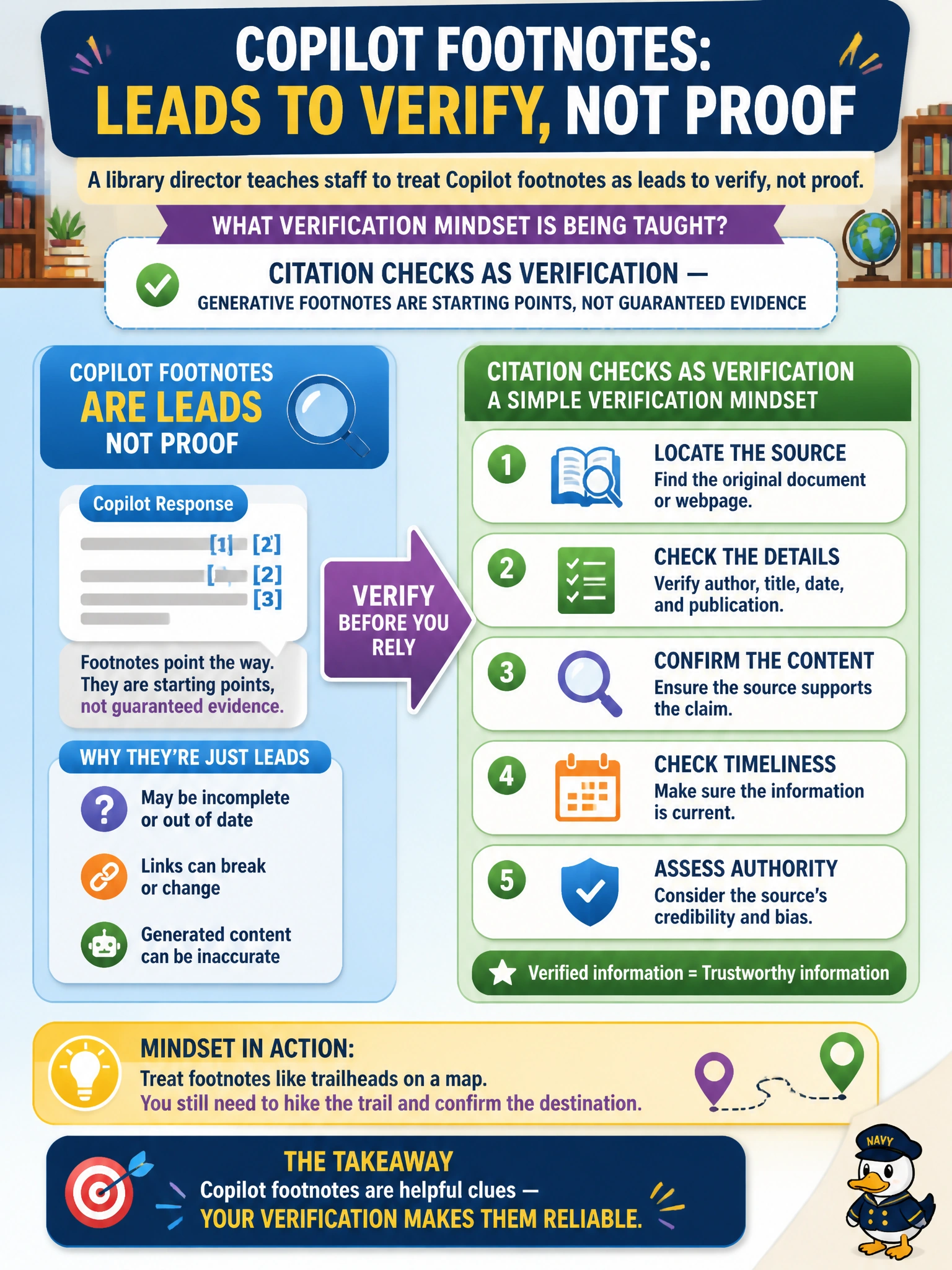
A library director teaches staff to treat Copilot footnotes as leads to verify, not proof. What verification mindset is being taught?
Select an answer to reveal the explanation.
Short Explanation
Footnotes from Copilot are like sticky notes saying “check this shelf.” Helpful — not a library stamp. Teach staff to verify, and the catalog stays trustworthy.
Full Explanation
Teaching staff to treat Copilot footnotes as leads to verify, not proof, teaches citation checks as verification: generative footnotes are starting points, not guaranteed evidence. Library directors protect catalog integrity and patron trust by insisting that every generative source pointer be opened and confirmed against authoritative records before it is treated as established fact.
Blind trust in Copilot footnotes because library catalogs cannot contain fabrications is false; generative systems can fabricate citations even in library contexts.
Deleting footnotes so patrons never see sources that might need checking removes transparency and the chance to verify rather than teaching verification.
Replacing human catalog review with scheduled Copilot prompts that auto-approve metadata removes human quality control and institutionalizes unverified generative metadata.
Exam caveat: “footnotes are leads, not proof” maps directly to citation-check mindset—reject blind trust, deletion, or auto-approve substitutes.
Operational check: when Copilot proposes a footnote or ISBN-related source, open the cited work or catalog authority record, confirm the claim, then accept or discard the footnote before patron-facing materials use it.