
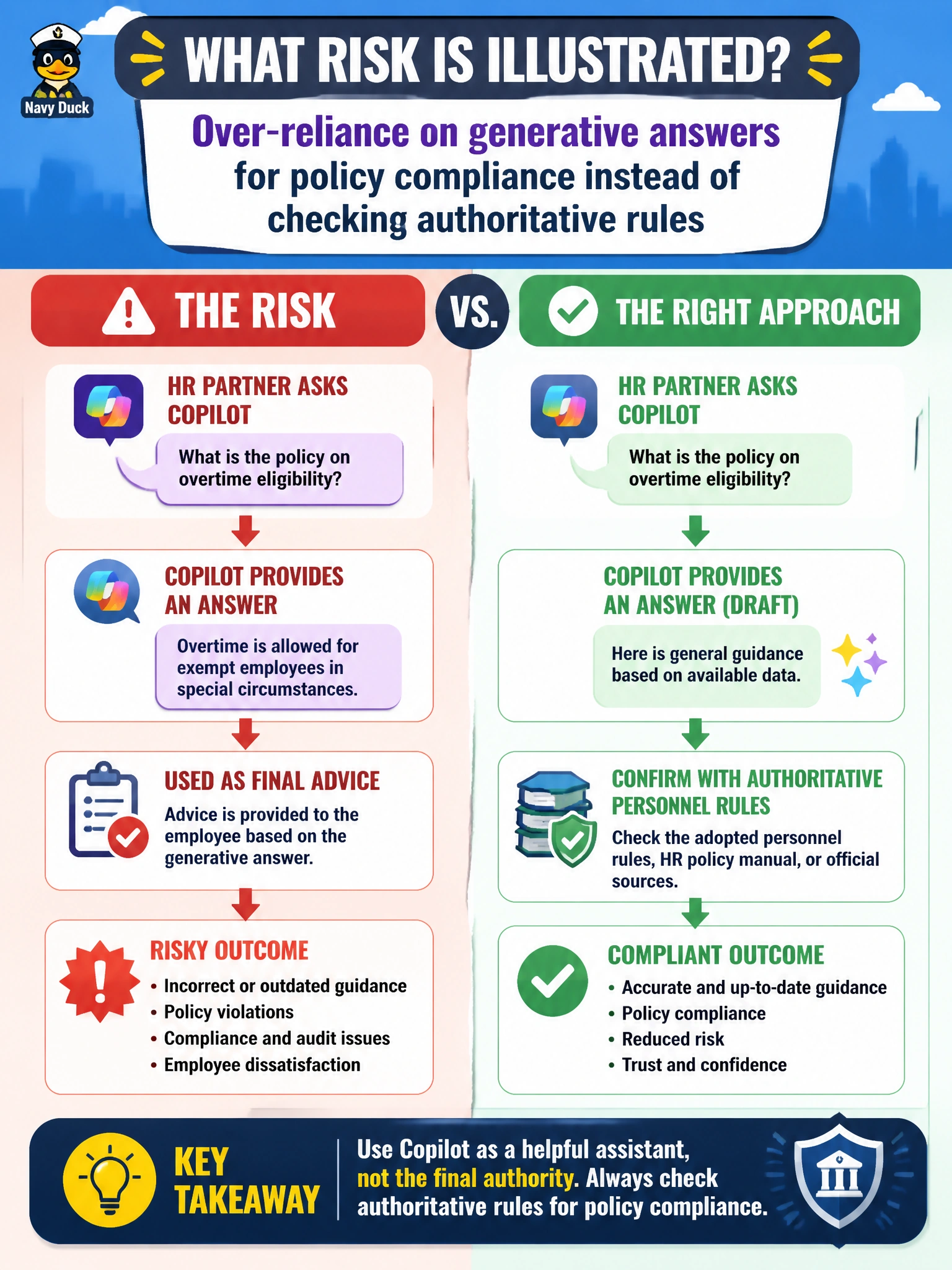
A city HR partner uses Copilot policy answers as final advice instead of confirming with the adopted personnel rules. What risk is illustrated?
Select an answer to reveal the explanation.
Short Explanation
Copilot can sound like the employee handbook, but it isn’t the handbook. When you use its answer as final HR advice without checking adopted rules, you’re relying too heavily on generated guidance. Confirm with the authoritative policy first.
Full Explanation
Using Copilot policy answers as final advice instead of confirming with adopted personnel rules illustrates over-reliance on generative answers for policy compliance. As a city HR partner, you must ground employment guidance in adopted ordinances, contracts, and personnel manuals; fluent Copilot answers can diverge from those authorities and lead to inconsistent staff advice. The claim that prompt injection rewrites personnel rules whenever Copilot is opened in Word misidentifies the risk: the issue is treating an answer as final, not injection rewriting rules on every Word launch. Calling this appropriate verification because Copilot citations reliably reflect adopted city rules is also incorrect; citations and paraphrases can be wrong or incomplete and still need confirmation against adopted text. A data-protection failure that only occurs when HR files lack sensitivity labels invents a labeling-only explanation. The risk described is over-reliance in compliance advice, not sensitivity-label absence alone. Exam caveat: using AI as final policy advice without checking adopted rules points to over-reliance, not prompt injection or a labeling issue. Practical check: open the adopted personnel-rules section Copilot cited, confirm that the answer matches its current language and effective dates, then provide guidance—or escalate to counsel if the rules are ambiguous.