
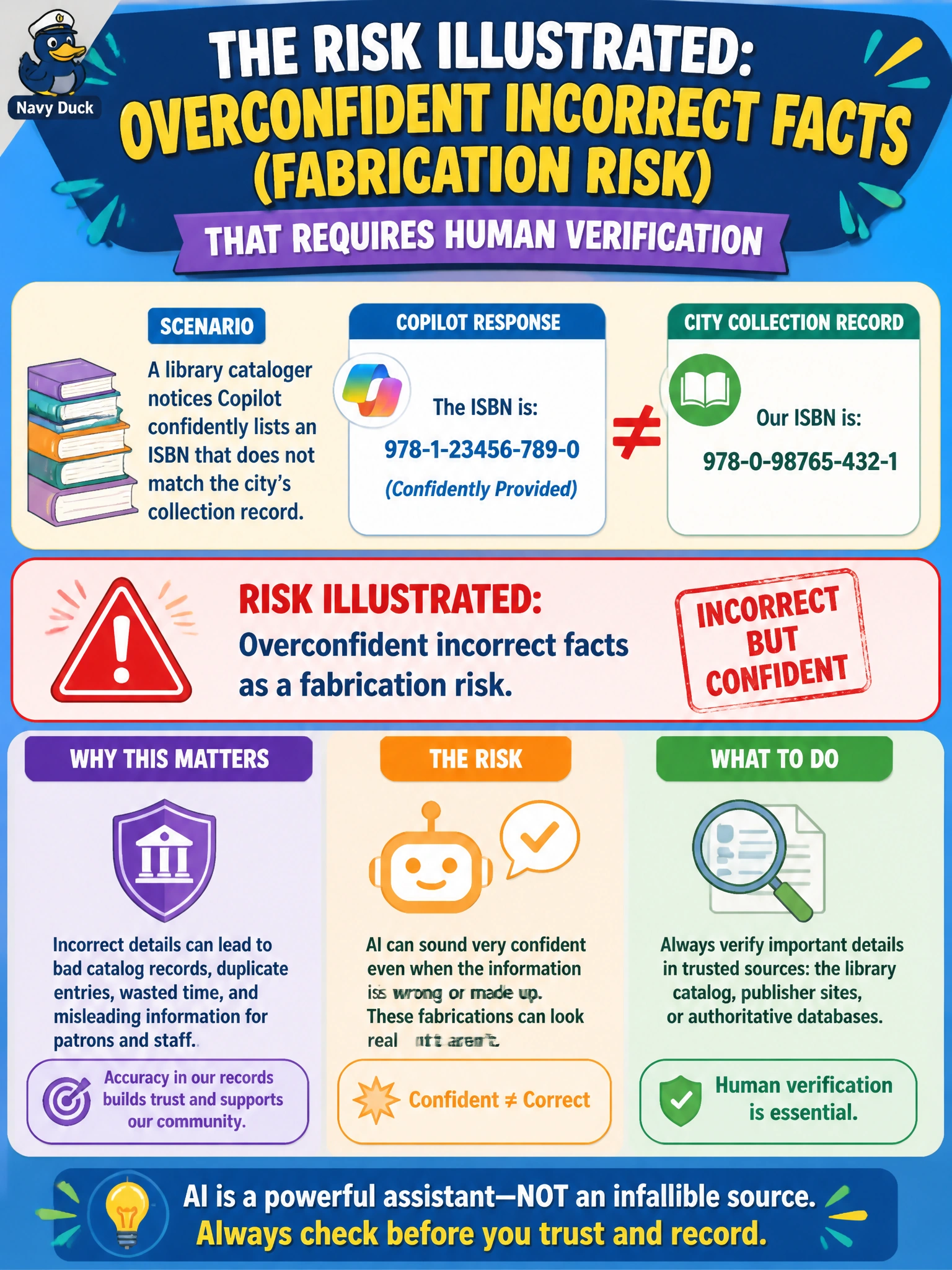
A library cataloger notices Copilot confidently lists an ISBN that does not match the city’s collection record. What risk does this illustrate?
Select an answer to reveal the explanation.
Short Explanation
Confidence isn’t accuracy. Copilot can sound sure about an ISBN and still be wrong for your catalog. Treat flashy metadata as a lead to check, not a stamp of truth.
Full Explanation
A library cataloger seeing Copilot confidently list an ISBN that does not match the city’s collection record illustrates overconfident incorrect facts as a fabrication risk that requires human verification. Confident tone is not evidence. Municipal catalog metadata must match authoritative collection systems; generative footnotes can invent plausible ISBNs that mislead patrons and staff.
Prompt injection that only affects ISBNs stored in sealed court folders mislabels the risk and invents a court-folder constraint the stem does not describe. The issue is false metadata, not injected instructions targeting sealed folders.
Proof that Copilot bypassed library permissions to invent a more modern catalog record confuses access control with hallucination. Inventing an ISBN does not demonstrate permission bypass.
Evidence that Outlook Copilot is required to validate every library metadata field invents an irrelevant app mandate. Validation belongs with catalog systems and human catalog review, not with forcing Outlook Copilot into metadata QA.
Exam caveat: confident wrong facts map to fabrication/overconfidence, not to injection, permission bypass, or a specific Copilot host requirement.
Operational check: compare the ISBN to the city’s integrated library system record before updating catalogs or public displays; if it mismatches, reject the Copilot suggestion and retain the authoritative collection metadata.