
A planning commissioner reads a Copilot brief that names a zoning hearing date the packet never stated. How should the commissioner treat that detail?
Select an answer to reveal the explanation.
Short Explanation
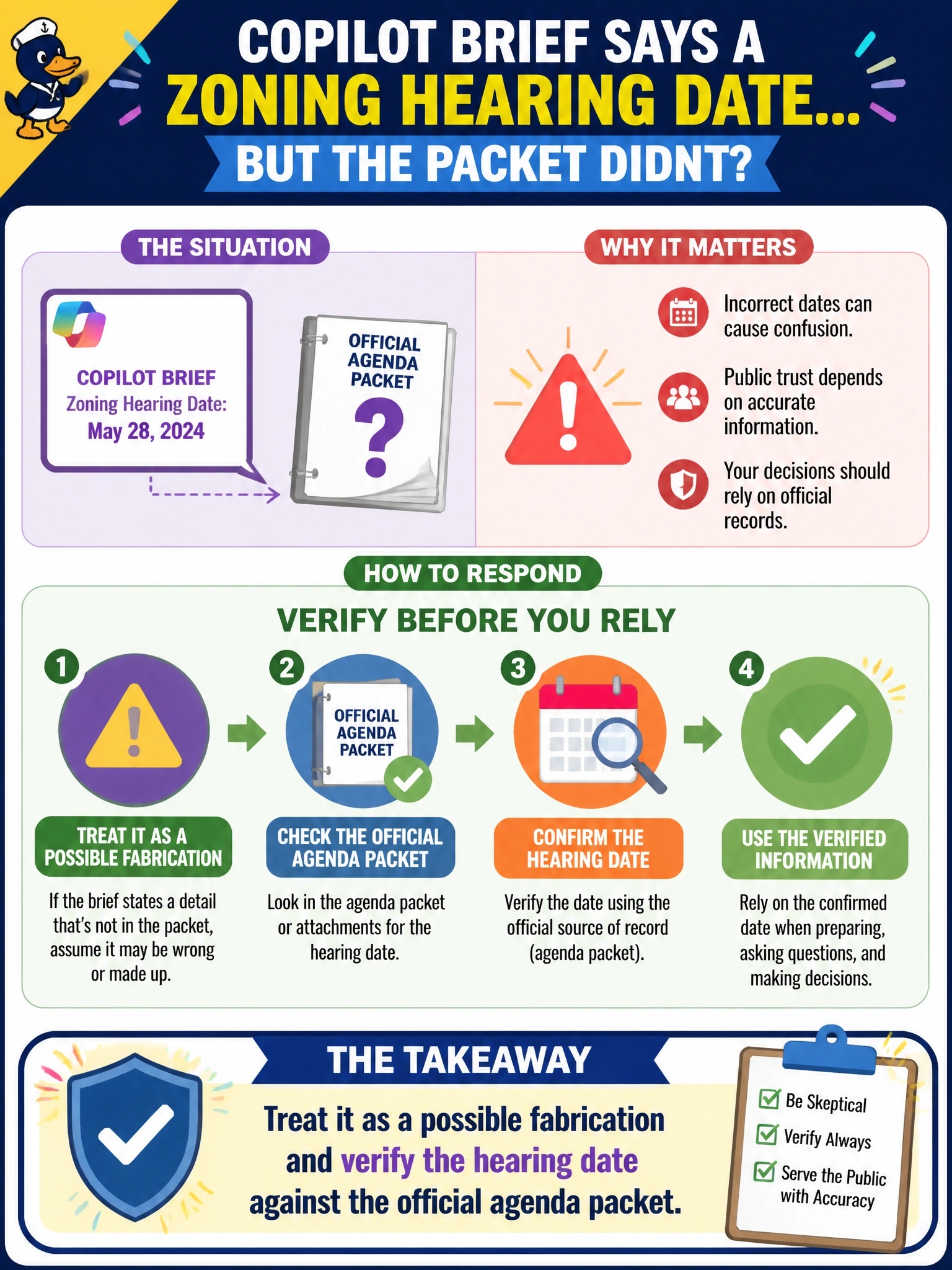
If the hearing date isn’t in the packet, Copilot may have made it up — politely, but still made it up. Check the official agenda before anyone blocks a Thursday on the calendar.
Full Explanation
The planning commissioner should treat the zoning hearing date as a possible fabrication and verify it against the official agenda packet. When a Copilot brief names a date the packet never stated, the responsible response is skepticism plus source check—not publication. Calendar details for municipal hearings affect public notice and due process expectations, so invented dates are high-impact errors.
Accepting the date because generative AI never invents calendar details fails outright: generative systems can invent dates, times, and hearing identifiers.
Assuming Copilot pulled the date from another city’s open-data portal and publishing immediately fails both verification and jurisdiction control. Even if a date existed elsewhere, it is not authoritative for this city’s packet, and immediate publication without checking planning staff is unsafe.
Converting the invented date into a Teams meeting without checking planning staff calendars operationalizes the fabrication and risks notifying the wrong public window.
Exam caveat: for “Copilot stated X that the packet never stated,” prefer verify-against-authoritative-source options over accept, publish, or schedule actions.
Operational check: open the official zoning agenda packet and planning calendar; confirm the hearing date with planning staff before any commissioner briefing, public notice, or Teams invite uses that date.