
A water-billing lead wants standing tone rules applied every time residents get payment-plan explanations. Why choose an agent over freeform chat?
Select an answer to reveal the explanation.
Short Explanation
Chat is a sticky note you write once; an agent is the laminated checklist taped to the counter. Standing tone rules for payment-plan letters belong on that checklist—the agent—so they don't get forgotten.
Full Explanation
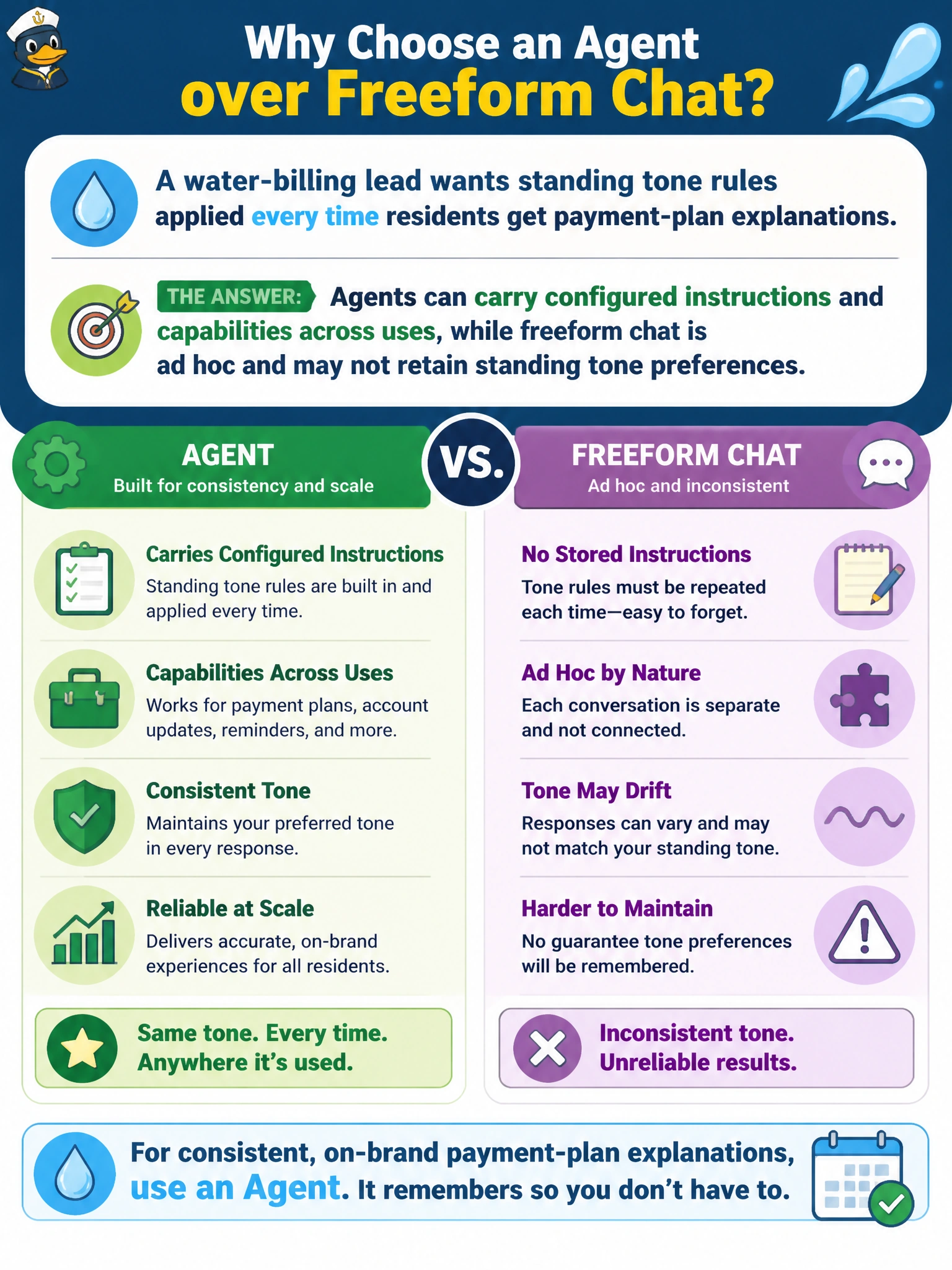
Agents can carry configured instructions and capabilities across uses, while freeform chat is ad hoc and may not retain standing tone preferences. A water-billing lead who needs the same plain, respectful tone every time residents receive payment-plan explanations should encode those rules in an agent so the guidance persists beyond a single conversation. That is the core reason to choose an agent over hoping each new chat remembers utility tone standards.
Freeform chat permanently storing tone rules for every future user in the utility fails because ad-hoc chat is not the durable, shareable instruction store for standing preferences. Agents cannot follow instructions and only generate random billing slogans fails by denying the instruction-following purpose of configured agents. Enforcing tone only by turning off Microsoft 365 entirely fails as a false dichotomy; tone guidance belongs in agent instructions and editorial review, not in disabling the productivity suite.
Exam caveat: Standing instructions improve consistency but do not replace human review for sensitive billing hardship communications. Agents can drift if knowledge or instructions are outdated.
Operational check: Capture approved payment-plan tone and required disclosures as agent instructions, ground the agent on the utility's billing FAQ, have leads sample outputs weekly, and escalate edge-case hardship letters to human review before sending.