
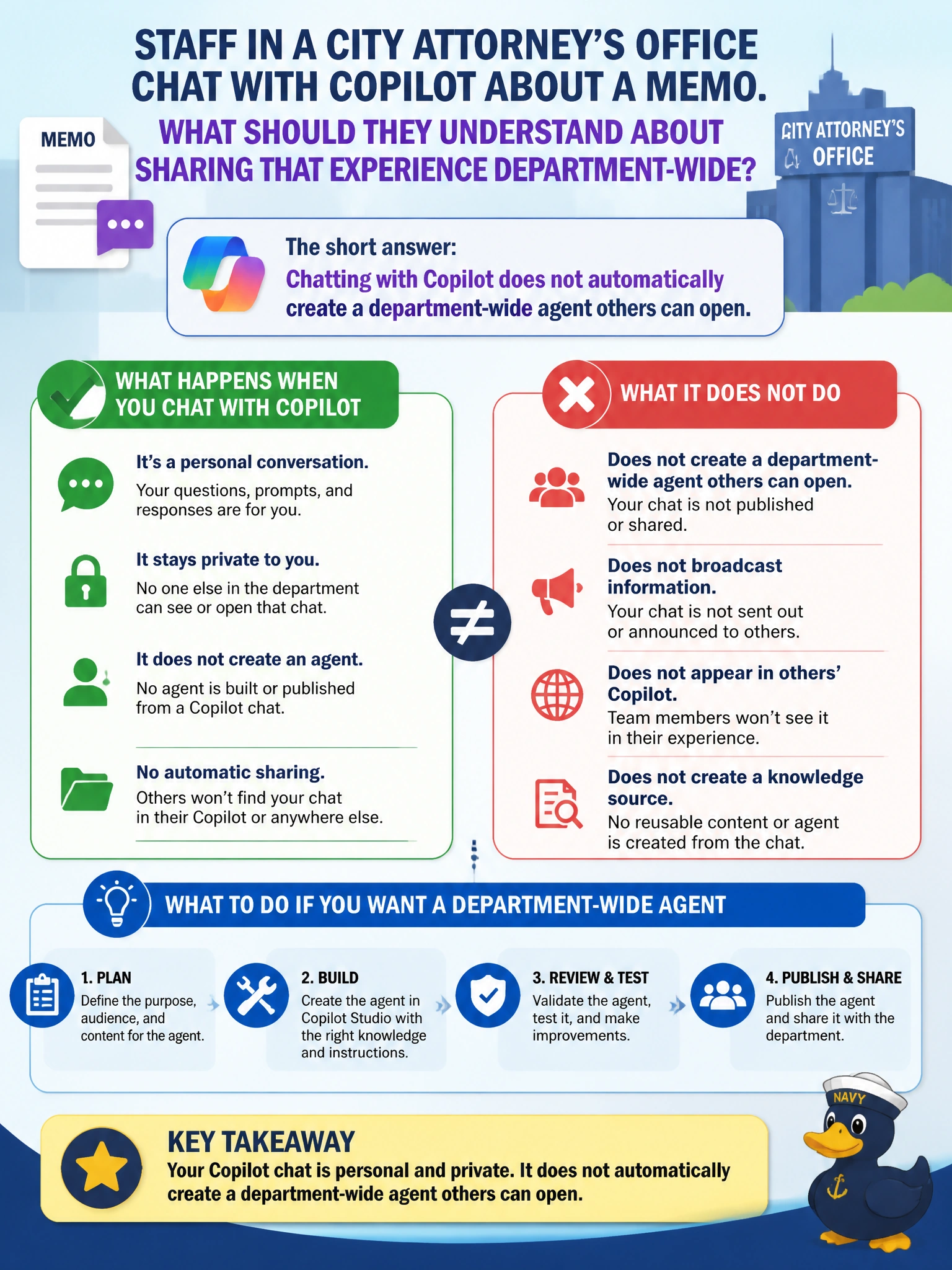
Staff in a city attorney's office chat with Copilot about a memo. What should they understand about sharing that experience department-wide?
Select an answer to reveal the explanation.
Short Explanation
Having a private hallway conversation isn't the same as posting a new help desk for the whole legal department. A Copilot chat stays a chat until someone actually builds and shares an agent.
Full Explanation
Chatting with Copilot does not automatically create a department-wide agent others can open. Staff in a city attorney's office discussing a memo in chat are having a conversation experience, not publishing a reusable municipal agent. Sharing an AI experience department-wide requires deliberate agent creation, configuration, and sharing—not merely typing in chat. That distinction protects the office from assuming private memo exploration somehow became a firm-wide bot.
Every chat automatically becoming a published department agent within one minute fails because chat threads are not auto-published agents. Chatting permanently deleting the ability to create agents later fails as an invented penalty; using chat does not revoke agent-creation capability. A single chat thread automatically visible to every employee in the city tenant fails because ordinary Copilot chat is not a tenant-wide broadcast of the conversation.
Exam caveat: Chat history and organizational compliance features (retention, eDiscovery) may still apply under tenant policy—"not a published agent" is not the same as "invisible to all governance." Keep confidential memo content inside approved channels.
Operational check: Use chat for memo exploration; if the office needs a reusable helper for standard memo formats or citation libraries, explicitly create and share an agent with the right audience and knowledge sources rather than assuming chat already did that.