
Woodgrove Bank operates three regional offices: East, West, and Central. Each region has its own IT support team that needs to manage password resets, group memberships, and user account properties — but only for users in their own region. The global IT team wants to ensure that the East IT team cannot accidentally modify a Central region user account. What should the Microsoft Entra administrator configure?
Select an answer to reveal the explanation.
Short Explanation and Infographic
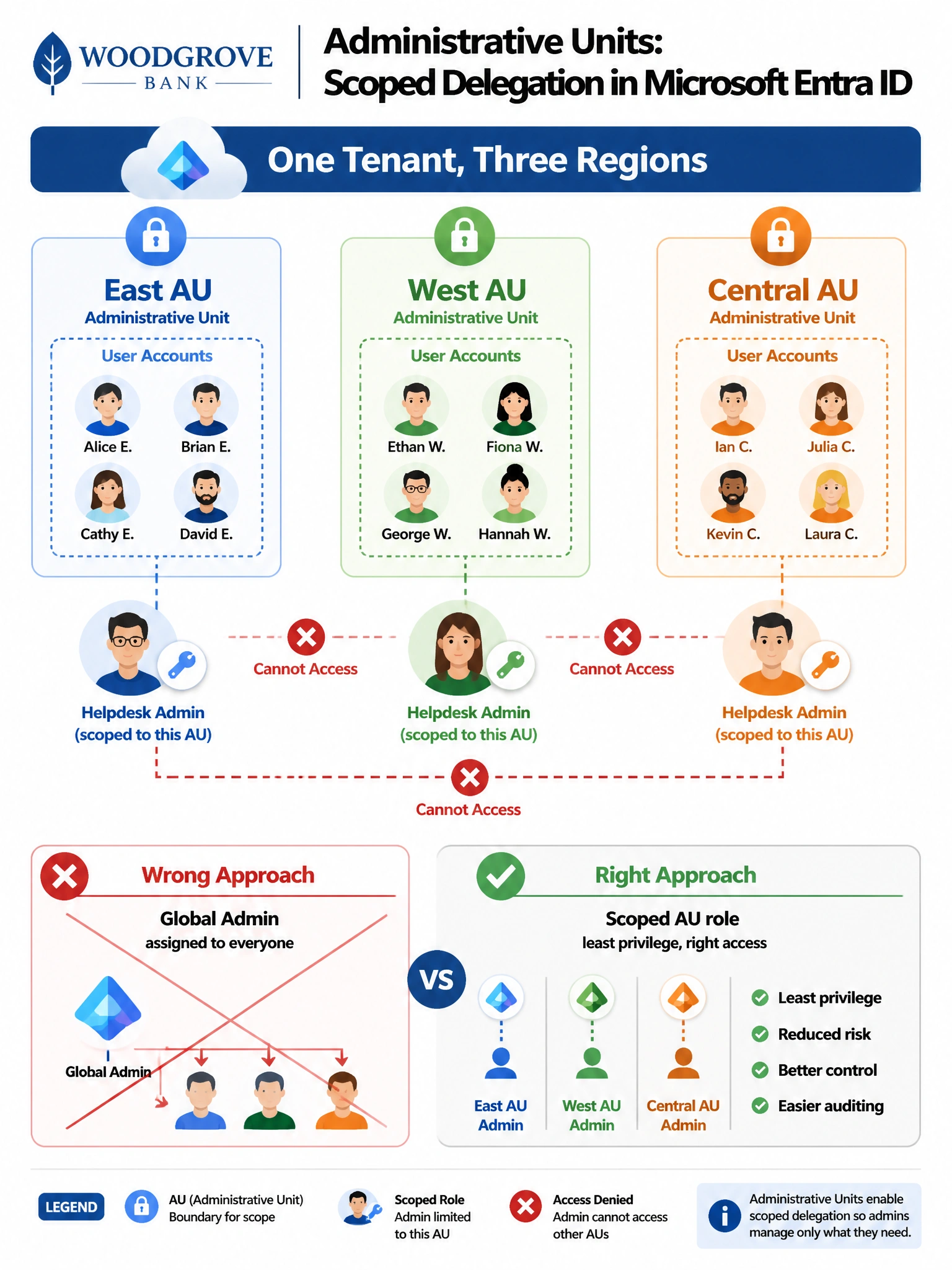
Administrative units are like department filing cabinets with a lock — only the person with the key for that cabinet can open it. You put each region's users in their own AU, then hand the right IT person only the key to that AU. They can manage everything inside their cabinet but can't even see what's in the others.
Full explanation below image
Full Explanation
The correct answer is C. Administrative units (AUs) in Microsoft Entra ID are containers that enable scoped, delegated administration. By placing each region's users into their own AU and assigning directory roles (such as Helpdesk Administrator, User Administrator, or Password Administrator) scoped to that specific AU, the East IT team's admin rights are limited exclusively to East region users. They cannot accidentally — or intentionally — modify users in other AUs. This is the purpose AUs were designed for.
Option A is wrong because creating separate Azure AD tenants for each region would create massive management overhead, complicate licensing, and break unified identity. Cross-tenant sync is a workaround for multi-tenant scenarios, not a delegation solution within a single organization. The exam tests whether you know the right tool for the right problem.
Option B is wrong because group ownership only allows someone to manage the group's membership list — who's in the group. It does not give the IT team the ability to reset passwords, update user profile attributes, enable/disable accounts, or perform other helpdesk tasks that require directory roles. It solves the wrong problem.
Option D is wrong for an obvious but important reason: Global Administrator is the most powerful role in Microsoft Entra, with unrestricted access to everything in the tenant. Assigning it broadly and trusting people to stay in their lane violates the principle of least privilege and would be flagged immediately in any security review. AUs exist precisely so you don't have to rely on trust instead of technical controls.
Exam tip: Whenever you see a question about limiting administrative scope within a single tenant by organizational boundary (region, department, subsidiary), the answer is almost always Administrative Units with scoped role assignments.