
An organization maintains a fleet of 12 Copilot Studio agents across three business units (HR, Finance, IT). Each business unit has its own Development and Production environment pair. A new tenant-wide security requirement mandates that all agents must incorporate a centrally managed 'Security Disclaimer' topic that shows a compliance message at the start of every conversation. This disclaimer topic must be versioned centrally and updated simultaneously across all 12 agents when the legal team revises the message. Which ALM architecture best satisfies this requirement while minimizing deployment risk?
Select an answer to reveal the explanation.
Short Explanation and Infographic
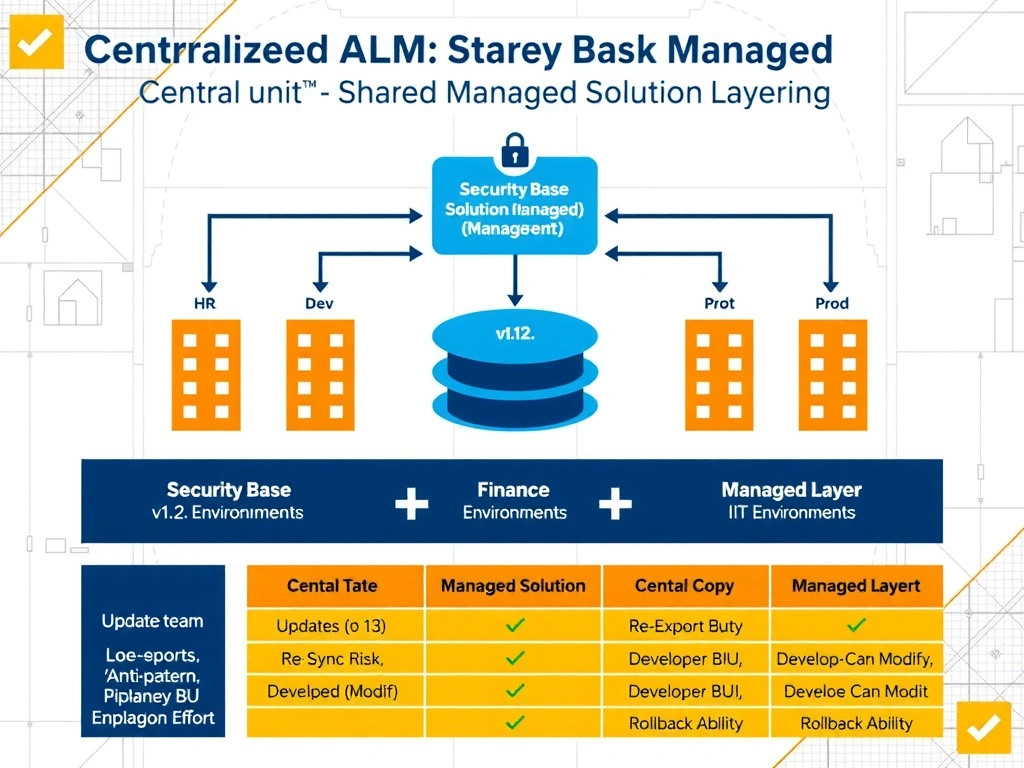
Think of the shared managed solution as a franchise operations manual — the franchisor (central team) maintains the master rules, and every franchise location (business unit agent) runs on top of those rules without owning or modifying them. When the franchisor updates page 1, every location gets the update automatically on next import, with no need to touch each franchise individually.
Full explanation below image
Full Explanation
This question tests your understanding of Power Platform solution layering as an ALM governance tool for multi-tenant, multi-team agent fleets. The requirement — centrally version a shared component and push updates to many agents simultaneously — is precisely what the managed solution layering architecture is designed to solve.
The correct architecture (Option B) works as follows: A central team creates a 'Security Base' solution in a dedicated centralized environment containing only the Security Disclaimer topic. This solution is exported as a managed solution. Each business unit's ALM pipeline imports this Security Base managed solution into their environments before (or alongside) their own agent solution. The Security Base managed layer sits beneath the business unit's agent solution layer. When the legal team revises the disclaimer, the central team increments the Security Base solution version, re-exports it as managed, and the update propagates through each business unit's ALM pipeline — requiring only a re-import of the Security Base managed solution, not a redeployment of the business unit's own agent solution.
Because the Security Base is a managed solution, business unit developers cannot modify the disclaimer topic in their environments — it is locked. This enforces the 'centrally controlled' requirement without depending on developer discipline.
Option A (manual copy to all 12 agents) is the anti-pattern this architecture is designed to avoid. Manual copying creates 12 independent copies that drift out of sync over time. When the legal team revises the disclaimer, someone must manually update all 12 copies — and there is no mechanism to ensure this happens correctly or simultaneously. This is high-risk operational overhead.
Option C (environment variables via Power Automate) is creative but architecturally fragile. It introduces a runtime dependency (the flow call) into every conversation start, adding latency and a failure mode. If the flow fails or the environment variable is misconfigured, users see no disclaimer at all — a compliance failure. It also does not provide version control or rollback of the disclaimer content.
Option D (single enterprise Production environment) eliminates business unit isolation, which almost certainly violates the security and data separation requirements that motivated per-business-unit environments in the first place. Collapsing 12 agents into one environment to solve a disclaimer update problem is an extreme and destructive solution that creates far more governance problems than it solves.
Exam tip: Whenever an exam question describes a 'centrally managed shared component that must propagate to many agents/solutions,' think managed solution layering. The pattern is: shared component → managed solution → imported as base layer → business unit solution sits on top. This is the Power Platform ALM answer for shared governance at scale.