
A retail company is building a Copilot Studio multi-agent solution. An intake agent receives all customer messages and must route them to one of three specialized agents: a returns agent, an order-tracking agent, or a product-recommendations agent. The routing decision must be based on the semantic meaning of the customer's message, not keyword matching. The intake agent must also maintain conversation context so routed agents can access prior turns. Which design approach satisfies both requirements?
Select an answer to reveal the explanation.
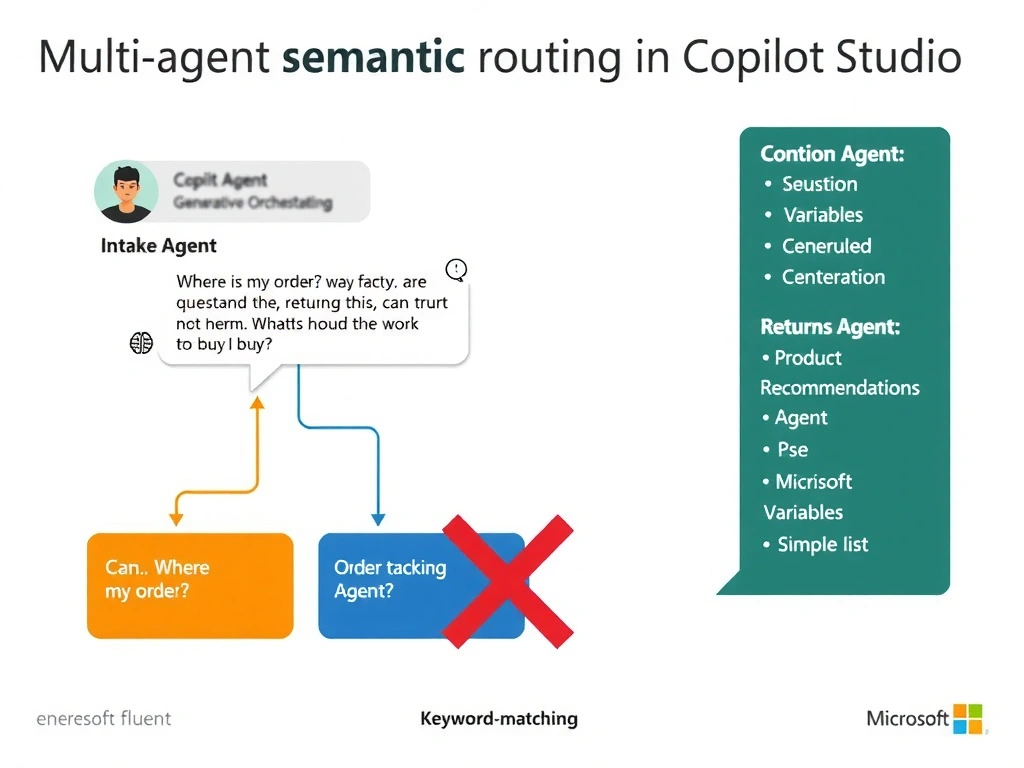
Short Explanation and Infographic
Trigger phrases are like a menu — they only work if the customer uses the right words. Generative orchestration is the smart maître d' who understands what the customer actually wants even if they phrase it differently. When semantic routing is required, the intake agent's generative AI orchestration mode is the right tool, and conversation variables carry context forward to the sub-agent. That combo is the exam answer when you see 'semantic meaning' plus 'maintain context'.
Full explanation below image
Full Explanation
Copilot Studio's generative AI orchestration mode uses the underlying language model to evaluate incoming messages and determine which topic or sub-agent to invoke — this is fundamentally different from keyword and trigger-phrase matching. When a question specifies routing based on 'semantic meaning,' generative orchestration is always the correct mechanism.
Option C is correct because enabling generative orchestration on the intake agent allows it to classify the customer's intent using natural language understanding rather than pattern matching. The intake agent can then invoke the appropriate specialized agent as a sub-topic and pass conversation variables (including prior turns) as parameters, preserving the context the downstream agent needs to respond coherently.
Option A is incorrect because trigger phrase matching is a deterministic pattern-recognition approach. It fails for semantically equivalent messages that use different vocabulary (e.g., 'Where is my package?' vs. 'Can you track my shipment?'). The requirement explicitly calls out semantic routing, which eliminates this option.
Option B is incorrect because using a Power Automate switch statement is also a form of keyword or rule-based routing. It moves the same limitation into a flow rather than solving it. Additionally, calling HTTP endpoints for each specialized agent bypasses Copilot Studio's native A2A invocation mechanism, losing built-in context propagation and error handling.
Option D is incorrect because cross-environment agent invocation is not a supported routing pattern in Copilot Studio. Agents in separate environments cannot natively invoke each other as sub-agents in a conversational flow. Routing based on account type via Dataverse also does not address the semantic intent classification requirement stated in the scenario.
Exam tip: Copilot Studio has two orchestration modes — trigger-phrase (classic) and generative AI. Questions mentioning 'intent,' 'semantic meaning,' or 'natural language routing' always point to the generative mode. Questions where routing must follow strict deterministic rules (e.g., 'If account type is premium, go to agent X') can use trigger phrases or conditions.