
Alpine Ski House is establishing governance for their Copilot Studio agent development lifecycle. The organization wants to ensure that: (1) makers can freely build and modify the agent in one environment, (2) testers can validate agent behavior without risk of changes from makers, and (3) end users interact only with a stable, approved version. Which environment architecture satisfies all three requirements?
Select an answer to reveal the explanation.
Short Explanation and Infographic
Think of it like a car assembly line: the factory floor (Dev) is where parts get built and modified constantly, the quality control station (Test) checks finished cars without anyone welding on them, and the showroom (Prod) is what customers actually see. Mixing any two of those stations defeats the purpose of having them at all.
Full explanation below image
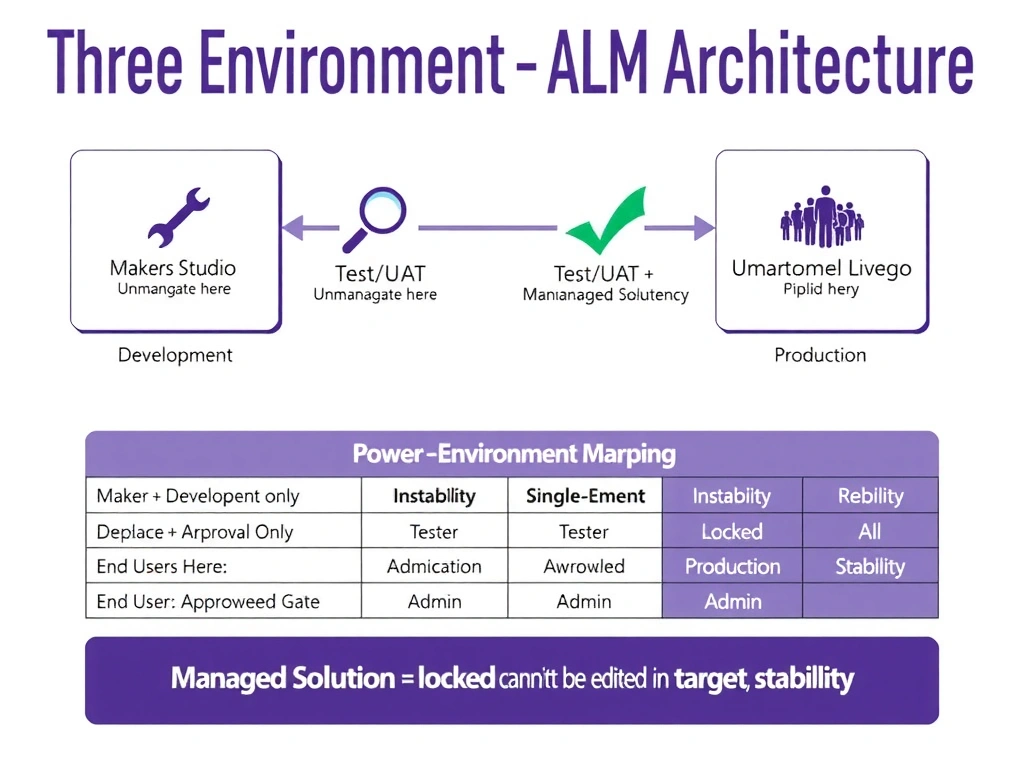
Full Explanation
The standard Power Platform ALM pattern uses three separate environments: Development, Test (or UAT), and Production. Each environment serves a distinct and isolated role:
Development is the active build environment. Makers have write access to agents, topics, flows, and configurations. Change frequency is high, and the environment may be unstable during active development.
Test (UAT) is the validation environment. Makers deploy managed solutions here via pipeline. Testers interact with the agent as end users would, but makers cannot directly edit components — the agent is deployed as a managed solution, protecting its integrity during testing.
Production is the live environment for end users. Only approved, fully tested managed solutions are deployed here via pipeline with approval gates. Makers and testers have no direct write access to the production environment's agent configuration.
Option A (single environment) is incorrect. A single environment cannot simultaneously support active development, isolated testing, and stable user access. Changes made by makers would immediately affect testers and users, creating instability and audit concerns.
Option B (two environments: Dev/Test + Production) is partially correct architecturally but does not satisfy requirement 2. If makers are building in the same environment where testers are validating, a maker's mid-session change could invalidate a tester's active test run. The three-environment model prevents this.
Option D (Dev + Production with Test pane as testing) is incorrect. The Test pane in Copilot Studio is a maker tool for rapid iterative testing during development — it does not provide the isolated, production-equivalent validation environment that formal QA requires.
For the AB-620 exam: the three-environment model (Dev, Test, Production) is the Microsoft-recommended architecture for Power Platform ALM. The key differentiators are: Development = unmanaged solutions, active editing; Test/Production = managed solutions, no direct edits, deployed via pipeline.