
A Contoso customer support agent is generating responses that sometimes include product pricing not found in the company knowledge base. The QA lead wants to implement a systematic metric to detect when the agent fabricates information not supported by its retrieved source documents. Which evaluation metric should the QA lead configure in Azure AI Foundry to address this concern?
Select an answer to reveal the explanation.
Short Explanation and Infographic
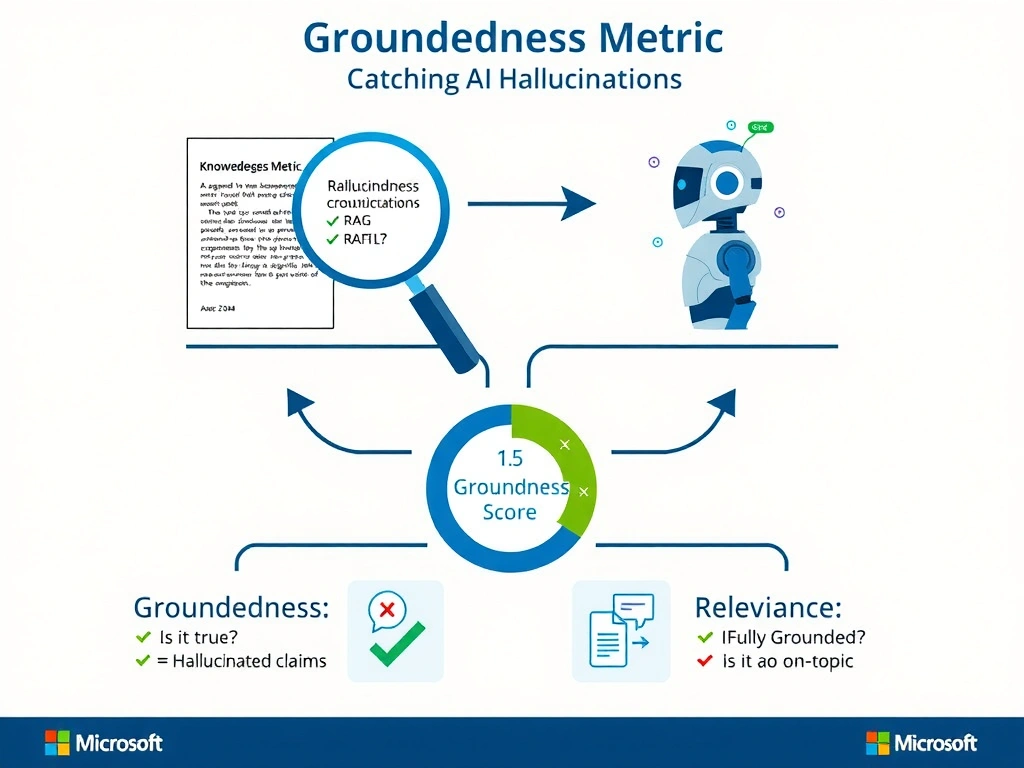
Think of groundedness like a fact-checker with a highlighter — it reads every claim the agent makes and asks 'can I find this in the source documents?' Relevance is about answering the right question; groundedness is about not making things up. When an agent invents pricing, that is a groundedness failure, not a relevance failure.
Full explanation below image
Full Explanation
Groundedness is an AI quality metric that evaluates whether every factual claim in an agent's response can be traced back to the content it retrieved from its knowledge sources. A response can be highly relevant to the user's question yet still be ungrounded if the agent supplements retrieved facts with hallucinated details — a pattern that is especially dangerous in domains like pricing, compliance, or medical information.
In Azure AI Foundry, the groundedness evaluator compares the agent's output against the source documents passed through retrieval-augmented generation (RAG). It assigns a score — typically 1 to 5 — indicating how well the response is anchored to the retrieved context. A score of 1 means the response contains claims not present in any source; a score of 5 means every claim is directly traceable.
Option A (relevance) is incorrect. Relevance measures how well the response addresses the user's question, not whether the facts are sourced. An agent could give a very relevant answer that still invents data. These are complementary but distinct metrics.
Option C (CSAT) is incorrect. Customer Satisfaction scores reflect user perception after the conversation and are not a technical measurement of factual accuracy. A user might rate an incorrect answer highly if it sounds confident.
Option D (escalation rate) is incorrect. Escalation rate is an operational KPI tracking how often conversations exceed the agent's capability. It does not evaluate the factual correctness of responses that the agent does provide.
For the AB-620 exam, remember that groundedness and relevance are the two primary AI quality metrics used in Azure AI Foundry evaluations. Groundedness = 'Is it true?' Relevance = 'Is it on-topic?' When the scenario describes an agent making up information, groundedness is always the answer.