
A Copilot Studio developer is building an HR agent that should dynamically answer questions from a SharePoint knowledge base without requiring a pre-built topic for every question. The agent should also fall back gracefully to a predefined response when no relevant information is found in the knowledge base. The developer enables generative answers. Which mode should be selected, and what fallback behavior should be configured?
Select an answer to reveal the explanation.
Short Explanation and Infographic
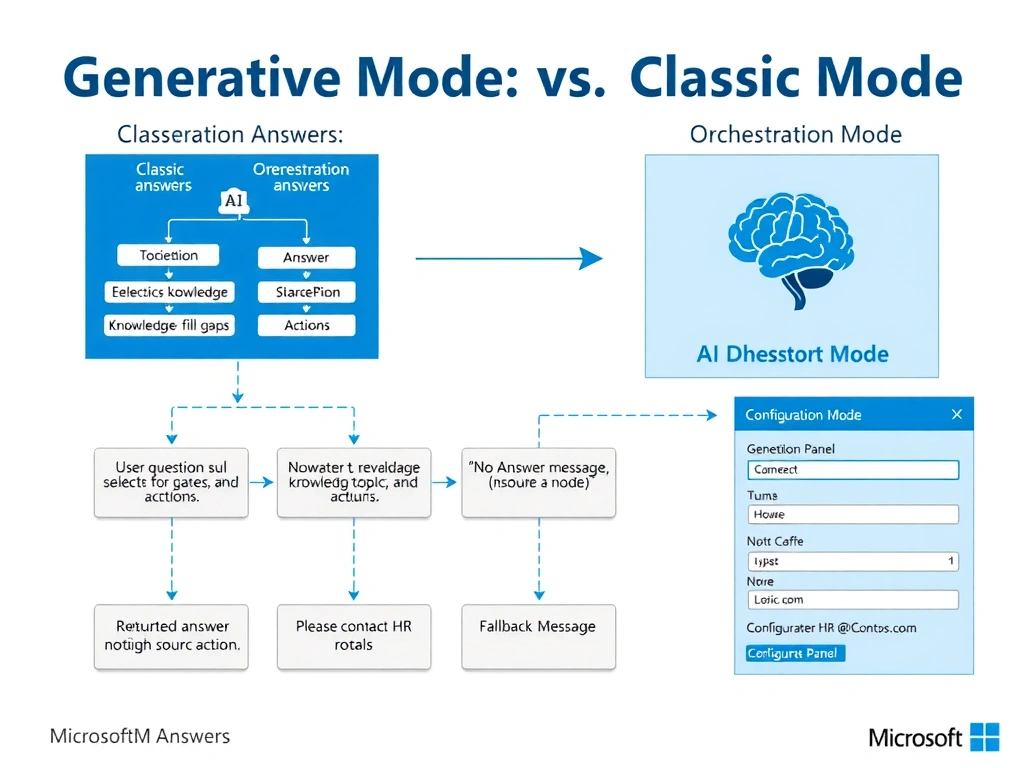
Orchestration mode is the AI-first lane — it lets the agent roam freely across topics and knowledge without a rigid decision tree. When the AI draws a blank, the fallback message is the safety net that keeps users from hitting a dead end. Without it, users see silence; with it, they see a helpful next step.
Full explanation below image
Full Explanation
Copilot Studio's generative answers feature operates in two modes. Classic mode uses the traditional topic-matching flow enhanced with generative answers — the agent first tries to match a topic, and generative answers fill in when no topic matches. Orchestration mode (also called Generative Orchestration) lets the AI dynamically decide which topics, knowledge sources, and actions to invoke for each user utterance, without requiring every question to have a pre-built topic. For an HR agent answering diverse questions from SharePoint, Orchestration mode is the appropriate choice.
In Orchestration mode, when no relevant content is found in the configured knowledge sources, the agent will return an empty or unclear response unless a fallback is configured. Best practice is to configure a fallback message (e.g., 'I couldn't find information on that topic. Please contact HR directly.') or redirect to a dedicated topic that provides alternative guidance.
Option A is incorrect because Classic mode requires pre-built topics for most flows. While the Escalate system topic is used for agent handoff, it is not the right fallback for a 'no knowledge found' scenario — escalation implies human agent transfer, not a simple 'no answer' response.
Option B is incorrect because Classic mode does not always generate an answer. It only generates answers when matching content is found in enabled knowledge sources. An empty knowledge result can still produce a blank response in Classic mode.
Option C is incorrect because redirecting to the Escalate topic on every 'no answer' situation would route users to live agents for all unanswerable questions, which is operationally expensive and unnecessary for many HR queries that simply need a 'please check the portal' message.
Exam tip: Know the difference between Orchestration mode (AI-driven topic selection) and Classic mode (rule-driven topic matching with AI gap-filling). This distinction appears in both scenario and definition questions.