
A company is deploying a Copilot Studio agent to answer employee questions from a large internal knowledge base. The product owner wants the agent to dynamically select the best source—whether a knowledge base article, a Power Automate flow, or a topic—to answer each question without requiring explicit topic triggers. Which node type and mode should the developer configure to achieve this behavior?
Select an answer to reveal the explanation.
Short Explanation and Infographic
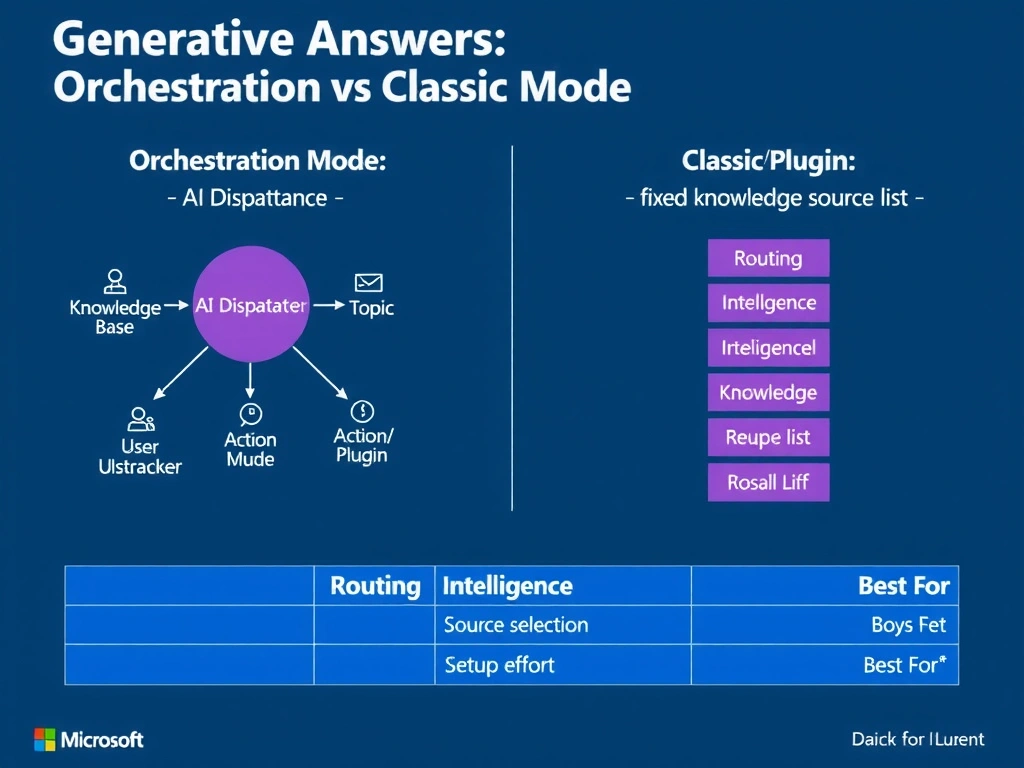
Orchestration mode is like having a smart dispatcher who reads every incoming call and decides on the fly whether to send it to the knowledge base, a topic, or an action—without you having to pre-build every decision tree.
Full explanation below image
Full Explanation
Copilot Studio's Generative answers node can operate in two modes: Classic and Orchestration. Orchestration mode is the more powerful of the two—it uses a large language model (LLM) to interpret the user's intent and dynamically route the request to the most appropriate resource, which may be a knowledge source, a defined topic, or an action (such as a connector or plugin). This eliminates the need to write exhaustive trigger phrase lists for every possible user question.
Option C is correct because Orchestration mode is specifically designed for scenarios where the agent must intelligently select between multiple resources at runtime. The developer does not need to pre-map every utterance; the AI handles disambiguation automatically.
Option A is wrong because a Question node with Multiple Choice branches requires the developer to enumerate every possible choice in advance and forces users to select from a menu. This is rigid and does not scale to a large knowledge base.
Option B is wrong because adding Condition nodes after topics creates a reactive check but still requires topics to be explicitly triggered first. It does not enable proactive dynamic routing.
Option D is wrong because using the Fallback topic as the primary routing mechanism is an anti-pattern for general query handling. Fallback fires only when no topic matches, making it a last-resort handler—not a dynamic orchestrator. It also adds unnecessary latency and complexity via Power Automate for every query.
Exam tip: Orchestration mode is the go-to answer whenever the scenario requires the agent to 'decide on its own' what to do with an utterance. Classic mode is appropriate when the developer wants to control the exact knowledge sources used and have more predictable, scoped responses.