
You are building a Company Hub agent and want to reuse the existing 'Benefits Enrollment' agent that was built by the HR team. Rather than rebuilding the HR logic, you want the Company Hub agent to simply hand off relevant conversations to the Benefits agent. What configuration step enables this specific routing?
Select an answer to reveal the explanation.
Short Explanation and Infographic
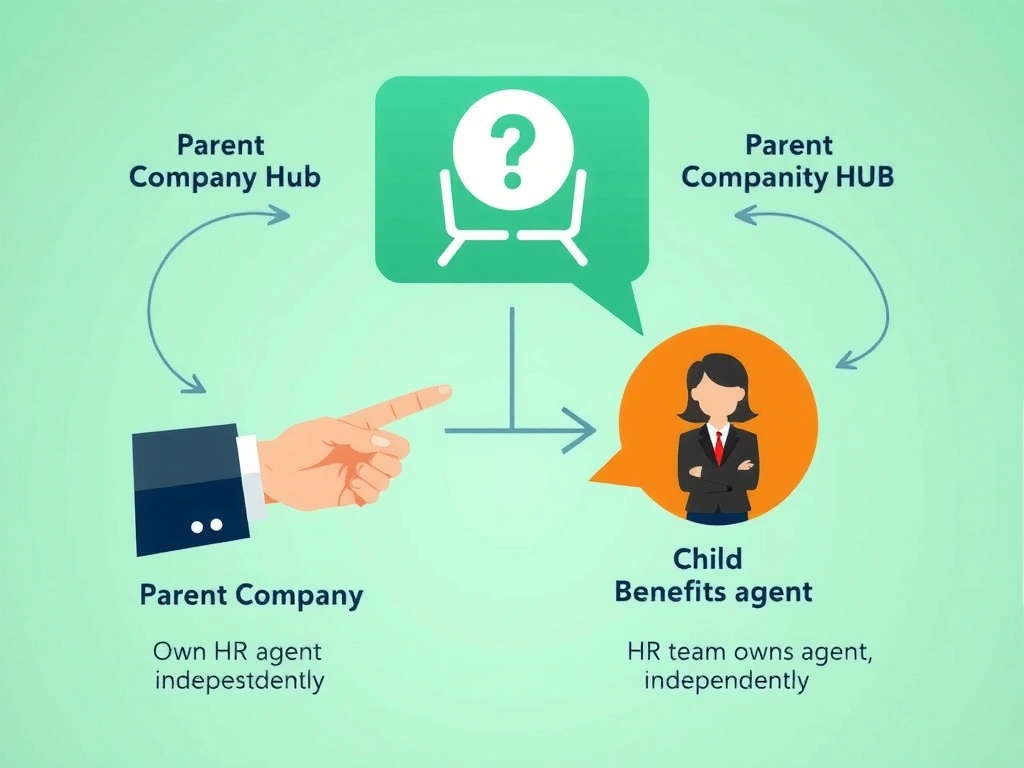
The child agent pattern is the way to reuse without rebuilding — add the Benefits agent as a recognized child of the Company Hub agent, and let the orchestration layer route 'benefits enrollment' conversations right to it. The HR team owns their agent, and the Company Hub just holds the door open.
Full explanation below image
Full Explanation
The multi-agent architecture in Copilot Studio allows a parent (orchestrator) agent to delegate conversations to child agents. To implement this, you add the existing Benefits Enrollment agent as a child agent in the Company Hub agent's configuration. Once registered, you can configure routing in two ways: 1) Generative orchestration — the AI automatically routes benefit-related queries to the child based on semantic intent matching against the child agent's description, or 2) Explicit redirect — you add a 'Redirect to agent' node in specific topics that explicitly hands off to the child.
This approach preserves separation of ownership — the HR team continues to develop and maintain the Benefits agent independently, while the Company Hub simply references it.
Option A (copy all topics) breaks the separation of concerns. The Benefits agent's topics would become orphaned copies that drift out of sync as the HR team updates the original.
Option C (Power Automate flow + API endpoint) — Copilot Studio agents are not typically exposed as HTTP API endpoints for inter-agent calls. The native child agent integration is the correct mechanism.
Option D (Teams channel routing) — Teams channels are used for user-facing deployment, not for inter-agent communication. Two agents on the same Teams channel would both respond to messages simultaneously, creating a confusing experience.
Exam pattern: parent orchestrator + child agents = multi-agent reuse architecture.