
You are importing a company REST API into Copilot Studio using the OpenAPI specification. During import, Copilot Studio rejects the spec with a validation error. Which of the following is a documented requirement for OpenAPI specs imported into Copilot Studio?
Select an answer to reveal the explanation.
Short Explanation and Infographic
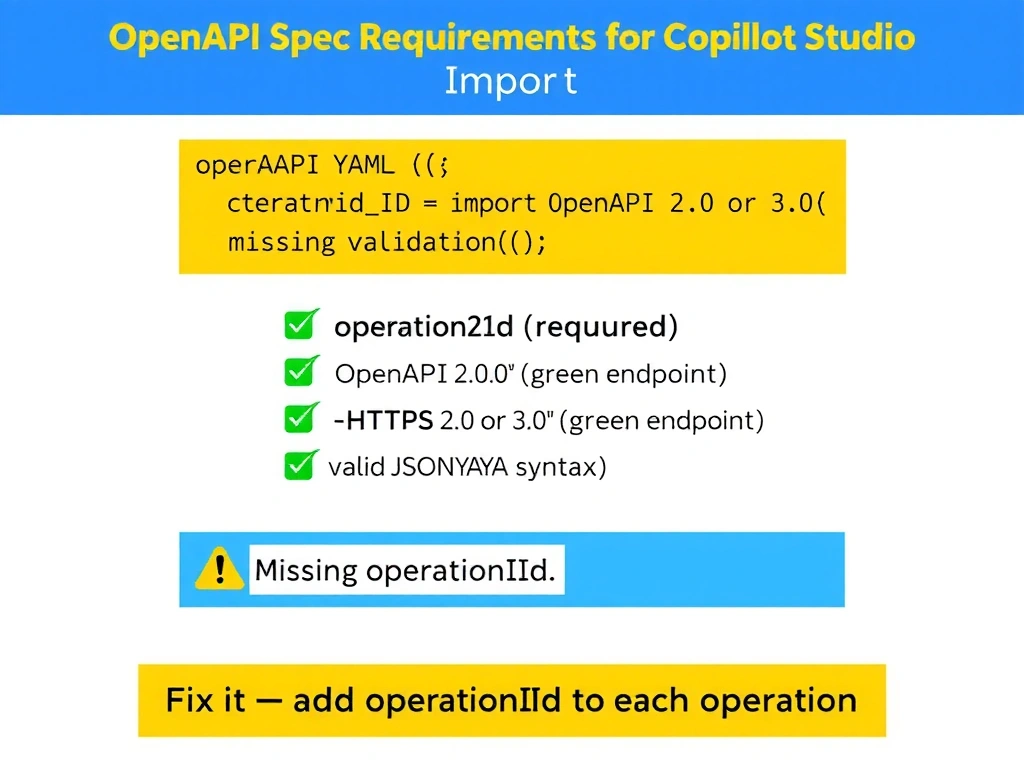
An operationId is like a name tag for each API operation — without it, Copilot Studio can't tell the operations apart or label them meaningfully in the authoring canvas. Every operation must have a unique operationId, or the import validation will reject the spec.
Full explanation below image
Full Explanation
When importing an OpenAPI specification into Copilot Studio via the REST API action, the platform validates the spec against several requirements. One critical requirement is that every operation (GET, POST, PUT, DELETE, etc.) must include a unique operationId field. This identifier is how Copilot Studio names and references each API operation as a callable action. Without it, the platform cannot create distinct, usable actions from the spec.
Additional common requirements include: the spec must be valid OpenAPI 2.0 (Swagger) or OpenAPI 3.0 format; the spec size must be within platform limits; and the spec must define at least one operation. HTTPS endpoints are strongly preferred.
Option A (OpenAPI 4.0) is incorrect — OpenAPI 4.0 does not exist as a finalized standard at the time of this exam, and Copilot Studio supports 2.0 and 3.0.
Option C (at least 10 endpoints) is fabricated — there is no minimum endpoint count requirement.
Option D (GraphQL) is completely wrong — OpenAPI specs describe REST APIs using JSON/YAML, not GraphQL syntax.
Exam tip: memorize the operationId requirement. It's the most common spec validation failure during import. If a spec fails, the first thing to check is whether all operations have unique operationId values. Other frequent issues: relative server URLs (must be absolute), unsupported authentication schemes, or malformed JSON/YAML.