
Adventure Works is deploying a customer service agent in Copilot Studio to handle refund requests up to $500. For refund requests exceeding $500, a human agent must review and approve. Which Copilot Studio feature should the architect configure to implement this human oversight requirement?
Select an answer to reveal the explanation.
Short Explanation and Infographic
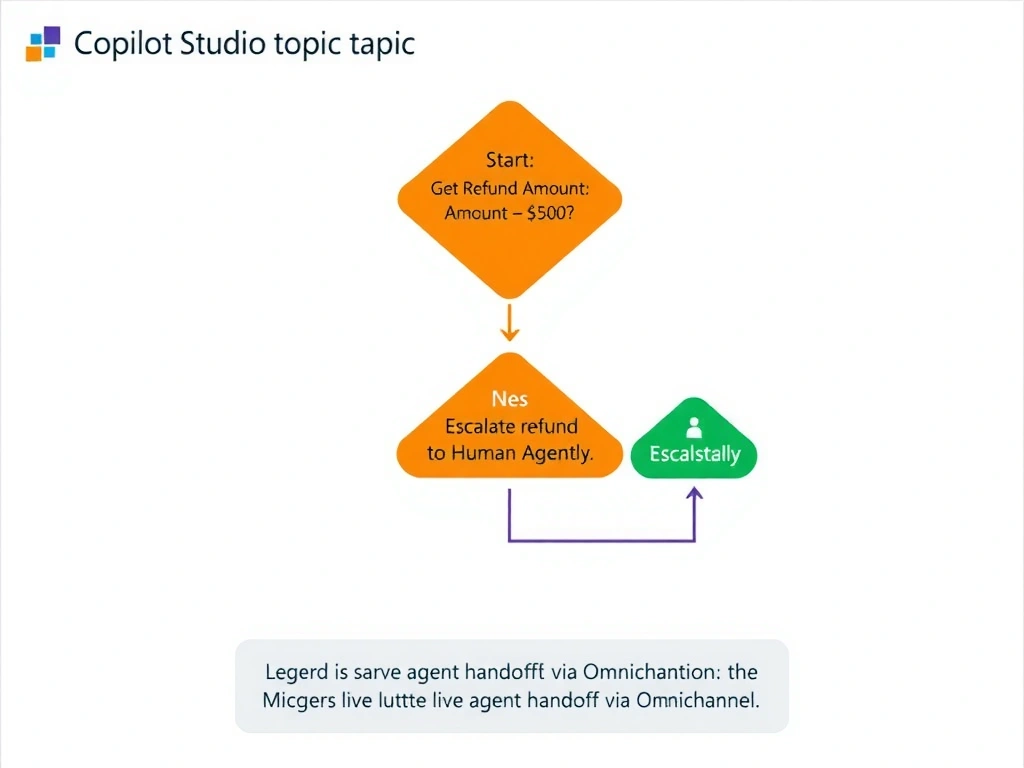
Human oversight in Copilot Studio works like a bank teller's approval limit — small transactions go through automatically, large ones need a supervisor. The right tool is a conditional branch that fires an escalation node when the amount crosses the threshold. The correct answer is A.
Full explanation below image
Full Explanation
## Why A is Correct Copilot Studio topics support conditional branching using variable values. The architect should store the refund amount in a variable, then use a condition node to check if it exceeds 500. When true, an Escalate node (or a redirect to an escalation topic) hands the conversation to a human agent via the configured escalation mechanism (e.g., Omnichannel for Customer Service).
## Why the Distractors Are Wrong B (Generative answers node): The generative answers node generates natural language responses from knowledge sources. It cannot enforce business logic thresholds or initiate a human handoff.
C (Fallback topic): The fallback topic fires when the agent cannot match any topic — it is not designed for business-rule routing based on variable values.
D (Email flow after every conversation): Post-conversation email is a notification mechanism, not a real-time oversight control. The agent would still process the $1,000 refund before the manager is notified.
## Exam Tip Human oversight in Copilot Studio = Escalate node inside a conditional branch. Remember that the Escalate node specifically signals the platform to transfer the conversation to a live agent.