
Fabrikam HR is building a Copilot Studio agent to pre-screen job applicants. During testing, the team notices that the agent consistently ranks applicants from certain zip codes lower than equally qualified candidates from other areas. Which responsible AI principle should the team prioritize to address this issue?
Select an answer to reveal the explanation.
Short Explanation and Infographic
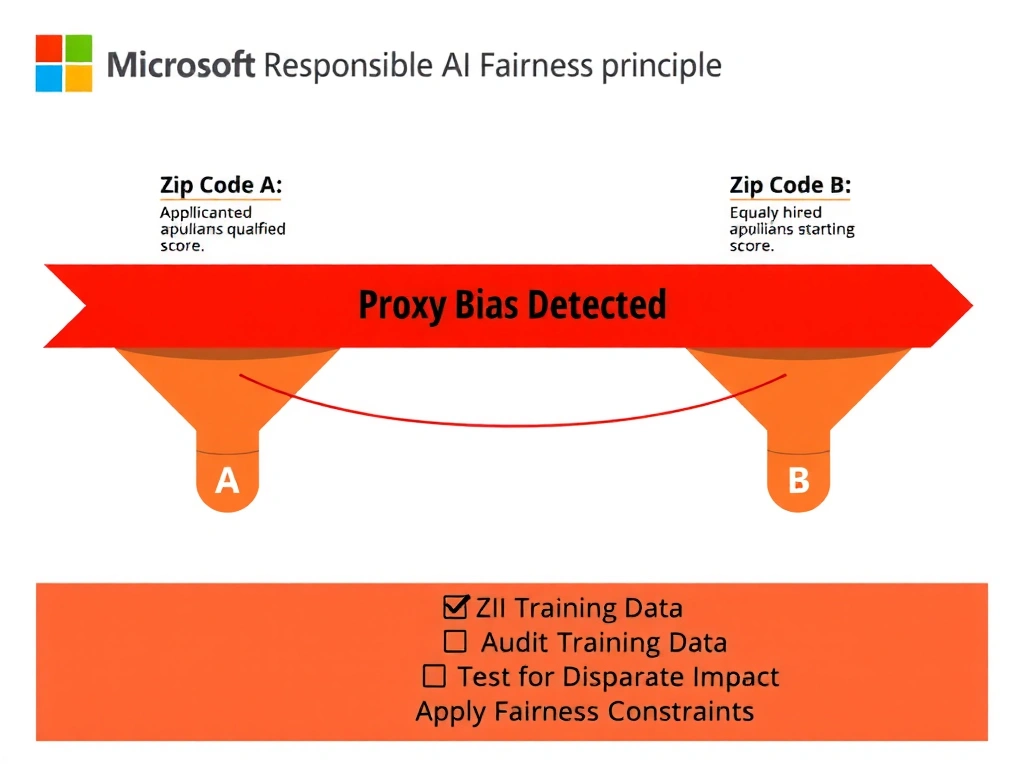
Zip code acting as a proxy for race or income is a classic fairness trap — like a scale that reads differently for left-handed people. The team must audit for bias and ensure the agent treats equivalent candidates equally. The correct answer is C.
Full explanation below image
Full Explanation
## Why C is Correct Fairness in AI means that systems should treat all people equitably and not create or reinforce unjust biases. When an agent systematically disadvantages applicants from certain geographic areas — which can correlate with protected characteristics like race or socioeconomic status — that is a fairness violation. The team should audit training data, review the model's decision logic, and implement fairness constraints.
## Why the Distractors Are Wrong A (Accountability): Accountability is about ensuring humans are answerable for AI outcomes. It is relevant but does not directly fix the discriminatory ranking pattern.
B (Inclusiveness): Inclusiveness focuses on accessibility (screen readers, language support) — not on equitable scoring logic.
D (Transparency): Adding a disclaimer helps with disclosure, but it does not eliminate the underlying bias causing the unfair rankings.
## Exam Tip Whenever a question describes an AI system producing different outcomes for equivalent inputs based on a demographic-adjacent attribute, that is a Fairness problem. Transparency adds a disclosure label; Fairness changes the underlying behavior.