
CloudSync Solutions operates a Copilot Studio agent for internal IT helpdesk support. The agent's knowledge base is a SharePoint site that is updated weekly with new runbooks, policy changes, and software release notes. After the initial evaluation passed with strong groundedness and relevance scores, the IT director declared the agent production-ready. Three months later, users report that the agent gives outdated or contradictory answers — likely because the knowledge base content has drifted significantly since the initial evaluation. The agent team lead, Hira, is tasked with preventing this from recurring. What approach should Hira implement to maintain ongoing evaluation quality as the knowledge base evolves?
Select an answer to reveal the explanation.
Short Explanation and Infographic
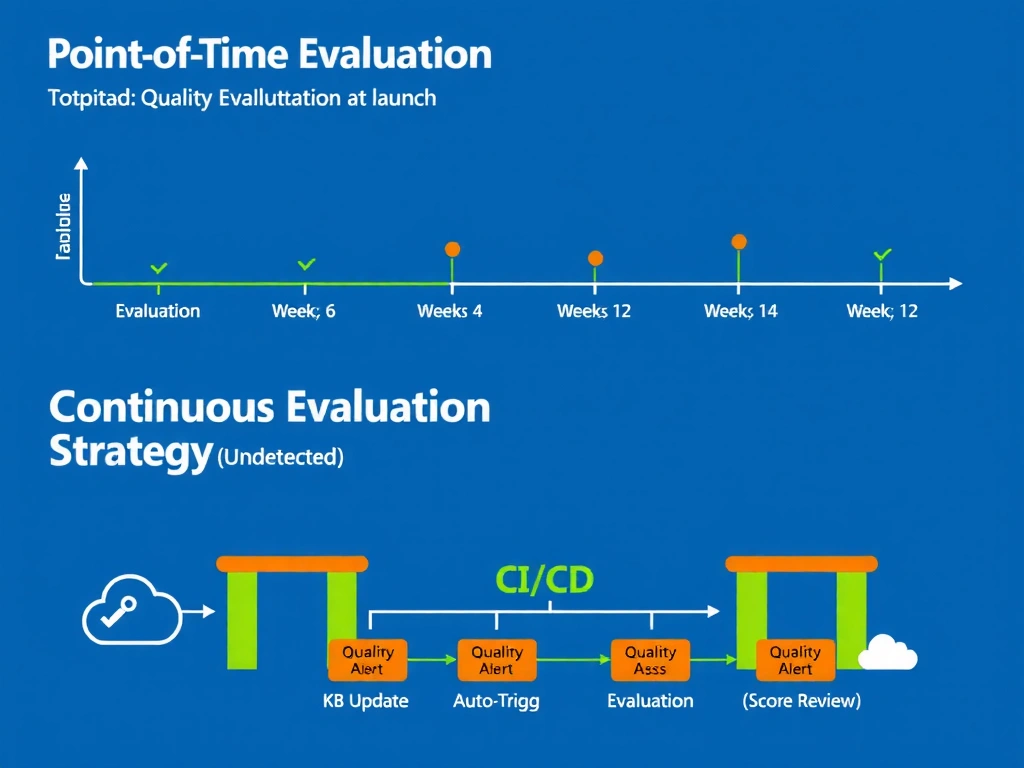
Running evaluation once at launch and never again is like getting a car inspected before a cross-country road trip and never checking the tire pressure, oil, or brakes again. When the knowledge base changes weekly, the evaluation must keep pace. A continuous evaluation strategy — tied to knowledge base update events — is the industry-standard approach. Correct answer: A.
Full explanation below image
Full Explanation
Continuous evaluation is the practice of re-running evaluation pipelines on a scheduled or event-triggered basis, rather than treating evaluation as a one-time pre-deployment activity. When an agent's knowledge base is updated regularly, the quality metrics established at launch can degrade as new content may conflict with or supersede the original test set's expected answers.
CloudSync's problem is a direct consequence of point-in-time evaluation without any ongoing quality gate. The agent passed evaluation when the knowledge base was in a specific state. Three months of weekly updates have shifted the content — new runbooks may contradict old ones, updated policies may invalidate previous expected answers, and new software topics may be out of scope of the original test set.
Option A is correct because a continuous evaluation strategy requires two components: (1) an updated test set that grows alongside the knowledge base, adding new test cases for new content areas, and (2) scheduled or event-triggered evaluation runs that ensure quality scores are checked after significant changes rather than only before initial deployment. Modern implementations use CI/CD-style automation where a knowledge base update automatically triggers an evaluation run and flags score regressions.
Option B is incorrect because quarterly evaluation is too infrequent for a knowledge base updated weekly. With 52 changes per year and only 4 evaluations, quality degradation could go undetected for up to 12 weeks. The evaluation cadence must be commensurate with the rate of knowledge base change.
Option C is incorrect for a critical reason: even though the AI model itself does not change, agent quality is NOT solely a function of the model. Quality depends on the interaction between the model and the knowledge base content. When the knowledge base changes, the agent's responses change, and groundedness and relevance scores can degrade significantly even without any model update.
Option D is incorrect because escalation rate monitoring in Analytics is a lagging indicator — it reflects quality degradation only after real users have already experienced failures. Continuous evaluation using test sets is a proactive quality gate that catches degradation before users encounter it. Analytics monitoring should complement continuous evaluation, not replace it.
Exam tip: The AB-620 exam tests the concept that evaluation is an ongoing process, not a one-time event. When a scenario describes a static evaluation that was run once at deployment and the knowledge base has since changed, the correct answer will always involve continuous or recurring evaluation tied to the change cadence.