
Westlake Insurance is deploying a Copilot Studio agent for claims inquiries. The business team has defined three escalation triggers: (1) the customer explicitly asks to speak with a human, (2) the agent has failed to resolve the customer's issue after two reprompts, or (3) the conversation involves a claim amount over $50,000. The developer needs to implement this human-in-the-loop logic. Which Copilot Studio capability should the developer primarily use to handle all three of these escalation triggers?
Select an answer to reveal the explanation.
Short Explanation and Infographic
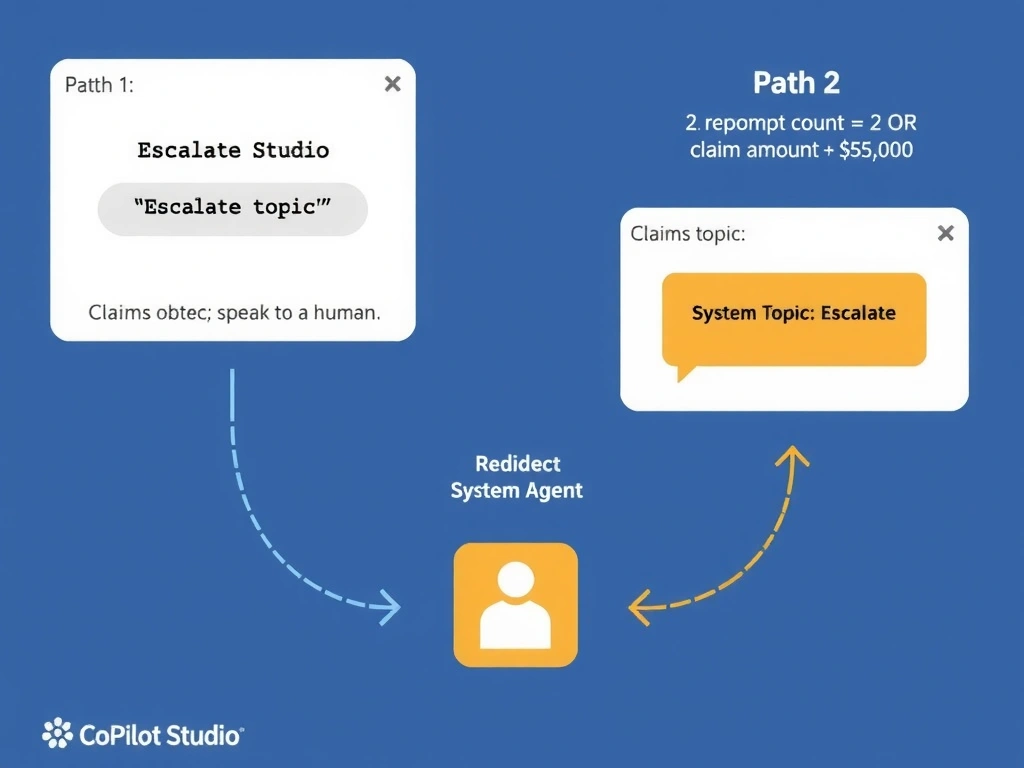
The Escalate system topic is Copilot Studio's built-in ejection seat — it fires when a user says 'I want a human' and it's the sanctioned endpoint for all escalation paths. Option A is correct: use the Escalate system topic for explicit requests, and use Condition nodes inside other topics to redirect to it when reprompts or claim thresholds are exceeded.
Full explanation below image
Full Explanation
Copilot Studio ships with a set of system topics that handle common conversational patterns: Greeting, Goodbye, Escalate, End of Conversation, and others. The Escalate system topic is specifically designed to handle the handoff from the agent to a human support representative. It can be customized to invoke an omnichannel transfer or send a notification.
Option A is correct because it correctly combines two mechanisms: - The Escalate system topic's built-in trigger phrases detect when a user says something like 'talk to a human' or 'agent please.' - Condition nodes in the claims topic check programmatic conditions (reprompt count stored in a variable, claim amount variable) and use a Redirect node to the Escalate topic when those conditions are met.
This is the correct, fully supported pattern for multi-trigger escalation.
Option B is wrong. NLU (natural language understanding) trigger phrases work for detecting user intent in natural language, but they cannot detect programmatic conditions like reprompt count or numeric claim amounts. A custom topic with trigger phrases alone cannot handle conditions (2) and (3).
Option C is wrong. The End Conversation node terminates the session; it does not transfer to a human agent. There is no 'Transfer to agent' property on the End Conversation node. The correct node for human handoff is the 'Transfer to agent' node (also called the End Conversation with handoff option), which is distinct from the plain End Conversation node — but accessing it properly still routes through the Escalate system topic pattern.
Option D is wrong. While Copilot Studio agents can be deployed through Azure Bot Service, configuring escalation at the Bot Service layer bypasses Copilot Studio's native authoring tools and requires custom code. This is unnecessary complexity when Copilot Studio has built-in escalation handling.
Exam tip: Always route programmatic escalation triggers (count exceeded, value threshold) through Condition nodes that Redirect to the Escalate system topic. The Escalate system topic is the single, centralized handoff point — do not create parallel custom escalation paths that bypass it.