
An enterprise is designing a multi-agent system in Copilot Studio where a primary 'Triage Agent' receives all user requests and routes them to one of three specialized sub-agents: a 'Policy Agent' (knowledge-based), a 'Transaction Agent' (API-connected), and a 'Escalation Agent' (human handoff). From a testing and management perspective, which design decision will create the greatest operational challenge in production?
Select an answer to reveal the explanation.
Short Explanation
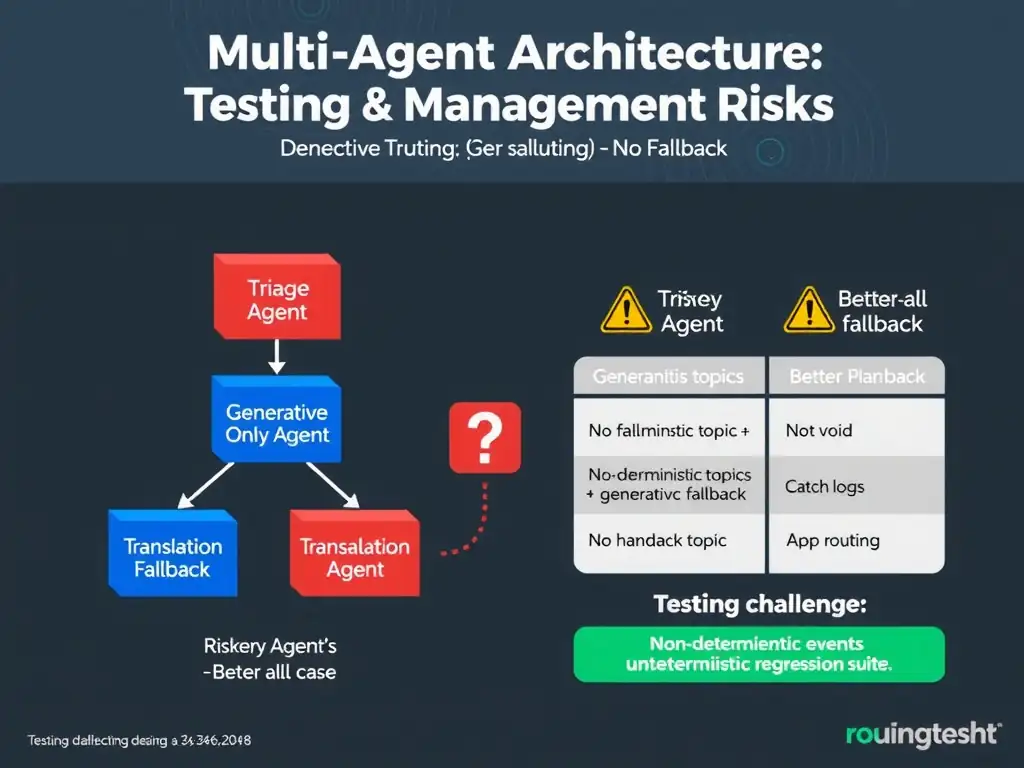
A traffic cop who makes routing decisions by vibes instead of rules is a production incident waiting to happen. When your triage agent decides which sub-agent to call using pure generative reasoning with no deterministic fallback, you get unpredictable routing in production that is nearly impossible to reproduce in testing — and when it routes wrong, there is no safety net to catch it.
Full Explanation
The greatest operational challenge in this multi-agent architecture is the purely generative routing in the Triage Agent with no fallback. This design decision creates multiple compounding problems from a testing and management perspective:
1. Non-determinism in testing: Generative routing means the same input may produce different routing decisions on different runs, depending on model temperature, context window state, and prompt variations. Standard regression testing, where you expect a given input to route to a given sub-agent, cannot reliably pass because the routing is not deterministic. You cannot write a test suite that verifies routing correctness with confidence.
2. Silent routing failures: Without a fallback topic, if the generative routing model is uncertain or receives an input outside its training distribution, there is no defined behavior. The agent may route to the wrong sub-agent, route to none, or produce an error. In production, this means some user requests will be silently misrouted without any alert or fallback response.
3. Monitoring complexity: When a production issue is reported, the debugging path starts at the Triage Agent's routing decision. Without deterministic routing logs that capture the reasoning path, incident response teams cannot determine whether the fault was in routing or in the sub-agent's execution.
The recommended design is to use hybrid routing: structured topic triggers or entities drive deterministic routing for well-defined request types, with generative routing only as a tiebreaker or for novel inputs — and always with a fallback topic that handles the not confident case.
The design that deploys each sub-agent as a separate Copilot Studio agent with its own solution, requiring three separate ALM pipelines to manage, is a management overhead concern, not a production operational challenge in the same severity class. Multiple ALM pipelines are manageable with proper tooling and are actually recommended for large agent portfolios to enable independent release cadences. This is a design trade-off, not a critical flaw.
The design where the Transaction Agent uses a Power Automate cloud flow to call an external REST API, introducing an asynchronous step in the conversation flow, is a standard and well-understood pattern in Copilot Studio. Power Automate flows can be called synchronously from topics with timeout handling. While async patterns require care in UX design, they are not the greatest operational challenge.
The design where the Escalation Agent transfers the conversation to a human agent using Omnichannel for Customer Service, which requires an Omnichannel license in addition to Copilot Studio, is a real consideration but is a deployment prerequisite, not an ongoing operational challenge. Licensing is resolved at rollout; it does not create recurring production management problems.
Exam tip: Multi-agent architecture questions from a testing/management perspective almost always reward answers that identify non-determinism, missing fallbacks, or unobservable decision points as the most dangerous design choices. Deterministic + observable + fallback-covered is the mantra for production-safe multi-agent systems.