
A project manager presents four proposed computer-use agent scenarios to an AI architecture review board. The board must identify which scenario is most appropriate for a computer-use agent and which scenario is most problematic from a reliability and governance standpoint. Which evaluation is correct?
Select an answer to reveal the explanation.
Short Explanation
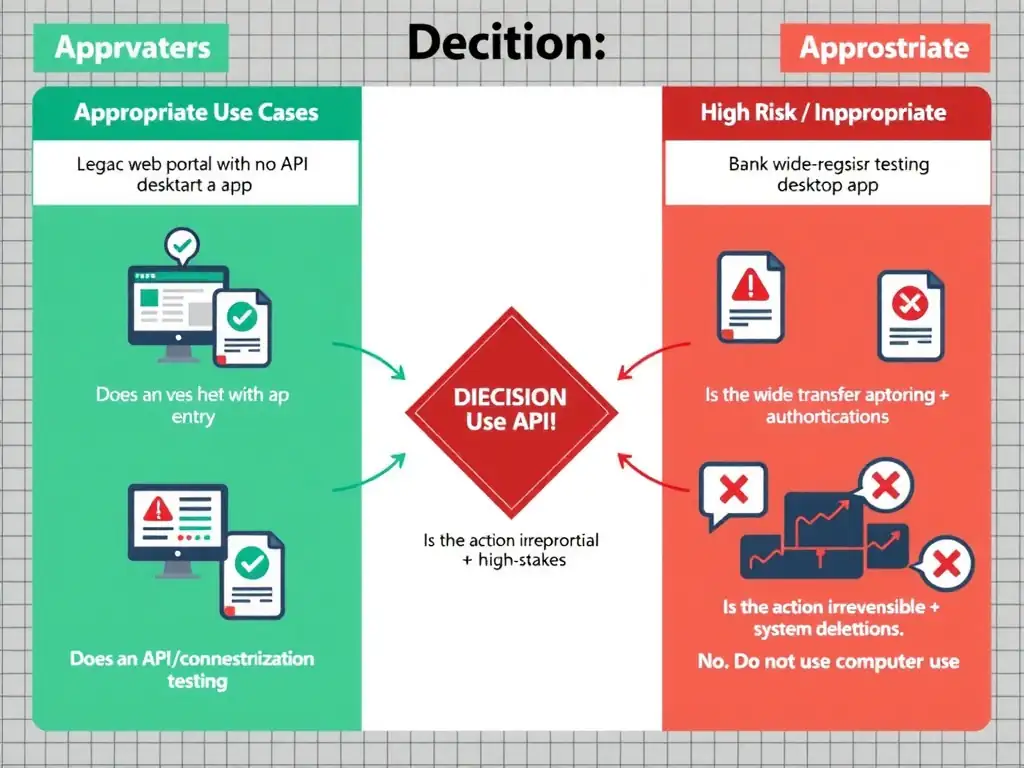
Computer-use agents are the janitor's skeleton key — great for opening doors that don't have proper locks (no API), but you wouldn't hand that key to someone standing next to a bank vault. You use them for vendor portals with no API, not for clicking financial wire approvals, because a screen misread or visual injection attack could trigger an irreversible financial action with no deterministic safeguard.
Full Explanation
Computer-use agents are designed for scenarios where no API, connector, or programmatic interface exists — they are the integration option of last resort for legacy or third-party systems that cannot be connected any other way. The classic appropriate use case is the vendor web portal with no API that requires visual navigation and data extraction, combined with entry into an internal system. This is a high-value automation that would otherwise require a human operator, and the consequences of occasional errors (mis-entered data) are detectable and correctable. The most problematic scenario is executing financial wire transfer approvals in a banking application by reading on-screen account balances and clicking approval buttons. This case fails on multiple dimensions: financial transactions are irreversible — a misread screen balance or injected instruction could trigger an incorrect transfer that cannot be undone; financial regulatory frameworks (SOX, PCI-DSS) require deterministic, auditable approval mechanisms — a computer-use agent clicking a button based on visual interpretation does not meet this bar; and this is a high-privilege action on a high-stakes outcome, making visual prompt injection particularly dangerous. The pairing that calls vendor-portal extraction most appropriate but employee onboarding form submissions across multiple internal web apps most problematic is incorrect because multi-internal-web-app onboarding form submissions are a legitimate computer-use case — form submissions in internal apps are lower-risk, more reversible, and the only concern is form layout changes breaking the agent's navigation. This is manageable operational risk, not a governance failure. The pairing that calls SharePoint approval workflow automation most appropriate and PDF report summarization from a shared network drive most problematic is incorrect on both counts. SharePoint has Power Platform connectors — using a computer-use agent to click lists is an unnecessary choice when proper connectors exist. PDF summarization from a network drive does not require computer-use at all; it is a standard knowledge processing task. Neither is a particularly good or bad computer-use scenario — both are simply wrong tool choices. The pairing that calls desktop-application regression testing most appropriate and competitor pricing extraction from public websites most problematic is also incorrect. Regression testing of desktop applications is a valid use case (QA automation for legacy desktop apps is a genuine computer-use scenario), but competitor web scraping raises legal and policy concerns and is harder to classify as 'most problematic from governance standpoint' compared to financial wire approvals. Exam tip: Computer-use agent appropriateness is evaluated on two axes: Is there a better (API-based) alternative? If yes, don't use computer-use. Is the action reversible and low-stakes enough that visual interpretation errors are acceptable? If the action is irreversible and high-stakes (financial, medical, legal), computer-use agents are inappropriate.