
An enterprise architect at a financial services company needs to design a Copilot Studio solution where a customer-facing agent must hand off specialized tasks to a compliance agent and a billing agent. The compliance agent must operate independently and should not be aware of the billing agent's operations. The solution must support asynchronous task completion and return results to the customer-facing agent. Which Agent2Agent (A2A) protocol pattern best supports this architecture requirement?
Select an answer to reveal the explanation.
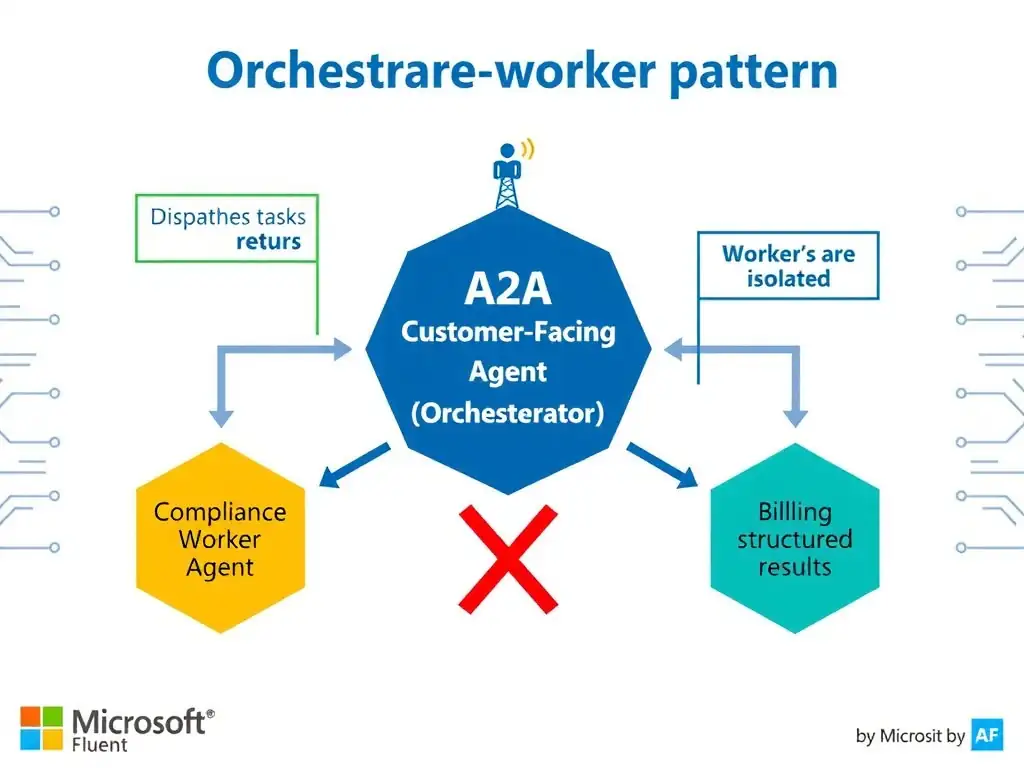
Short Explanation
Think of the customer-facing agent as an air traffic controller — it directs specialized worker agents to their tasks without the workers needing to talk to each other. You should use the orchestrator-worker Agent2Agent pattern to dispatch work to isolated compliance and billing agents and collect their structured results. On the exam, 'independent operation' and 'return results to caller' point to the orchestrator pattern.
Full Explanation
The Agent2Agent protocol in Copilot Studio defines how agents communicate with one another within a multi-agent solution. The orchestrator-worker pattern is the canonical Agent2Agent design when one agent must delegate discrete tasks to specialized agents while keeping those worker agents decoupled from each other.
In the correct approach, the customer-facing agent acts as the orchestrator. When a customer interaction requires compliance review or billing action, the orchestrator invokes the appropriate worker agent via an Agent2Agent topic call. The worker executes its specialized logic independently and returns a structured response. Because the compliance and billing agents only interact with the orchestrator, they have no awareness of each other's operations — satisfying the isolation requirement.
The peer-agent approach using shared Dataverse tables is incorrect because peer-to-peer agent communication via shared Dataverse tables introduces tight coupling between the compliance and billing agents. This violates the stated requirement for independent operation and creates a coordination problem where both agents must manage shared state, increasing the risk of data conflicts and race conditions.
The single composite agent with internal routing logic implemented in Power Fx is incorrect because collapsing three agents into a single composite agent eliminates the architectural benefit of agent specialization. Internal Power Fx routing cannot replicate the independent security contexts, lifecycle management, and scalability that separate agents provide. It also makes the solution harder to maintain as each agent's logic grows.
The Power Automate flow intermediary approach with scheduled polling and adaptive cards is incorrect because using Power Automate flows as polling intermediaries introduces latency, adds unnecessary complexity, and shifts the orchestration responsibility outside of Copilot Studio's native agent framework. Scheduled polling also means results are not returned to the customer agent in real-time, breaking the conversational experience.
For the exam, memorize the three Agent2Agent roles: orchestrator (coordinates), worker (executes specialized tasks), and peer (collaborates as equals). When a question specifies that worker agents must not be aware of each other, the answer is always the orchestrator pattern. When agents must collaborate with shared context, peer communication applies.