
A retail company uses a Copilot Studio agent for customer service. Management requires that the agent automatically escalate to a live agent when: (1) the agent's confidence score falls below 50% on a customer's question, or (2) a customer explicitly says 'speak to a human' or similar phrases. A developer must implement both escalation paths. Which approach correctly implements both triggers?
Select an answer to reveal the explanation.
Short Explanation
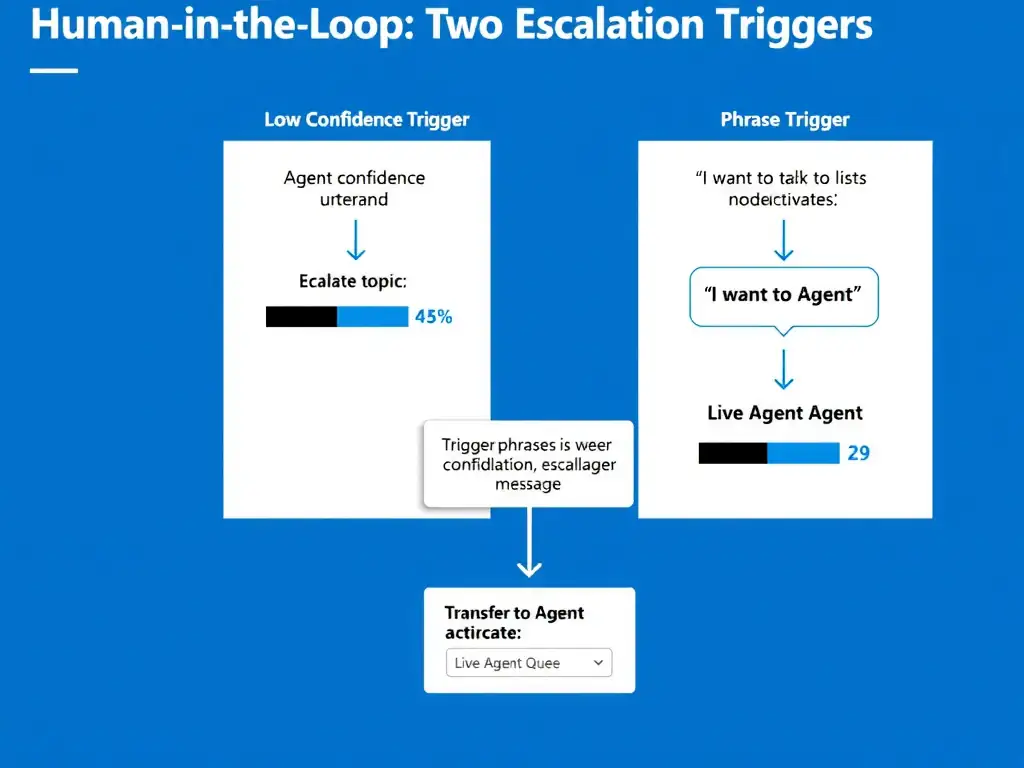
You need two alarm systems: the Escalate system topic for low-confidence fallback and a trigger-phrase topic for 'speak to a human.' One setting won't cover both, so wire each path to the same handoff node.
Full Explanation
Copilot Studio provides distinct mechanisms for each escalation scenario. The correct approach is to configure the 'Escalate' system topic to fire on low-confidence fallback and also create a topic with trigger phrases like 'speak to a human' that routes to the same escalation node. Low-confidence fallback is handled by the built-in system topic called 'Escalate' (or the fallback topic), which fires automatically when the agent's match confidence drops below the configured threshold. Developers can customize this topic to add a Transfer to Agent node or call a Power Automate flow to hand off to a live agent. Phrase-based escalation is a separate concern. When a customer says 'speak to a human,' 'I want a live agent,' or similar, these are recognized as trigger phrases for a topic. The developer creates a dedicated topic with these phrases as triggers and routes it to the same escalation node (Transfer to Agent) that the low-confidence path uses. This ensures consistent handoff behavior from both paths. The approach that sets the agent's confidence threshold to 50% in Settings is incorrect because the confidence threshold setting only affects which topic is matched — it does not create a separate detection path for explicit user phrases like 'speak to a human.' Those phrases need to be recognized as topic triggers. The Power Automate flow that routes to a human agent whenever session duration exceeds two minutes is incorrect because session duration is not a valid or reliable escalation signal. A brief, efficiently-resolved conversation should not escalate, and a long but satisfied interaction should not either. Duration-based routing is not a Copilot Studio best practice. The approach that enables the 'Multiple topics matched' fallback only is incorrect because 'Multiple topics matched' is a disambiguation scenario, not a low-confidence fallback. It handles when the agent finds two plausible topics for a single utterance, not when confidence is generally low or when users request humans explicitly. Exam tip: Memorize the names of Copilot Studio system topics — 'Escalate,' 'Fallback,' 'Greeting,' and 'End of Conversation' are frequently tested. Know which scenarios trigger each one.