
A developer is configuring a Copilot Studio agent that should retrieve answers from an internal SharePoint site containing company policies. The SharePoint site is restricted to authenticated employees only. The agent must respect SharePoint's existing permissions—employees should only see content they are individually authorized to access. Which configuration enables this user-level permission trimming when using SharePoint as a knowledge source?
Select an answer to reveal the explanation.
Short Explanation
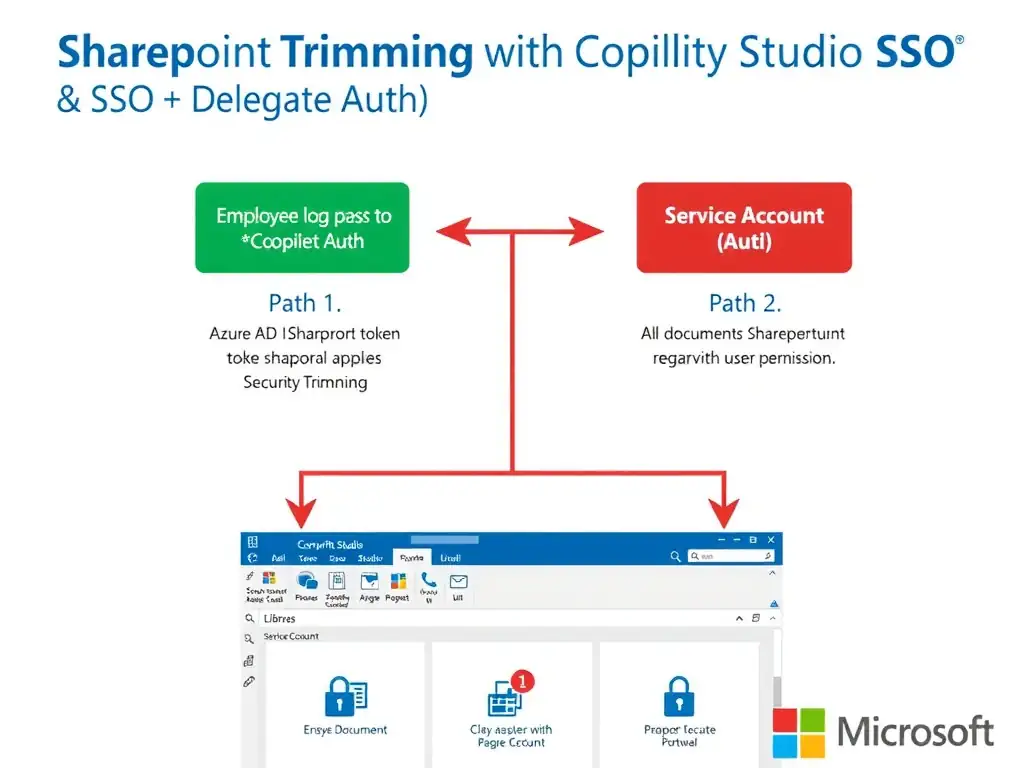
Think of SharePoint security trimming like a locked filing cabinet where every employee has a different key. When you connect the agent with user authentication and Azure AD SSO, SharePoint sees the signed-in employee's identity and automatically returns only the files their key opens.
Full Explanation
SharePoint Online has built-in permission trimming: when content is queried on behalf of a specific authenticated user, SharePoint returns only the documents that user has permission to view. To leverage this in Copilot Studio, the agent must be configured to query SharePoint using the end user's own identity rather than a service account. This is achieved by enabling user authentication (Azure AD SSO) on the agent and configuring the SharePoint knowledge source to use delegated permissions.
The configuration that enables this is the SharePoint knowledge source with user authentication enabled and connected to the agent with Azure AD SSO so the agent queries SharePoint using the signed-in user's identity and respects their permissions. This ensures every SharePoint query is executed using the signed-in employee's identity token. SharePoint's native security trimming then automatically filters results to only return documents that employee is authorized to see—no custom filtering logic is required.
The approach that indexes all SharePoint content into Azure AI Search using a service account and then applies manual category filters in the Copilot Studio query to restrict results by department is wrong because indexing via a service account retrieves all content that the service account can access (typically everything), and the index itself has no concept of individual user permissions. Manual category filters in Copilot Studio are not equivalent to SharePoint security trimming—they are crude approximations that could expose documents a user shouldn't see or hide documents they should.
The approach that enables content moderation in the Copilot Studio agent settings to filter out restricted documents before they reach the user is wrong because content moderation in Copilot Studio is designed to filter harmful or inappropriate language/topics, not to enforce document-level access control based on SharePoint permissions. It has no knowledge of which user is authorized to see which document.
The approach that creates a Power Automate flow that checks user group membership in Azure AD before passing queries to SharePoint, then returns only permitted results to the agent is wrong because building a Power Automate flow to check group membership is a fragile, custom reimplementation of what SharePoint already does natively through security trimming. It adds latency, complexity, and maintenance burden, and is unlikely to correctly replicate all SharePoint permission inheritance scenarios (site permissions, library permissions, item-level permissions).
Exam tip: SharePoint security trimming only works automatically when the agent uses delegated user authentication. Service account (application) authentication bypasses trimming. The exam frequently tests this distinction: delegated auth = user-level permissions; application auth = service account permissions (usually broader).