
Litware uses Dev, Test, and Production Power Platform environments. Their Copilot Studio agent and its dependent flows live in a solution. They want makers to promote the solution with approvals and minimal custom scripting. Which approach best fits?
Select an answer to reveal the explanation.
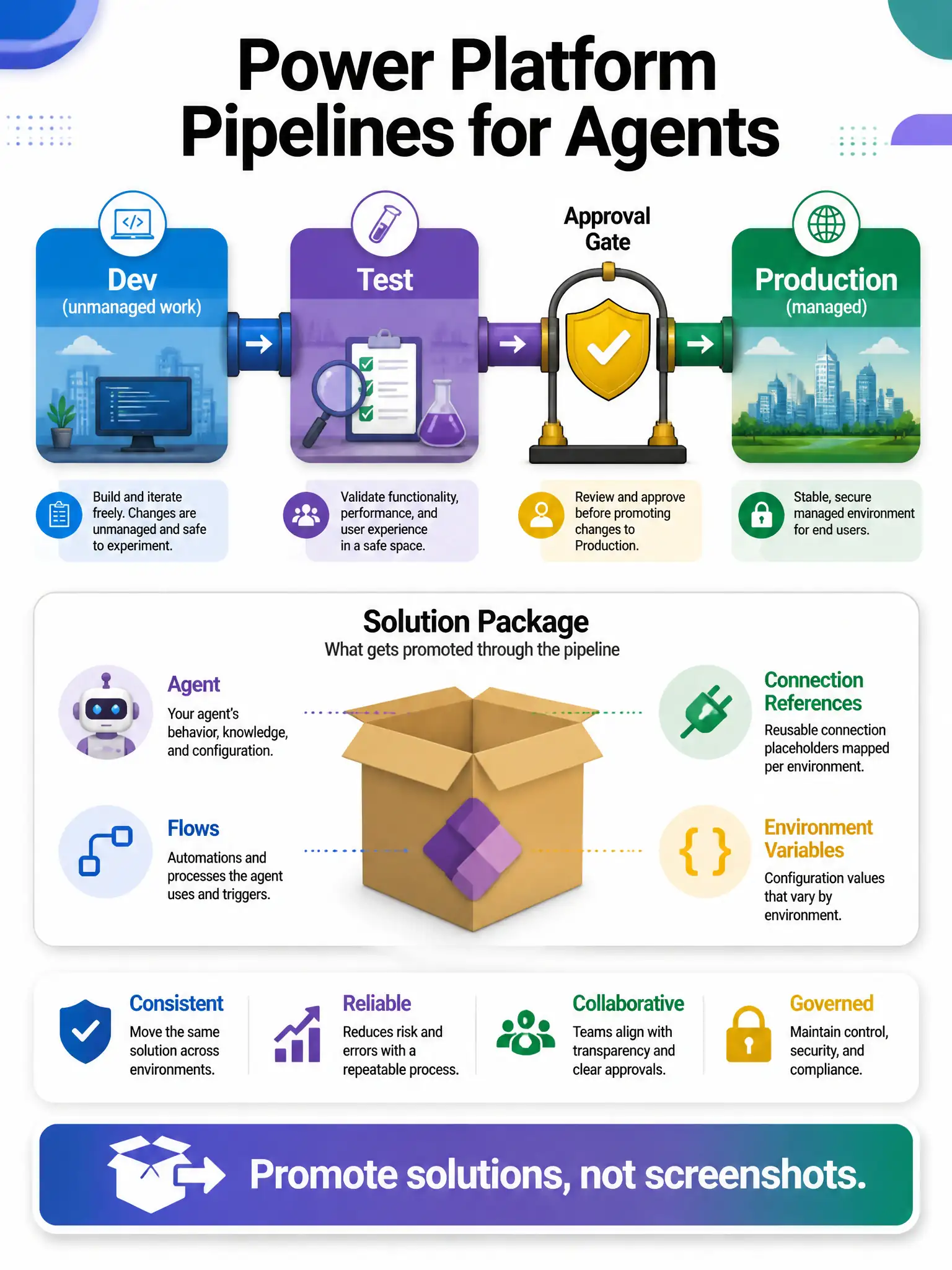
Short Explanation
Power Platform Pipelines is the moving truck for solutions — pack the agent in Dev, drive through Test, get a signature at the gate, then unload in Production. Manual copy-paste is how things get lost between houses.
Full Explanation
Application Lifecycle Management (ALM) for Copilot Studio relies on solution-aware components. Power Platform Pipelines provide a first-party promotion experience across environments with stage definitions and approvals. The approach using Power Platform Pipelines configured with Dev → Test → Production stages and optional approval gates for production deployments is correct because Pipelines plus solution packaging is Microsoft's low-friction ALM path for agents and dependencies. The manual copy-and-paste approach from the Dev agent UI into a separately created Prod agent every Friday is wrong because manual UI copy is error-prone, loses dependencies such as connection references and environment variables, and does not scale. The screenshots-in-Git approach is wrong because screenshots are not deployable artifacts. The disable-solutions approach that keeps all agents as non-solution components exclusively in Production to avoid ALM is wrong because skipping solutions and building only in Production removes change control and safe testing. Exam tip: Solution-aware agent + Pipelines (or PAC CLI/Azure DevOps for advanced) = exam-ready ALM story.